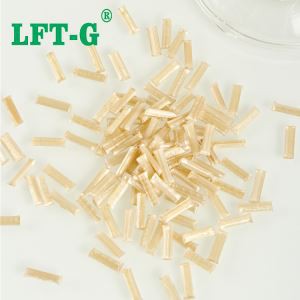

The Short Answer: Dry Pellets Mold, Wet Pellets Fail
Drying is not a preparation step that can be skipped when the schedule is tight. It is a molding condition, as much as melt temperature, mold temperature, and injection pressure. Wet pellets carry moisture into the barrel, and moisture turns to vapor in molding, leaves voids and surface defects, and, in polyamide, can break polymer chains in the barrel. A part molded from wet pellets can look right at first and fail later, in strength, in dimensions, or in surface, and the failure looks like a material problem when it is really a drying problem.
The short answer is a grade window, not a general rule. Drying time, drying temperature, and the moisture limit come from the grade datasheet for the grade being molded, because resin and fiber content change the window. A drying window that works for one grade cannot be transferred to another grade without checking, and a part molded from material dried outside its window has not been proven, even when the part looks right.
What Moisture Does Inside the Barrel and the Mold
Moisture in pellets does not stay in the pellet. In the barrel, heat turns moisture into vapor, and vapor has nowhere to go in a closed mold except into the part. The result, in direction, is voids inside the part, splay and silver streaks on the surface, and less repeatable filling, because vapor disturbs melt flow and packing. A part with voids loses load-bearing area where the void sits, and a part with surface defects fails appearance even when it passes a strength test.
Polyamide adds a second, chemical loss. PA absorbs moisture from air, and moisture in the barrel at molding temperature can hydrolyze polyamide chains, cutting molecular weight and changing melt behavior. That loss does not show as a void. It shows as a part that molds easily, looks right, and holds less in service, especially under sustained load and heat. PP absorbs very little moisture by comparison, so the same drying failure looks different by resin: a PP part fails more visibly, in voids and surface, while a PA part can fail invisibly, in chain length and service strength. The drying check must therefore name resin, grade, and window together.
Wet Pellets vs Dry Pellets: What Changes, What Does Not
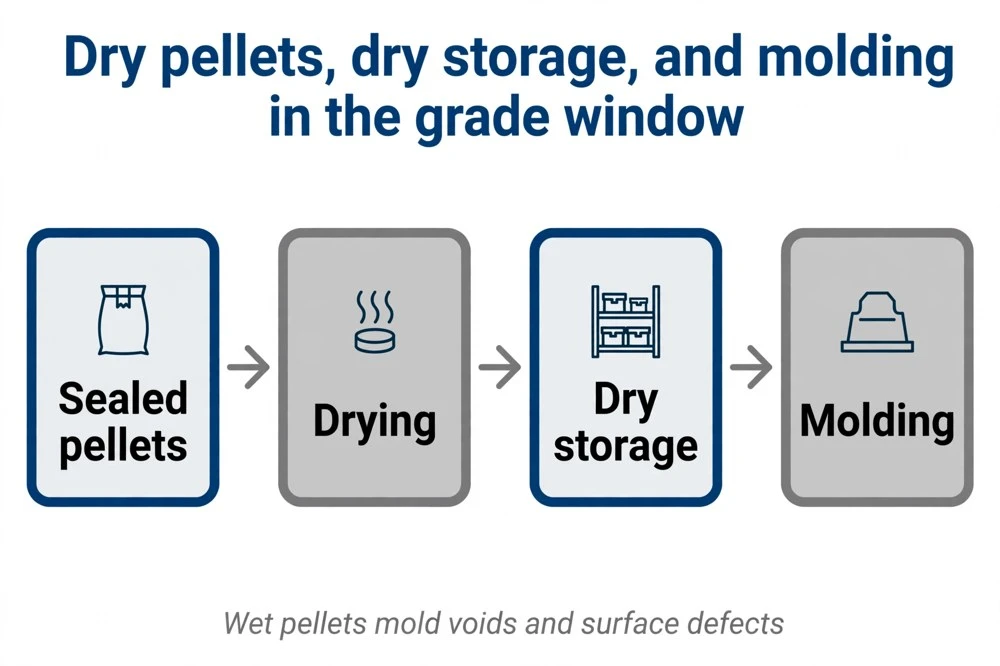
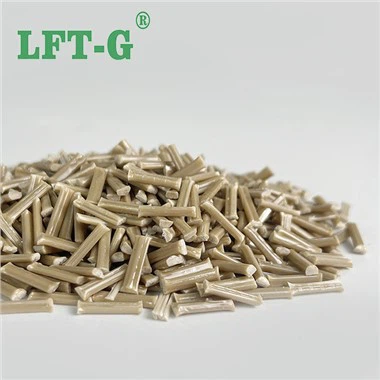
Schematic, not to scale. Dry pellets, dry storage, and molding in the grade window.
The table below compares direction only. It gives no moisture percentage limit for all grades, because the limit is grade-specific and comes from the grade datasheet.
| Item | Wet pellets | Dry pellets, in the grade window |
|---|---|---|
| Vapor in molding | More vapor, more voids and splay | Less vapor, cleaner filling in direction |
| Surface | More splay, silver streaks, spots | Cleaner surface in direction |
| Internal structure | More voids, less load-bearing area | Fewer voids, more repeatable structure |
| Polyamide chains | More hydrolysis risk in the barrel | Less hydrolysis risk in the barrel |
| Melt behavior | Less stable, more sensitive to hold time | More stable within the grade window |
| Dimensions | More variation after molding and service | More repeatable in direction |
| What stays the same | Resin family, fiber type, and grade | Resin family, fiber type, and grade |
Two readings matter more than the table. First, drying failure is a process failure, not a pellet failure. The same grade, dried in its window, molds repeatably, and the same grade, molded wet, fails in voids, surface, or service strength. Second, looking right is not proof of drying. A wet PA part can look clean and still carry shorter chains, and a wet PP part can pass a quick strength test and still carry voids that fail later. Only a trial in the grade window, with dimensions and appearance checked, proves the part.
When Drying Matters Most, and When It Matters Less
Drying matters most where moisture has the longest time to act, or the least room to escape. A PA grade, with high moisture absorption, matters more than a PP grade, because PA picks up moisture in storage and loses chain length in the barrel. A part with thick walls, a part molded with a long hold time, a part stored open in a humid shop, and a part made from regrind, which picks up moisture faster than sealed virgin pellets, all matter more, because moisture has more time, more surface, or more history to act.
Drying matters less only in relative terms, never as a skip. A PP grade, molded soon after opening a sealed bag, in a dry shop, with a short hold time, carries less moisture risk than a PA grade stored open in humidity, but it still needs its grade window checked, and it still fails in voids and surface when molded wet. A short, dry, sealed run is not a reason to skip drying for the next run, and a part that passed once wet is not proof that wet molding works. The window, not the last result, decides.
How to Dry by Grade, Without Guessing a Window
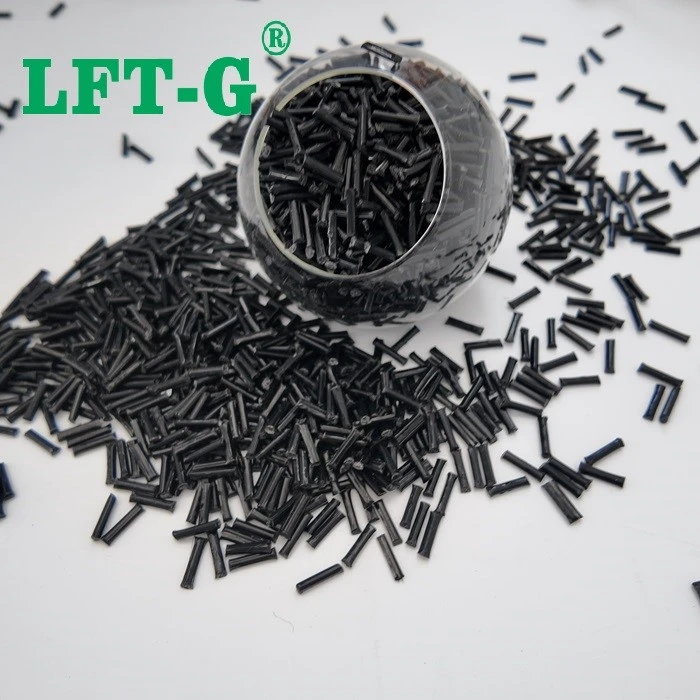
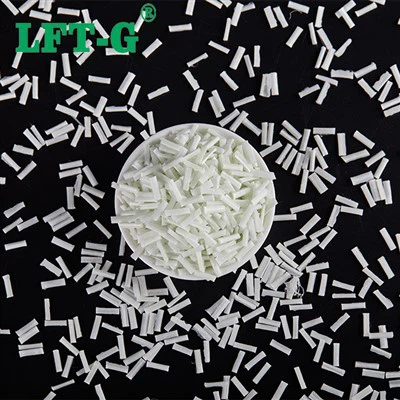
PP LGF40 black pellets.
Drying starts with the grade datasheet, not with a shop habit. For the grades named here, the windows are examples, not universal rules: PP LGF40 dries 2–4 hours at 80–90 °C, with moisture below 0.1%, and PA66 LGF40 dries 3–5 hours at 85–105 °C, with moisture below 0.05% by the datasheet table. Those windows belong to those grades. Another grade, another resin, or another fiber content needs its own datasheet window, and a window copied from another grade has not been proven.
Storage is part of drying. Keep pellets sealed until use, keep opened bags closed and dry, and keep regrind in closed, labeled bins, because open storage in humidity re-wets material that was already dried. Dry only what the run needs, within the window, and do not hold dried material open for a long time before molding. If drying time runs long, or material sits open, dry again by the grade window rather than molding and hoping. Longer drying is not automatically better: drying outside the grade window, at the wrong temperature or for the wrong time, is still outside the window, and the fix is the grade window, not more heat by guess.
How to Trial Dry Material for Your Part
For a part, a drying trial follows a fixed sequence, and it comes before production use of a new grade, a new storage condition, or a new regrind ratio:
- Send the part application and a product photo, so wall, appearance, and load path can be seen.
- Send the current grade and its datasheet, so the drying window and moisture limit start from a known baseline.
- State the storage history: sealed or opened, how long open, shop humidity in direction, and whether regrind is involved.
- Run a trial dried in the grade window on the real part, tool, and joint, and check voids, surface, dimensions, and strength with the same standards as the baseline.
- Decide on production only if the trial meets appearance, dimensional stability, strength, and repeatability for that part.
If the trial shows voids, splay, or dimensional drift, the answer is not a higher melt temperature to force filling. It is to check drying, storage, and hold time first, dry again in the grade window, and re-trial. Only a part proven dry, in its grade window, should enter production.
FAQ
Can I skip drying for PP because PP absorbs little moisture?
No. PP absorbs very little moisture, but wet PP still molds voids and surface defects. Check the grade window for the grade being molded, and dry by that window.
Why does a PA part look right but fail in service after wet molding?
Moisture in the barrel can hydrolyze PA chains, cutting molecular weight without leaving a visible void. The part looks clean and holds less in service, especially under sustained load and heat.
Is longer drying always better?
No. Drying must stay in the grade datasheet window for time and temperature. Drying outside the window, or holding dried material open for a long time, is still outside the window.
Does regrind need more drying attention than virgin pellets?
Yes, in direction. Regrind picks up moisture faster than sealed virgin pellets, and damp regrind carries more voids, surface, and hydrolysis risk. Store regrind closed and dry, and dry it by the grade window.
What should I send to trial dry material for my part?
Send the part application and a product photo, the current grade and its datasheet, the storage history, and whether regrind is involved, plus the appearance and dimensional requirement the part must still meet.
Trial Dry Material for Your PartSend your part application, current grade datasheet, and storage history. LFT-G will review the drying window for that grade, and what the dry-material trial needs to prove. Email: candyhu@lfrtplastic.com WhatsApp: https://wa.me/8613950095707 |
 |