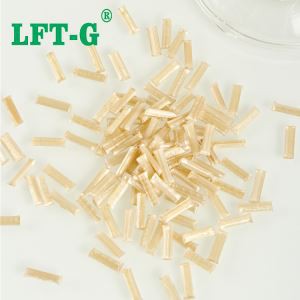

The Short Answer: Regrind Is Shorter Fiber, Not the Same Pellet
Sprue and runner regrind saves material, but it does not return the same pellet. Grinding breaks the sprue and runner into pieces, remelting heats the material again, and molding shears it again. Each step cuts fiber length, and long fiber parts depend on fiber length for stiffness and impact. Regrind therefore loses the long fiber advantage first, before it loses anything else, and the loss grows with the regrind ratio and with repeated cycles.
The short answer is a ratio and a trial, not a yes or no. A low ratio, clean and dry, from the same grade and color, trialed on the real part, can fit a non-critical part. A high ratio, mixed grade or color, damp or dusty, or used in a critical structural part without a trial, should not be used. Some processing guidance and a PA66 grade datasheet cap regrind at 5%, but that cap is grade-specific. Check the datasheet for the grade being used, and do not treat 5% as a universal LFT rule.
What Sprue and Runner Regrind Actually Is
In injection molding, the sprue and runner carry melt from the machine to the cavity, then solidify with the part and are removed. That removed material is clean, same-grade, same-color material, and it is tempting to grind it and feed it back. It is not virgin pellet, even when it comes from the same shot. It has already been heated, sheared, cooled, and cut, and its fibers, its pellet shape, and its surface are no longer the same as the virgin pellet that entered the machine.
Regrind also differs from virgin pellet in handling. Ground pieces are irregular in size and shape, carry dust and fines, and pick up moisture faster than sealed virgin pellets if stored open. Mixed storage adds a second risk: a different grade, a different color, or a different resin in the same bin changes the melt, the color, and the part, even when the regrind ratio looks low. Regrind must therefore be treated as a different feedstock with its own storage, drying, and trial, not as virgin pellet with a lower price.
Why Grinding and Remelting Cut Fiber Length
Long fiber strength comes from a load-bearing fiber network. Long fibers bridge load, resist crack growth, and raise stiffness and impact compared with short fiber material. That network depends on fiber length surviving molding. Grinding cuts fibers mechanically. Remelting and remolding shear them again, especially through a small gate, high screw speed, or high back pressure. Each cycle therefore starts shorter than the last, and the part made from regrind starts with a shorter, more broken network than the part made from virgin pellets.
Heat adds a second loss. Repeated heating can degrade the resin, change melt behavior, and shift color, especially when regrind is stored damp or held hot for too long. Contamination adds a third loss. Dust, fines, degraded particles, and foreign material act as weak points, raise scrap, and change surface appearance. None of these losses needs a percentage to be real: shorter fibers, degraded resin, and contamination all move the part in the same direction, toward lower stiffness, lower impact, and less repeatable molding.
Regrind vs Virgin Pellets: What Changes, What Does Not

Schematic, not to scale. From virgin pellets to regrind and back to molding.
The table below compares direction only, because regrind loss depends on ratio, cycles, grade, and process, and no single number describes every case.
| Item | Virgin pellets | Regrind |
|---|---|---|
| Fiber length | Starting length as supplied | Shorter after grinding and remolding, shorter again each cycle |
| Stiffness and impact | Baseline for the grade | Lower in direction, more so at high ratio and repeated cycles |
| Melt behavior | Stable as supplied | Less stable, more sensitive to moisture, dust, and heat history |
| Color and surface | Baseline for the grade | More variation, more risk of streaks, spots, and yellowing |
| Feeding and dosing | Uniform pellets | Irregular pieces, dust, and fines, harder to feed and dose evenly |
| Contamination risk | Sealed, single grade and color | Higher if stored mixed, open, or dirty |
| Trial needed | Baseline trial for the grade | Ratio trial on the real part, tool, and joint |
| What stays the same | Resin family and fiber type, when regrind is same grade and color | Resin family and fiber type, when regrind is same grade and color |
Two readings matter more than the table. First, fiber length loss is the main loss for LFT, not resin change. A short fiber grade loses less from regrind than a long fiber grade, because it has less length to lose. Second, loss is not linear with ratio in practice, because high ratio also brings more dust, more moisture risk, and less uniform feeding. A ratio that works in one tool can fail in another, and a ratio proven on one part cannot be transferred to a different part without a trial.
When Regrind Fits, and When It Does Not
Regrind fits a part where the loss can be absorbed. A non-critical part, with margin in stiffness and impact, no tight tolerance that creep or moisture shift would break, no appearance requirement that color variation would fail, and no certification that forbids regrind, is a candidate for a low, trialed ratio. Internal, non-visible, non-structural parts are the usual first candidates, and even then the ratio must be fixed, recorded, and trialed, not adjusted by feel on the shop floor.
Regrind does not fit a part where the loss lands on the critical requirement. A structural part that needs full long fiber stiffness and impact, a part with tight tolerance under heat or moisture, a visible part with a strict color and surface requirement, a part under sustained load where creep matters, or a part whose certification or customer specification forbids regrind, should stay on virgin pellets, or use regrind only if a trial on that exact part proves the requirement still holds. When the requirement is unknown, the answer is to find it first, not to add regrind and hope it holds.
How to Reuse Regrind Without Losing the Part
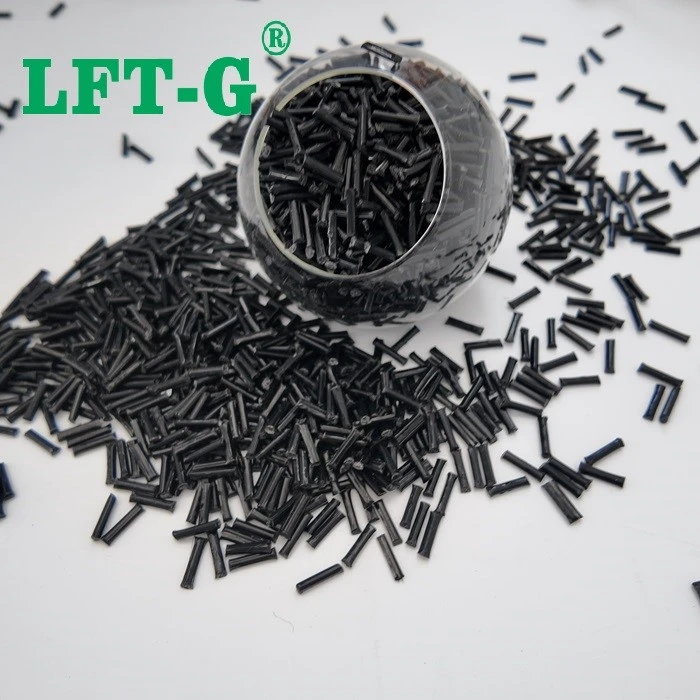
PP LGF40 black pellets.
Reuse starts with segregation. Keep regrind by grade and by color, in clean, closed, labeled bins, and never mix grades, colors, or resins. Grind only clean sprue and runner material, not purging, not contaminated parts, and not material of unknown history. Keep the grind size as uniform as the grinder allows, remove dust and fines where the equipment allows, and store regrind dry and closed, because damp regrind needs drying and still carries more risk than dry virgin pellets.
Ratio and cycles come next. Fix one ratio for one part, record it, and do not drift upward when virgin pellets run short. Avoid regrind of regrind: material that has already been ground and remolded once starts the next cycle shorter and more degraded, and repeated cycles compound the loss. Dry regrind by the grade datasheet, mold it within the grade window, and keep gate, screw, and back pressure from adding more shear than the virgin trial used. If feeding becomes uneven, or scrap rises, the ratio, the grind, or the storage is wrong, and the fix is to lower the ratio or clean the feed, not to raise melt temperature to force it through.
How to Trial a Regrind Ratio for Your Part
For a part, a regrind trial follows a fixed sequence, and it comes before production use:
- Send the part application and a product photo, so the load path, tolerance, and appearance requirement can be seen.
- Send the current grade and its datasheet, so the comparison starts from a known baseline and the grade regrind cap, if any, can be checked.
- State the proposed ratio, the regrind source (sprue and runner only, same grade and color), and the number of cycles.
- Run a trial at that fixed ratio on the real part, tool, and joint, and test it with the same standards as the virgin baseline, including dimensions and appearance.
- Decide on production only if the trial meets stiffness, impact, dimensional stability, appearance, and repeatability for that part at that ratio.
If the trial fails, lower the ratio, clean the feed, or return to virgin pellets for that part. A failed ratio trial is not a reason to raise the ratio, to mix grades, or to use regrind in a different part without its own trial. Only a ratio proven on that part, at that cycle count, should enter production, and the ratio should stay recorded and fixed.
FAQ
Can I reuse sprue and runner material in LFT parts?
Yes, in some parts, at a fixed, trialed ratio, from the same grade and color, clean and dry. Regrind is not virgin pellet, and it should not be used in a critical part without a trial on that part.
What does regrind lose first?
Fiber length. Grinding and remolding cut long fibers, and long fiber stiffness and impact depend on that length. Heat degradation, dust, and moisture add further loss in the same direction.
Is 5% regrind safe for every LFT grade?
No. Some processing guidance and a PA66 grade datasheet cap regrind at 5%, but that cap is grade-specific. Check the datasheet for the grade being used, and trial the ratio on the real part.
Can regrind be used more than once?
Avoid it. Regrind of regrind starts shorter and more degraded, and repeated cycles compound fiber loss, heat degradation, and contamination risk.
What should I send to trial a regrind ratio?
Send the part application and a product photo, the current grade and its datasheet, the proposed ratio and regrind source, and the requirement the part must still meet, including tolerance, appearance, and any regrind restriction.
|
Trial a Regrind Ratio for Your Part Send your part application, current grade datasheet, and proposed regrind ratio. LFT-G will review whether regrind fits that part, and what the ratio trial needs to prove. |
 |