
The Short Answer: Keep Metal When the Boundary Fails
LFT can replace metal, but not every metal part should switch. The question is whether this part, in its real load, temperature, environment, joint, and tolerance, still fits what a thermoplastic part can hold. If any boundary fails, keep metal, or redesign before any trial.
The short answer is a screening rule, not a ranking. Keep metal when the part sees sustained heat above the resin boundary, carries sustained load that will creep, must hold tight tolerance under heat or moisture change, must conduct or shield, must meet a flame rating above the grade on offer, cannot change its joint or tool, or costs more as a system after tooling and redesign than it saves in weight. If none fails, LFT becomes a trial candidate.
Why Metal Replacement Fails After the Trial
A metal replacement project usually starts with a datasheet comparison. Tensile strength and modulus look close enough, density looks lower, and the trial part looks right. The failure comes later, in service, because a datasheet compares a material, while a part lives in a system. Heat, moisture, sustained load, vibration, chemical exposure, assembly preload, and tolerance stack all act at once, and a room-temperature value on a standard bar does not describe that system.
The second failure is geometry. A metal part was shaped for metal: thin walls, sharp corners, and bolted joints holding preload, with no draft, gate, or fiber flow to consider. Molding the same shape in LFT, without changing ribs, bosses, wall, gate, and joint, often keeps the shape and loses strength. Fiber orientation follows flow, and fiber length falls with shear and small gates.
The third failure is cost counted too narrowly. Pellet price is only one line; tooling change, redesign, drying and molding control, scrap, assembly change, and failure in service belong in the same count, and a part saving weight but needing a new tool, a new joint, and a longer trial can cost more as a system than the metal part it replaced.
Heat and Load: Where Thermoplastics Soften and Creep
Heat is the first boundary: a thermoplastic softens as temperature rises, while metal keeps its shape over a much wider range. Heat deflection temperature gives a reference point, not a service guarantee. PP LGF40 has a heat deflection temperature of 159 °C by ISO 75-2, and PA66 LGF40 has 254 °C by the same standard, from their factory datasheets. Those values describe a standard test, not a part under real load, environment, and service life. A part near sustained heat, with heat spikes, or carrying load while hot, must be checked at that temperature and load.
Load is the second boundary, and it acts with heat. Under sustained load, a thermoplastic part can creep: it slowly changes shape even below its short-term strength. Creep grows with temperature, load, and time, and matters most where tolerance is tight, a seal must stay closed, or a bolted joint must keep preload. A short-term strength test does not screen creep, and neither does a trial that runs for a day and stops. If the part must hold shape under sustained load, check how it behaves over service life, at service temperature.
Moisture adds a third load on some resins: PA66 absorbs moisture and shifts dimensions, while PP absorbs very little, so screening must name resin, temperature, load, and environment together.
Metal vs LFT: A Boundary Table, Not a Ranking
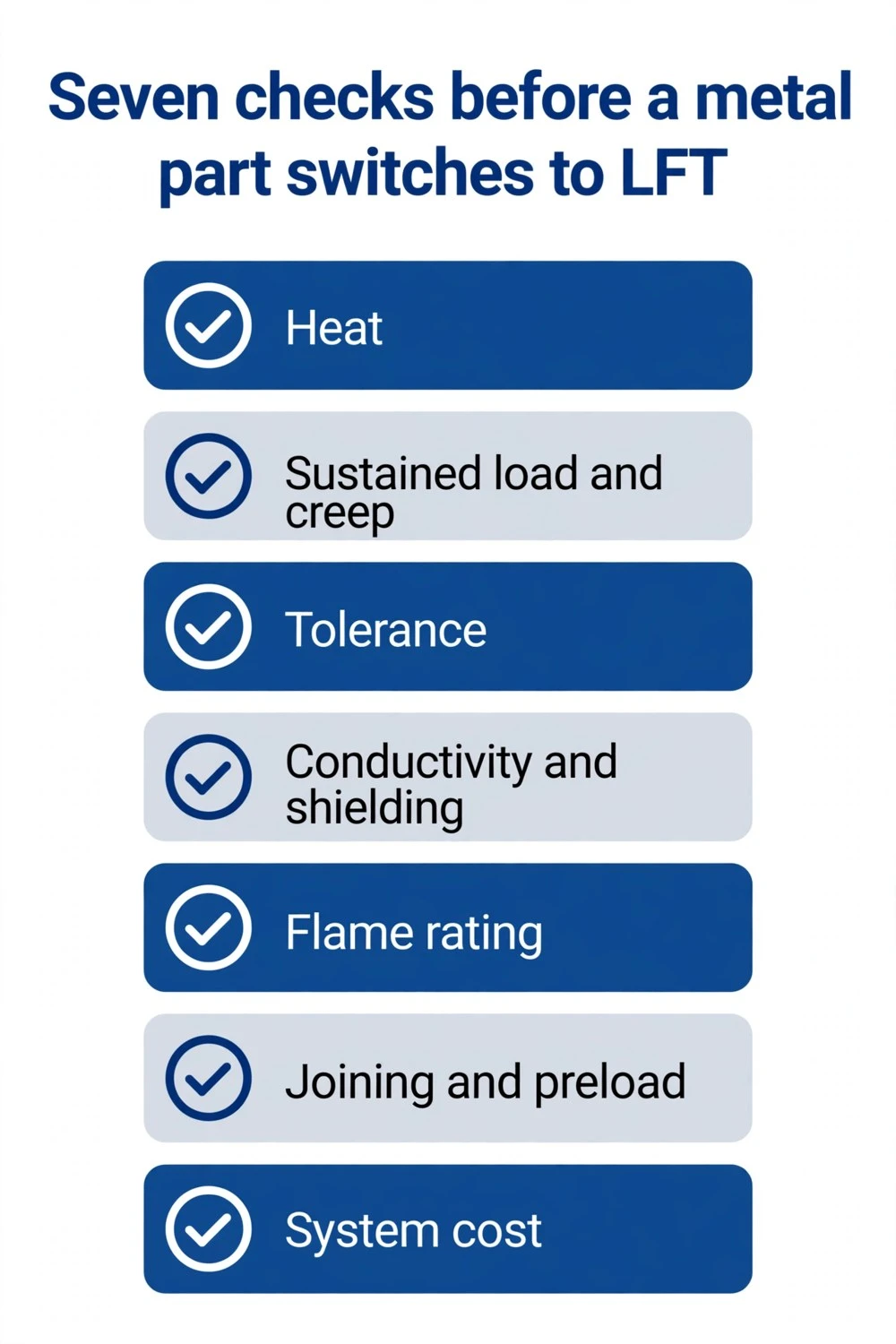
Schematic, not to scale. Seven checks before a metal part switches to LFT.
The table below compares boundaries, not grades, and states direction only; a metal part and an LFT grade do not share one datasheet.
| Boundary | What metal tolerates | What LFT needs checked | Screen before switching |
|---|---|---|---|
| Sustained heat | Shape over a wide temperature range | Softening and creep as temperature rises | Service temperature, heat spikes, load while hot |
| Sustained load | Shape under long-term load | Creep over service life, worse when hot | Load, time, temperature, tolerance that must hold |
| Dimensional tolerance | Tight tolerance under heat and moisture change | Shift with heat, moisture, and creep by resin | Tolerance, humidity, wet exposure, resin choice |
| Electrical function | Conductivity, grounding, shielding | Insulating by nature unless a conductive grade is specified for that function | Whether the part must conduct, ground, or shield |
| Flame rating | Rating set by the metal part specification | Grade rating on offer, for example HB at 1.5 mm by UL-94 for the LGF40 grades named here | Required rating, thickness, and test condition |
| Joining and preload | Bolt preload held by metal threads | Creep under preload, thread and insert design, joint redesign | Joint type, clamp load, insert, and service vibration |
| System cost | Part, assembly, and service cost as built | Tooling, redesign, trial, scrap, and service cost together | Full system cost, not pellet price alone |
Two readings matter more than the table. First, one failed boundary is enough to keep metal: a part passing six checks and failing heat, or passing heat and failing its joint, still fails as a system. A boundary can move with redesign, but only if redesign is allowed.
When LFT Still Fits, Despite These Boundaries
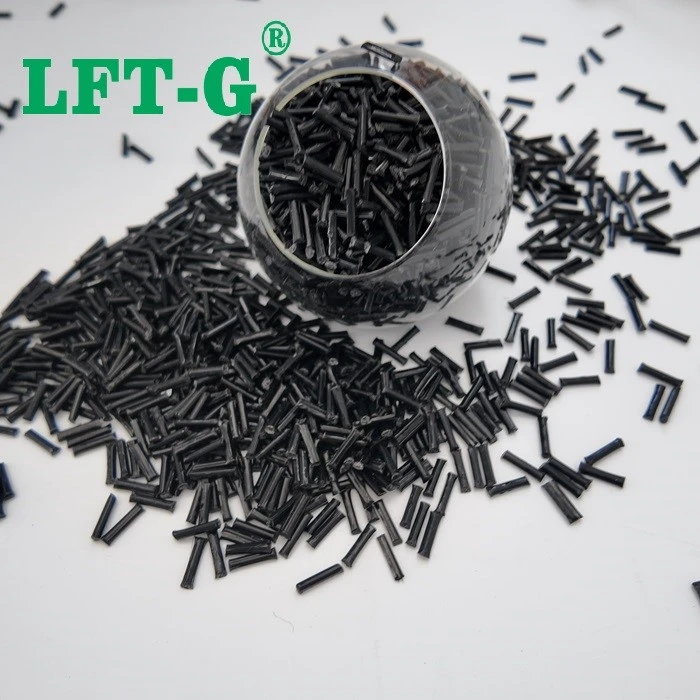
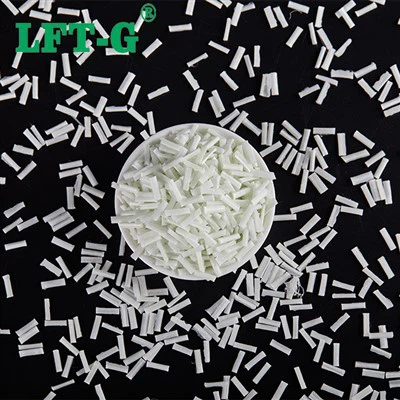
PP LGF40 black pellets.
LFT still fits many metal parts, once the boundaries above are screened. A part inside the resin heat boundary, without tight creep-sensitive tolerance, without conductivity or a flame rating above the grade on offer, and able to change ribs, bosses, and gate, is a trial candidate. Weight saving then comes from lower density plus a shape designed for molding.
Resin choice follows the boundary that matters most. PP LGF40 fits a part benefiting from low moisture absorption and lower density below the PP heat boundary. PA66 LGF40 fits a part needing higher heat deflection and stiffness that can be dried properly and run in a hotter mold. Choose by the part boundary, and trial on the real part and tool before production.
Trial discipline is part of the fit. A trial changing gate, wall, and joint together proves nothing about any one of them; keep tool, gate, and joint fixed, test at service temperature and environment, and check dimensions after service exposure. If that trial meets stiffness, heat, dimensional stability, and repeatability, production can be decided; if not, redesign or keep metal.
Switching Without Redesign Is Where Most Failures Start
Gate size is a first check: as a general rule for long fiber pellets, the gate should be at least 3 mm, and the grade datasheet sets the real value. For the LGF40 grades named here, the gate is 5–6 mm, and pin-point gates are not used, because a small gate breaks fibers. A metal part whose tool cannot take a gate that large should not switch without a tool change.
Drying, melt temperature, mold temperature, and injection pressure follow the grade datasheet, not a general window, because resin and fiber content change the window. A trial on old tool settings, or on another grade window, has not proven the grade. Check fiber retention after molding: a pellet that starts long does not guarantee a part that stays long, and high shear, a small gate, or poor control can lose the fiber network the design counted on.
Joint design is the last processing check, and often the one that keeps a part metal. A molded part under bolt preload can creep, and a thread cut directly into thermoplastic can fail where an insert or redesigned boss would hold. If the joint cannot change, and clamp load and vibration cannot be proven on the real joint, the part should stay metal.
How to Screen a Metal Part Before You Trial LFT
For a metal part, screening follows a fixed sequence, and it comes before any pellet trial:
- Send the part application and a product photo, so the load path, size, and joint can be seen.
- Send the current metal, shape, and specification, so the comparison starts from a known baseline.
- State service conditions: load, temperature, heat spikes, moisture or chemical exposure, vibration, and service life.
- State joint, tolerance that must hold, flame or electrical requirement, and any certification the part must still hold.
- Decide: keep metal, redesign part and tool for LFT, or trial LFT on the real part, tool, and joint.
If screening finds a failed boundary redesign cannot move, keeping metal saves a trial. If redesign can move it, redesign comes first, then the trial. Only a part passing screening, or passing after redesign, should enter a pellet trial, and production only if that trial meets stiffness, heat, dimensional stability, and repeatability.
FAQ
Is LFT always lighter than a metal part?
Not as a finished part. Lower density helps, but wall thickness, ribs, and bosses can change the weight, so weight must be checked on the real part shape, not on pellet density alone.
Can LFT replace metal in a high-temperature part?
Only when sustained temperature, heat spikes, and load while hot stay inside the resin boundary. Heat deflection temperature is a reference point, not a service guarantee; check the part at service temperature and load.
Why did an LFT trial pass in the lab but fail in service?
Lab tests run at room temperature, dry, for a short time, on a standard shape. Service adds heat, moisture, sustained load, vibration, and the real joint.
Do I need to redesign a metal part to switch to LFT?
In most cases, yes. Ribs, bosses, wall thickness, gate position, and joint design must suit molding and fiber flow. Copying the metal shape without change often keeps the shape and loses strength where the load goes.
What should I send to screen a metal part for LFT?
Send the application and a product photo, the current metal and specification, service load, temperature, environment, and life, plus joint, tolerance, and any flame, electrical, or certification requirement.
|
Screen Your Metal Part for LFT Send your metal part application, current material specification, and service conditions. LFT-G will review whether the part stays inside the LFT boundary, needs redesign first, or should stay metal. Email: candyhu@lfrtplastic.com WhatsApp: https://wa.me/8613950095707 |
 |