

BLUF: Screw Shear Controls Whether PP-LGF50 Acts as a Structural Composite or Brittle Thermoplastic
In 50 wt% long glass fiber reinforced polypropylene (PP-LGF50), mechanical properties do not depend solely on fiber weight fraction-they are dictated by post-molding weight-average fiber length (Lw). While 12mm continuous pultruded pellets enter the feed hopper intact, aggressive shear stresses inside conventional injection molding screws can fracture these fibers to sub-millimeter lengths (< 0.8 mm). This microstructural degradation results in an immediate 45% to 55% loss in Charpy unnotched impact strength and a 30% reduction in fatigue endurance, even though tensile and flexural modulus remain virtually unchanged.
To maintain a self-entangled 3D fiber skeleton capable of structural energy dissipation, molded parts must achieve a residual fiber length Lw ≥ 2.5–3.5 mm. Achieving this target requires replacing standard 3.0:1 compression ratio general-purpose screws with low-shear 1.8:1–2.0:1 LFT-dedicated screws, reducing back pressure to 0.1–0.3 MPa, and opening runner and gate passages beyond 3.5 mm.
| Property Parameter | Test Standard | Raw Pellet (12mm) | Low-Shear Molded (Lw ≥ 3.2 mm) |
High-Shear Molded (Lw ≤ 0.7 mm) |
|---|---|---|---|---|
| Tensile Strength (MPa) | ISO 527 | - | 145 – 155 | 110 – 118 (-24%) |
| Tensile Modulus (MPa) | ISO 527 | - | 12,500 – 13,200 | 11,800 – 12,100 (-8%) |
| Flexural Modulus (MPa) | ISO 178 | - | 11,800 – 12,600 | 11,000 – 11,400 (-7%) |
| Charpy Unnotched Impact (kJ/m²) | ISO 179/1eU | - | 72.0 – 80.0 | 34.0 – 38.0 (-53%) |
| Charpy Notched Impact (kJ/m²) | ISO 179/1eA | - | 22.0 – 26.0 | 12.5 – 14.0 (-46%) |
| HDT @ 1.80 MPa (°C) | ISO 75 | - | 158 – 162 | 148 – 152 (-6%) |
Physical Mechanisms: How Hydrodynamic Shear Crushes 50% Glass Fiber Load-Bearing Networks
Understanding why PP-LGF50 suffers from shear damage requires an examination of the micro-mechanics of fiber-matrix stress transfer. In reinforced thermoplastics, the composite's ability to transfer load from the ductile polypropylene matrix to the rigid E-glass fibers depends on the Critical Fiber Length (lc), defined mathematically as:
Where σf is fiber tensile strength (~3400 MPa for E-glass), d is fiber diameter (~17 μm), and τy is the interfacial shear yield strength of the chemically-coupled PP matrix.
For standard maleic anhydride polypropylene (MAPP) coupled matrices, the critical length lc ranges between 1.2 mm and 1.6 mm. When the retained fiber length exceeds this threshold (L > lc), fibers carry their ultimate tensile load and fail via fiber fracture during high-energy impact events, absorbing immense strain energy. However, when excessive screw shear grinds the fiber length below 0.8 mm (L < lc), the failure mechanism shifts entirely to interfacial pull-out. The fibers pull cleanly out of the polymer matrix before reaching tensile saturation, causing catastrophic drop-offs in unnotched impact toughness.
Viscous Dissipation and Fiber-to-Fiber Attrition in High-Loading (50 wt%) Suspensions
In a 50 wt% long glass fiber system, the volumetric packing fraction of glass reaches approximately 30–32% within the melt. At this ultra-high concentration, fibers can no longer rotate freely in hydrodynamic shear fields. Instead, the melt behaves as a semi-concentrated suspension where fiber-fiber interactions (contact friction, bending attrition, and mechanical interlock) dominate the degradation process.
When this high-viscosity suspension passes through restricted screw flight clearances (< 0.15 mm) or narrow compression zones, local shear rates (γ̇) spike beyond 10,000 s-1. The resulting hydrodynamic drag creates severe bending moments along individual 12mm filaments. Once bending stresses exceed the transverse flexural strength of the glass (~1.5 GPa), the fibers buckle and snap into short rods.
Screw Geometry Comparison: General Purpose (GP) vs. Dedicated Low-Shear LFT Screws
The geometric design of the injection molding screw is the single largest controllable variable determining residual fiber length. Conventional General Purpose (GP) screws are engineered to homogenize unfilled or short-fiber polymers through aggressive shear heating and mechanical kneading. When applied to PP-LGF50, GP screws act as high-speed grinders.
| Screw Feature | Standard General Purpose Screw | Dedicated Low-Shear LFT Screw |
|---|---|---|
| Compression Ratio | 3.0:1 – 3.5:1 (Aggressive) | 1.8:1 – 2.0:1 (Gentle Transition) |
| Flight Depth (Metering Zone) | Shallow (2.5 – 3.5 mm) | Deep Flighted (5.0 – 8.0 mm) |
| L/D Ratio | 20:1 – 22:1 | 18:1 – 22:1 (Short Plasticizing Path) |
| Mixing Heads (Maddock / Pin) | Present (Forces Extreme Shear) | Strictly Prohibited (Zero Dispersive Mixers) |
| Non-Return Valve (Check Ring) | Narrow 45° Seat, Small Clearance | Free-Flow, 30° Streamlined Taper, Wide Clearance |
The Non-Return Valve: The Overlooked Shear Bottleneck
Even if the screw channel is optimized with a gentle 2.0:1 compression ratio, substantial fiber breakage often occurs at the check ring assembly. Standard three-piece non-return valves force molten PP-LGF50 through sharp, restrictive annular gaps. As the screw moves forward during the injection phase, the sudden convergence of melt flow produces extensional shear rates exceeding 15,000 s-1. A low-shear free-flow non-return valve featuring streamlined lead-in angles (30° instead of 45° or 90°), increased passage volume (+30%), and highly polished carbide wear coatings is mandatory to avoid wiping out the gains achieved in the screw barrel.
Optimized Injection Molding Window for 50% Long Fiber Retention
Tooling geometry must be paired with low-shear process kinematics. Process technicians frequently make the mistake of running PP-LGF50 with excessive back pressure to improve shot weight repeatability, or running high screw rotation speeds (RPM) to minimize cycle time. In a 50 wt% long glass system, both practices crush the reinforcing skeleton.
| Process Parameter | Recommended Window (Low Shear) | Risk of Excessive Setting (High Shear) |
|---|---|---|
| Back Pressure | 0.1 – 0.3 MPa (1 – 3 bar hydraulic) | > 0.8 MPa compacts fibers, causing intense attrition. |
| Screw Speed (RPM) | 25 – 45 RPM (Peripheral ≤ 0.15 m/s) | > 60 RPM generates shear heat and fiber fractures. |
| Barrel Temperature Profile | 230°C – 260°C (Flat / Reverse Profile) | < 220°C creates high melt viscosity, snapping fibers. |
| Injection Speed | Slow-to-Moderate (20 – 50 mm/s) | Fast injection creates gate jetting and shear degradation. |
| Cushion Size | 5 – 10 mm | < 3 mm risks bottoming out and uneven packing. |
Application Engineering: Automotive Front-End Modules & Industrial Structural Frames

Automotive Front-End Carrier (FEM): Eliminating Impact Micro-Cracking
A Tier-1 automotive supplier experienced recurring low-temperature cold impact failure (-30°C pendulum test) on an integrated radiator support molded with PP-LGF50. Chemical formulation analysis showed no resin defects.
A tooling audit revealed the molder was running a 3.2:1 compression GP screw with 1.2 MPa back pressure, degrading the molded fiber length down to Lw = 0.65 mm. Switching to a dedicated 2.0:1 LFT screw and dropping back pressure to 0.2 MPa raised average fiber retention to Lw = 3.1 mm. The part passed 100% of OEM crash-energy dissipation tests with zero cracking, cutting scrap rates from 14.2% to under 0.3%.
Heavy-Duty Industrial Water Pump Housing: Long-Term Creep Resistance
In pressurized fluid handling equipment, PP-LGF50 replaces die-cast aluminum to achieve zero chemical corrosion and 40% weight reduction. However, sustained internal hydrostatic pressure (1.6 MPa at 60°C) demands superior long-term creep rupture resistance.
By maintaining a post-molded fiber length greater than 3.0 mm, the internal intertwined fiber mesh acts as a continuous mechanical skeleton, reducing creep strain by 68% compared to short glass fiber PP (SGF-PP) over 5,000 continuous operating hours.

LFT-G® PP-LGF50 Grades & Technical Datasheet Access
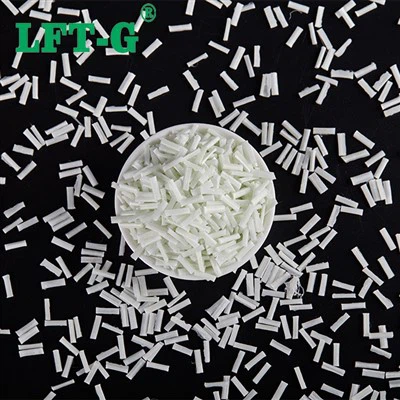
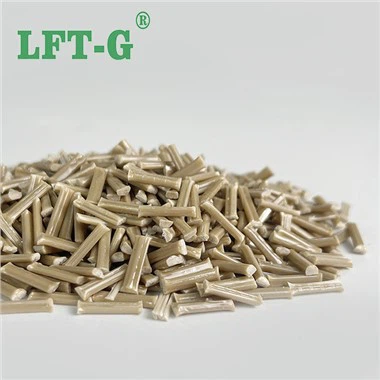
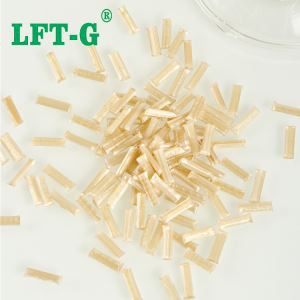
High-performance molding begins with fully impregnated, unbroken long fiber pellets. Xiamen LFT Composite Plastic Co., Ltd, abbreviated as LFT-G® utilizes advanced proprietary melt-pultrusion processes to ensure 100% individual fiber wetting and consistent 10–12mm cut lengths in every pellet of our structural PP-LGF series.
Whether you require chemically coupled UV-stabilized grades, flame-retardant V0 formulations, or heat-aged automotive grades, explore our comprehensive technical datasheets and long fiber portfolio:
- LFT-G® PP-NA-LGF50: Natural / Black general-purpose structural grade with superior flow. [View Product Specifications & TDS]
- LFT-G® PP-HI-LGF50: Impact-modified formulation engineered for extreme cold-temperature ductility (-40°C).
- LFT-G® PP-UV-LGF50: High weatherability exterior grade for outdoor industrial and marine components.