

BLUF: Long Fiber Networks Transform Flexible Elastomers into Heavy-Load Structural Composites
Standard neat thermoplastic polyurethane (TPU) and short glass fiber reinforced TPU (SGF-TPU) face severe physical boundaries when deployed in structural, load-bearing applications. Under continuous static loads above 10 MPa or high-frequency cyclic vibrations, neat TPU undergoes severe viscoelastic creep and permanent compression set. Meanwhile, SGF-TPU (fiber lengths < 0.4 mm) exhibits localized micro-stress concentrations around sharp fiber ends, accelerating interfacial fatigue micro-cracking and causing premature brittle failure.
By incorporating 10–12mm pultruded continuous glass fibers, TPU-LGF creates a self-entangled 3D internal structural skeleton. This structural network raises the flexural modulus up to 8,500–12,000 MPa (a 10-fold increase over neat TPU), reduces 1000-hour compressive creep strain by over 75%, and retains superior elastomeric energy dissipation with unnotched Charpy impact resistance exceeding 85 kJ/m² at -30°C.
| Engineering Property | Test Standard | Neat TPU (Shore 64D) |
SGF-TPU (40% Short GF) |
LFT-G® TPU-LGF40 (40% Long GF) |
|---|---|---|---|---|
| Tensile Strength (MPa) | ISO 527 | 45 – 55 | 95 – 110 | 155 – 175 (+60%) |
| Tensile Modulus (MPa) | ISO 527 | 450 – 650 | 5,200 – 6,000 | 8,800 – 9,600 (+60%) |
| Flexural Modulus (MPa) | ISO 178 | 400 – 580 | 4,800 – 5,500 | 8,200 – 9,100 |
| Charpy Unnotched Impact @ 23°C (kJ/m²) | ISO 179/1eU | No Break | 45.0 – 55.0 | 95.0 – 110.0 (No Break) |
| Charpy Notched Impact @ -30°C (kJ/m²) | ISO 179/1eA | 18.0 – 22.0 | 8.5 – 10.5 | 24.0 – 28.5 (+170%) |
| Compressive Creep Strain (1000h @ 20 MPa, %) | ISO 899-1 | > 18.5% (Severe Yield) | 4.8% – 5.6% | 1.1% – 1.4% (-76%) |
| Taber Abrasion Loss (mg, H-22 Wheel, 1kg) | ISO 4649 / ASTM D1044 | 25 – 35 | 95 – 120 (Fiber Pitting) | 30 – 42 |
Viscoelastic Creep & Micro-Phase Mechanics: Why Neat and Short-Fiber TPU Fail Under Load
Thermoplastic polyurethane is a block copolymer consisting of alternating alternating hard segments (diisocyanates and short-chain diols acting as physical crosslinks) and soft segments (long flexible polyether or polyester chains providing rubbery elasticity). In neat TPU, these domain structures provide superior resilience at low strain levels.
However, under sustained mechanical stress, the hydrogen bonds within the hard domains gradually dissociate. This triggers viscoelastic chain slippage and irreversible plastic flow, causing severe creep deformation and structural collapse.
The Short-Fiber Paradox in Elastic Matrices: Severe Stress Concentration & Debonding
Attempting to reinforce TPU with short glass fibers (SGF, typical length 0.2–0.4 mm) introduces an engineering paradox. Because the elastic modulus difference between the glass fiber (approx 72GPa) and the rubbery TPU matrix (approx 0.5GPa) spans more than two orders of magnitude, immense shear stress concentrations develop at every fiber endpoint under dynamic loading.
Because short fibers cannot form a continuous mechanical network, load is continuously transferred into the soft elastomeric matrix through millions of discrete fiber ends. Under cyclic loading, micro-voids nucleate at these termination points, rapidly coalescing into macro-cracks that cause interfacial debonding and sudden brittle catastrophic rupture.
The Long-Fiber Solution: The Load-Carrying 3D Skeletal Cage
In TPU-LGF, the retained fiber length (Lw3.0mm) exceeds the critical threshold (approx1.2mm), forming a self-supporting, continuous 3D entangled skeletal cage. This structural architecture fundamentally alters load transfer:
- Direct Load Absorption: Over 85% of sustained compressive and flexural stress is borne directly by the high-modulus glass fiber network, shielding the TPU matrix from plastic flow and eliminating heavy-load creep.
- Crack Blunting & Energy Dissipation: When dynamic shock waves enter the composite, the elastomeric TPU matrix undergoes micro-hysteresis damping, absorbing impact energy while the continuous fiber network prevents crack propagation.
- Tribological Integrity: Unlike short fibers that pull out and create abrasive glass debris (scuffing and gouging the surface), long fibers remain firmly anchored within the polyurethane mesh, preserving exceptional Taber abrasion resistance.
Dynamic Fatigue Resistance & Acoustic Damping (Tan) Performance
One of the greatest challenges in mechanical engineering is isolating high-frequency harmonic vibration without sacrificing structural rigidity. Rigid engineering plastics such as PA66-GF50 or POM transmit vibration and acoustic noise directly into adjacent assemblies, while pure elastomers lack the structural stiffness required for heavy-duty mounting brackets.
Dynamic Mechanical Analysis (DMA) reveals that TPU-LGF maintains a high loss factor (Tan δ = 0.08–0.12 at 23°C, 10 Hz) across broad operational temperature ranges (-40°C to +80°C). This allows TPU-LGF structural housings to absorb dynamic shock pulses, attenuate acoustic resonance by up to 12 dB compared to die-cast aluminum, and survive millions of cyclic stress reversals without fatigue failure.
Low-Shear Processing Window: Preserving Long Fiber Integrity in TPU Resins
Processing TPU-LGF requires tight thermal and kinematic control. Polyurethane melts exhibit strong pseudoplastic non-Newtonian flow behavior; excessive shear heating inside the injection barrel will degrade both the polyurethane polymer chains and the long glass fiber skeleton.
|
Processing Parameter |
Target Setting Window |
Engineering Justification |
|---|---|---|
| Pre-Drying (Dehumidifying) | 95°C – 105°C for 3–5 hours (Moisture ≤ 0.02%) | Prevents hydrolytic degradation of urethane linkages and foaming. |
| Barrel Temperature Profile | Rear: 205°C | Middle: 215°C | Front: 225°C | Nozzle: 220°C | Prevents thermal degradation while ensuring complete matrix plasticization. |
| Screw Compression Ratio | 1.8:1 – 2.0:1 (LFT Dedicated, Deep Flight) | Minimizes fiber attrition and shear-induced thermal spikes. |
| Back Pressure | 0.1 – 0.3 MPa (Minimal hydraulic setting) | Avoids high-shear filament compaction in the metering zone. |
| Mold Temperature | 40°C – 70°C | Optimizes TPU hard segment crystallization and surface resin layer. |
Application Engineering: Heavy Industrial & Dynamic Damping Systems

Automated Guided Vehicle (AGV) Heavy-Duty Wheels: Zero Flat-Spotting
Industrial warehouse AGVs carrying 2.5-ton continuous payloads regularly suffered from "flat-spotting" when parked stationary overnight on neat cast polyurethane wheels.
Upgrading the wheel hub core to LFT-G® TPU-LGF40 completely eliminated stationary creep deformation, cutting rolling resistance by 34% while maintaining silent, non-marking operation on high-friction industrial flooring.
Downhole Mining & Slurry Valve Seals: High-Pressure Erosion Resistance
In mining slurry pumping operations, high-velocity quartz particle impingement combined with 15 MPa cyclic pressure pulses rapidly erodes metallic valves and fractures brittle short-glass reinforced plastics.
TPU-LGF components combine the elastomeric resilience of polyurethane (which elastically yields to deflect solid particles) with the structural anchorage of long fibers. The result is a 4.2× service life extension over stainless steel 316 and SGF-nylon components in slurry erosion testing.
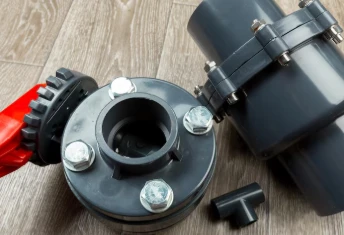
LFT-G® TPU-LGF Material Series & Engineering Datasheets
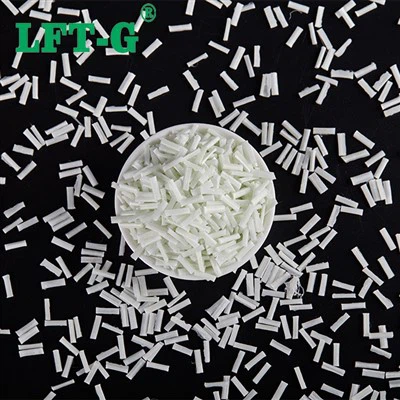
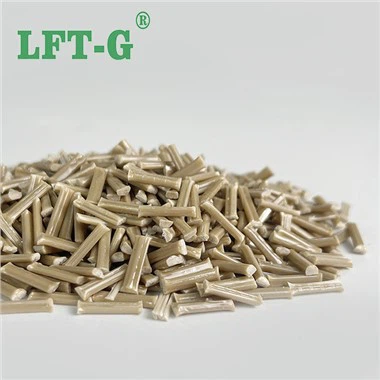
High-performance structural elastomeric engineering requires fully impregnated, intact 10–12mm long fiber pellets. Xiamen LFT Composite Plastic Co., Ltd, abbreviated as LFT-G® engineers advanced ether and ester-based TPU long fiber compounds tailored for the most demanding dynamic environments.
Discover our high-durability TPU long fiber product portfolio:
- LFT-G® TPU-EU-LGF30: Polyether-based 30% long glass fiber grade featuring superior hydrolytic stability, microbial resistance, and sub-zero flexibility.
- LFT-G® TPU-ES-LGF40: Polyester-based 40% long glass fiber grade engineered for maximum oil resistance, tensile strength, and heavy-duty creep resistance. [View TPU-LGF TDS Portfolio]
- LFT-G® TPU-LCF40: 40% Long Carbon Fiber reinforced TPU for ultra-lightweight structural damping, anti-static (ESD) protection, and high dimensional stiffness.