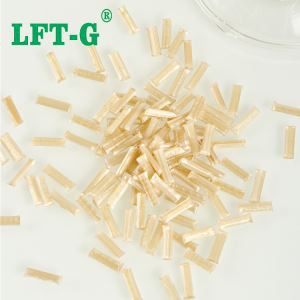

Paddle Design Reimagined: How Long Fiber PA6 Conquers the Water
Every kayaker knows the feeling: you plant your blade for a powerful stroke, and instead of solid resistance, the blade flexes - robbing you of power and efficiency. Or worse, you hit a submerged rock and hear that sickening crack.
Paddles live in a harsh world. Water, UV, rocks, sand, and thousands of repetitive loads - every stroke is a cycle. The material has to survive all of it while staying light enough to carry and stiff enough to deliver power. That's a tall order for any material.
This case study explores how LFT-G® PA6 LGF30 - a 30% long glass fiber-reinforced polyamide 6 - delivers the ideal balance of stiffness, impact resistance, and lightweight durability for kayak and canoe paddle blades, outperforming traditional aluminum and short-fiber composites.

Figure 1. Paddle blade comparison: traditional aluminum (left) vs. LFT-G® PA6 LGF30 (right). 50% lighter with superior impact resistance.
The Problem: Paddles That Don't Deliver
A paddle blade is deceptively simple. In reality, it's a high-performance engineering component that must balance four conflicting demands:
Stiffness under load. A flexible blade wastes energy. Every millimeter of deflection is power that never reaches the water. Paddlers need a blade that stays straight under maximum stroke force.
Impact survival. River bottoms are full of surprises - rocks, logs, gravel bars. A blade that chips or cracks on impact is a blade that fails when you need it most.
Endless fatigue cycles. A typical kayaker takes 5,000 to 10,000 strokes per day. Over a season, that's millions of load cycles. The material must not gradually soften or develop micro-cracks.
Water resistance. Paddles live in water. Fresh water, salt water, UV rays, temperature swings - all of which degrade lesser materials.
The trade-off problem: Aluminum is stiff but heavy and corrodes. Short-fiber nylon is light but flexes too much. Carbon fiber performs but costs too much. LFT-G® PA6 LGF30 eliminates all three compromises.
The Solution: Why Long Glass Fiber Changes Everything

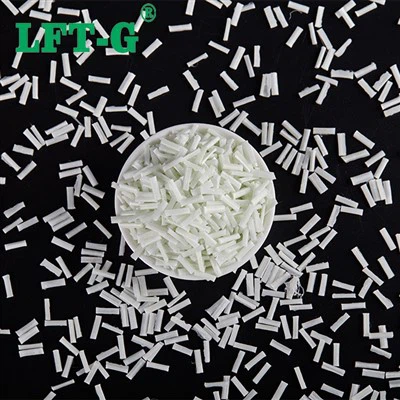
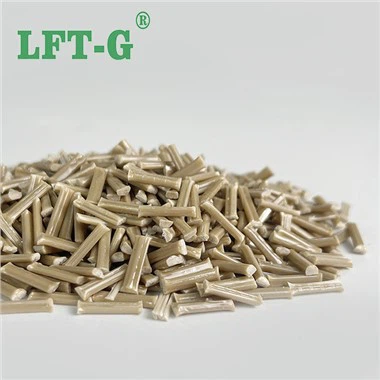
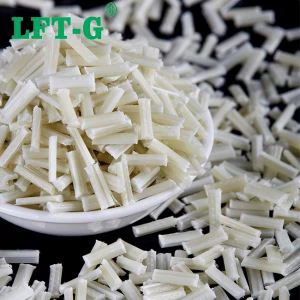
What sets LFT-G® PA6 LGF30 apart is its long glass fiber structure. Unlike short-fiber compounds where fibers are chopped to less than 1mm, PA6 LGF30 starts with continuous glass fibers that are impregnated, drawn, and pelletized with fibers remaining 5–25mm long.
In the molded paddle blade, these long fibers form a three-dimensional reinforcing network - not the random dispersion of short fibers, but a genuine structural skeleton. This network delivers superior stiffness (fibers spanning the blade resist bending far more effectively), exceptional impact resistance (the network absorbs and dissipates energy before it reaches the resin), and fatigue endurance (millions of load cycles with no progressive weakening).
PA6 offers the ideal matrix for this reinforcement in water applications. It has excellent toughness, good chemical resistance to water and salts, and superior fatigue performance compared to other thermoplastics. Combined with long glass fibers, it creates a material that absorbs impact without fracturing and resists gradual degradation from repetitive loading and environmental exposure.
Key performance highlights: 50% lighter than aluminum · 60% less deflection than short-fiber PA6 · 2.5× fatigue strength vs. unreinforced PA6 · Superior impact resistance.
The Results: What Happened When We Put It to the Test

A leading paddle manufacturer replaced their aluminum blade with LFT-G® PA6 LGF30. The results were immediate and measurable.
The PA6 LGF30 blade delivered a 50% weight reduction vs. aluminum - from 380g to 190g. Paddlers immediately noticed the difference. The blade felt crisper, more responsive, and transmitted power more efficiently with each stroke. Under load, deflection was reduced by 60% compared to short-fiber PA6, meaning more of the paddler's energy reached the water.
The weight reduction eliminated arm fatigue on long trips, while the impact resistance meant paddlers no longer feared hidden rocks. After 100,000+ load cycles - simulating an entire season of aggressive paddling - there was no visible wear, no cracking, and no loss of stiffness. The blade performed as well on day 200 as on day one.
In salt spray testing (ASTM B117), the PA6 LGF30 blade showed zero corrosion after 1,000 hours. Aluminum blades in the same test showed visible pitting after 500 hours. The elimination of coatings and anodizing further simplified production.
Paddler feedback: I've paddled aluminum, carbon, and short-fiber blades. The LFT-G blade is the first one that feels like carbon at a fraction of the cost. It's stiffer than any composite blade I've used and I don't worry about cracking it on rocks.
The Economics: Performance Without the Premium
One of the most compelling aspects of LFT-G® PA6 LGF30 is its cost-to-performance ratio. Carbon fiber blades deliver exceptional stiffness and light weight, but their cost puts them out of reach for most paddlers. Aluminum blades are affordable but heavy and corrosion-prone. Short-fiber nylon is cheap but flexes too much.
PA6 LGF30 sits in the sweet spot: carbon-like performance at a fraction of the cost. Injection molding enables high-volume production with consistent quality, driving unit costs down. The elimination of post-processing - no coating, no anodizing, no assembly of multiple components - further reduces total cost.
The result is a paddle blade that outperforms aluminum, matches carbon in stiffness, and delivers superior impact resistance - all at a price that makes high-performance paddling accessible to more people.
|
Property |
Aluminum |
Short-Fiber PA6 |
Carbon Fiber |
LFT-G® PA6 LGF30 |
|---|---|---|---|---|
| Weight | Heavy | Light | Very light | Light |
| Stiffness | Good | Moderate | Excellent | Excellent |
| Impact | Moderate | Moderate | Moderate | Superior |
| Corrosion | Poor | Good | Good | Excellent |
| Cost | Low | Low | High | Competitive |
Beyond the Blade: Where Else This Solution Applies
The LFT-G® PA6 LGF30 solution isn't just for paddles. It's a blueprint for any application where the part must be light, stiff, tough, and cost-effective - and where water, fatigue, and impact are part of everyday life.
In water sports, this material works for kayak paddles, surfboard fins, and SUP accessories. In industrial applications, it's ideal for pump impellers, fan blades, and conveyor components that face constant wear and moisture. In outdoor gear, it applies to ski bindings, bicycle components, and camping equipment where lightweight durability is essential.
Wherever you need a material that balances high performance with reasonable cost, LFT-G® PA6 LGF30 is worth evaluating.
The best paddle is the one you forget you're holding. LFT-G® PA6 LGF30 gets you there - lighter, stiffer, tougher, and ready for whatever the river throws at it.
LFT team: ready to solve your lightweighting challenges
Xiamen LFT Composite Plastic Co., Ltd. is a global supplier of long-fiber-reinforced thermoplastics with 20+ years of innovation. We specialize in LFT‑PP, LFT‑PA, LFT‑PPS, and LFT‑Elastomers – offering high‑strength, lightweight alternatives to metal for automotive, aerospace, industrial, and sporting goods applications. Our engineering team provides material selection, mold design review, and on-site technical support for customers worldwide - from concept to production. Reach out for a free consultation.