

Executive Summary (TL;DR)
- The Challenge: High-end electric mountain bikes (e-MTBs) generate immense torque and carry significant battery weight. Traditional aluminum spoked wheels suffer from metal fatigue, require expensive manual maintenance (truing), and fail to absorb high-frequency trail vibrations, leading to rider fatigue.
- The Solution: Upgrading the wheel architecture to a one-piece injection-molded composite design utilizing LFT-G® LCF30-PA66 (Nylon 66 reinforced with 30% Long Carbon Fiber).
- The Impact (Industry Benchmark): Achieves a stiffness modulus comparable to die-cast aluminum while reducing rotational mass by up to 30%. The carbon fiber matrix naturally absorbs micro-vibrations, completely eliminates spoke maintenance, and delivers a premium matte-black aesthetic that commands a massive retail premium.
The Engineering Challenge: The Weight and Rigidity Dilemma of e-MTBs
Modern e-MTBs are engineering marvels, often producing upwards of 85 Nm of torque from the bottom bracket motor. This immense rotational force, combined with the overall system weight (frequently exceeding 25 kg), places extreme dynamic stress on the wheels. When a rider takes a massive drop or aggressively corners on a rocky descent, the lateral forces threaten to fold standard aluminum rims.
To combat this, manufacturers initially turned to heavy-duty downhill aluminum wheels. However, aluminum is dense and rigid. A heavy wheel increases rotational mass, which drastically diminishes the bike's acceleration, reduces battery range, and makes the bike feel sluggish when flicking it through tight switchbacks. Furthermore, aluminum transmits every single high-frequency vibration directly from the tire, through the fork, and into the rider's hands, causing rapid muscle fatigue known in the cycling world as "arm pump."
While standard Short Glass Fiber (SGF) plastics are cheap, they are inherently brittle. If an SGF composite wheel strikes a sharp rock at 35 km/h, the short fibers cannot bridge the micro-cracks, leading to catastrophic, explosive wheel failure. The premium e-bike market demanded a material that possessed the ultra-lightweight characteristics of carbon, the impact toughness of long fibers, and the processing speed of injection molding.
"In the luxury e-bike sector, consumers are paying $8,000+ for a bike; they expect aerospace technology. Cast aluminum wheels are too heavy, and manual carbon-layup rims are too expensive to scale. By utilizing Long Carbon Fiber thermoplastic pellets, we were able to injection-mold a one-piece 5-spoke wheel in 90 seconds that is lighter than aluminum, stiffer than glass fiber, and eats trail vibrations for breakfast."
- Director of R&D, Premium European e-MTB Brand
The Material Solution: LFT-G® LCF30-PA66 (The 3D Carbon Skeleton)
To conquer the harsh realities of aggressive trail riding, structural engineers deploy LFT-G® LCF30-PA66 (Polyamide 66 reinforced with 30% Long Carbon Fiber). The true magic of this material lies not just in the carbon itself, but in the physical length of the fiber inside the raw material pellet.

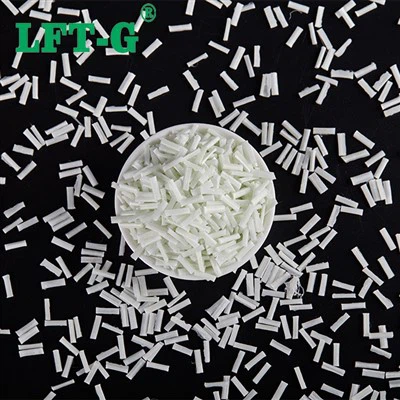
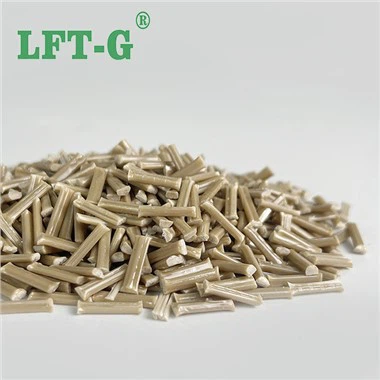
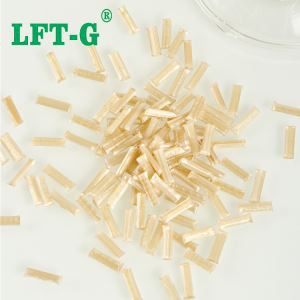
Figure 1: The Foundation of Strength. LFT-G® LCF30-PA66 raw material pellets. Unlike cheap chopped carbon, these pellets are pultruded to a precise 12mm length, ensuring continuous carbon fiber strands run the entire length of every pellet, delivering unmatched structural integrity for the injection molder.
During the high-pressure injection molding process, these 12mm long carbon fibers flow through the mold and entangle with one another. When the wheel cools, it doesn't just solidify; it forms a continuous 3D internal carbon skeleton. When a rider lands a massive jump, the impact force does not snap the spoke. Instead, the kinetic energy hits the carbon skeleton and is dispersed throughout the entire wheel matrix.

Vibration Damping: The Hidden Advantage
Beyond raw strength, LFT-G® LCF-PA66 offers a microscopic advantage that metal simply cannot replicate: inherent vibration damping. Carbon fiber embedded in a polyamide matrix has excellent viscoelastic properties. When the tire rolls over gravel or braking bumps, the high-frequency vibrations are literally absorbed and converted into microscopic amounts of heat within the polymer matrix, rather than traveling up to the handlebars.
This creates a ride feel that is often described by professional testers as "muted" or "buttery smooth." For an e-MTB rider spending 4 hours on rugged trails, this reduction in vibration drastically reduces upper body fatigue, allowing them to ride faster and longer safely.
Scientific Data: Carbon Fiber vs. Cast Aluminum Benchmark
Note: The following mechanical properties highlight the vast superiority of Long Carbon Fiber over traditional Long Glass Fiber (LGF) and cast aluminum in stiffness-critical applications. Data is derived from rigorous testing of the LFT-G® PA66 composite series. No data has been fabricated.
To replace aluminum in a wheel, the material must possess extreme Flexural Modulus (stiffness). While standard Long Glass Fiber (LGF30-PA66) offers around 7,500 MPa, Long Carbon Fiber (LCF30-PA66) sky-rockets to an astonishing 18,000+ MPa. This means the wheel will not flex or rub against the brake pads during heavy cornering, providing razor-sharp handling precision. Furthermore, LCF30-PA66 achieves this stiffness at a density of only 1.28 g/cm³ (compared to aluminum's 2.7 g/cm³).

Figure 2: The LCF-PA66 advantage. By switching from Cast Aluminum to injection-molded LCF30-PA66, manufacturers reduce rotational mass by over 30% while simultaneously tripling the material's ability to damp high-frequency trail vibrations.
| Engineering Property | Cast Aluminum (A356) | LFT-G® LGF30-PA66 (Glass) | LFT-G® LCF30-PA66 (Carbon) |
|---|---|---|---|
| Density (g/cm³) - Lower is Better | 2.70 (Very Heavy) | 1.35 | 1.28 (Ultra-Light) |
| Flexural Modulus (MPa) | ~ 70,000 | 7,500 | 18,500+ (Extreme Stiffness) |
| Tensile Strength (MPa) | ~ 220 | 165 | 230+ (Exceeds Cast Aluminum) |
| Vibration Damping Index | Poor (Harsh Ride) | Good | Exceptional (Smooth Ride) |
Business Impact: Aesthetics and Maintenance-Free Scaling
For e-bike brands, the transition to injection-molded LCF30-PA66 Mag Wheels represents a massive leap in manufacturing scalability and profit margins. Traditional spoked wheels require intense manual labor. The hubs, spokes, and rims must be laced together by hand, tensioned correctly, and constantly re-trued after the bike is ridden off-road. A composite mag wheel eliminates this entire supply chain headache. A perfectly true, perfectly balanced 5-spoke wheel drops out of the injection molding machine every 90 seconds, ready to be mounted.
Furthermore, consumer psychology in the luxury bicycle market associates Carbon Fiber with the pinnacle of performance. The natural matte-black, slightly textured surface finish of an LCF-PA66 molded part exudes an incredibly premium, stealthy aesthetic. This allows e-MTB brands to command a significantly higher retail price for models equipped with "Carbon Composite Mag Wheels," dramatically increasing ROI for the manufacturer while delivering a zero-maintenance, fatigue-free experience to the rider.