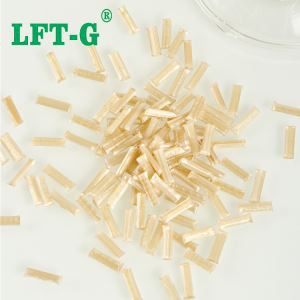

5 Reasons Designers Are Switching from Metal to LFT
What Long Fiber Thermoplastics Make Possible That Metal Cannot
If you're a design engineer, you've probably been asked: Can we replace this metal part with plastic? The question used to be about cost reduction. Today, it's about something bigger: design freedom.
Long fiber thermoplastics (LFT) have matured from a niche material to a mainstream engineering solution. They're not just replacing metal - they're redesigning what's possible in automotive, aerospace, industrial equipment, and consumer products. Here are five reasons why designers are making the switch.
1. Part Consolidation: 7 Parts Become 1
Metal assemblies are built piece by piece. Brackets welded to brackets. Rivets. Fasteners. Alignment challenges. Tolerance stack-ups. Each additional part adds cost, weight, and failure points.
LFT changes this completely. A complex assembly of multiple stamped, welded, or machined metal components can be redesigned as a single injection-molded LFT part. This isn't just about saving assembly time - it's about rethinking the geometry itself.
Consider a real-world example: a Tier 1 automotive supplier replaced a 7-piece steel front-end module assembly with a single LFT-G® PP-GF40 injection-molded part. The result: 40% weight reduction (6 kg lighter than the 10 kg steel assembly), 22% per-unit cost savings, and a 60% faster production cycle. That's not a minor improvement - that's a complete rethinking of how the component is designed and manufactured.
The design freedom here is profound. With metal, you're limited by stamping and welding. With LFT, you can integrate ribs, bosses, mounting points, and complex curves into a single, optimized geometry - features that would be impossible or prohibitively expensive to achieve with metal.

Key takeaway: LFT lets you consolidate. What used to require 7 parts, 3 welding stations, and 2 coating lines now requires one mold, one machine, one cycle.
2. Weight Reduction: 40–50% Lighter Than Metal
The numbers are simple: aluminum has a density of 2.70 g/cm³. Steel: 7.8 g/cm³. LFT composites: 1.07–1.71 g/cm³, depending on formulation. That translates to 40–50% weight reduction compared to aluminum, and even more compared to steel.
But weight reduction isn't just about the number on the scale. For automotive designers, every kilogram saved improves fuel efficiency and range. For aerospace engineers, weight drives performance. For industrial equipment, lighter components mean lower shipping costs, easier handling, and reduced structural demands on supporting systems.
What's remarkable is that LFT achieves this weight reduction without sacrificing structural performance. A 50% long glass fiber PA66 LFT can match the performance of the metal part it replaces while weighing significantly less. In fact, LFT composites offer a strength-to-weight ratio that can be 55% higher than aluminum alloys.

Real-world example: A skating shoe suspension frame switched from machined aluminum to LFT-G® PA6 LCF30. Result: 45% weight reduction, 4× higher impact resistance, and 20% lower total part cost.
3. Corrosion Resistance: No Coating, No Rust, No Worry
Metal parts rust. Aluminum corrodes. Steel requires e-coating, anodizing, painting, or galvanizing - each adding cost, weight, and environmental concerns.
LFT composites are inherently corrosion-resistant. They don't rust. They don't require protective coatings. They perform just as well in salt spray, humidity, and chemical exposure as they do in dry conditions - without any secondary processing.
This is a design advantage that's easy to overlook but impossible to ignore once you've experienced it. When you eliminate corrosion from the equation, you eliminate:
- Coating line capital and operating costs
- Environmental compliance burdens
- In-field corrosion failures and warranty claims
- The need for sacrificial coatings or galvanic protection
In the automotive front-end module case, eliminating e-coating alone contributed significantly to the 22% cost savings. For outdoor equipment, marine applications, and automotive underhood components - where corrosion is a constant threat - LFT's inherent resistance is a design enabler, not just a material property.

4. Design Iteration: Fast, Flexible, Forgiving
This is where LFT truly shines from a designer's perspective. Metal tooling is slow and expensive. A die-cast mold can cost hundreds of thousands of dollars and take months to produce. Modifying a metal design means modifying expensive hard tooling - or starting over.
LFT injection molding tools are faster to produce, easier to modify, and significantly less expensive to iterate. This means you can test, validate, and refine your design with a speed that's simply not possible with metal.
The implications for product development are profound:
- More iterations in the same time frame - you can try three design variants for the cost of one metal tool modification
- Earlier physical testing - functional prototypes are available weeks, not months, into the project
- Lower risk - if a design doesn't perform as expected, the cost of pivoting is dramatically lower
- Customization at scale - small design variations for different markets or applications are economically feasible
And this isn't theoretical. Modern CAE simulation tools - including mold flow analysis and FEA - allow designers to validate LFT designs virtually before cutting steel. The combination of fast simulation and fast tooling means design cycles that were measured in years are now measured in months.
5. The 3D Fiber Network: Performance That Metal Can't Match
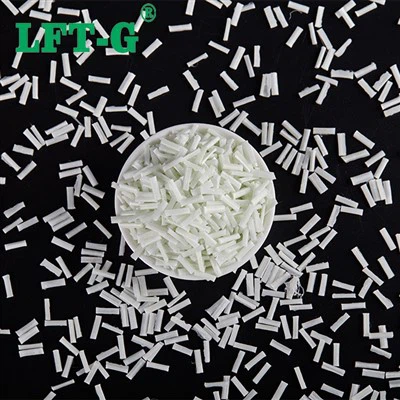
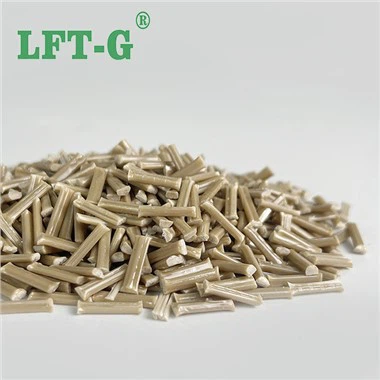
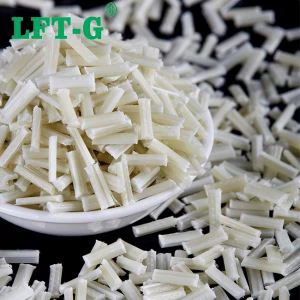
Here's the secret that makes all of the above possible: the 3D fiber network. When LFT is injection molded, the long fibers (6–25 mm, compared to less than 1 mm in short-fiber compounds) form an entangled, three-dimensional skeletal structure throughout the part.
This network is what delivers:
- Impact resistance up to 5× higher than short-fiber compounds
- Exceptional creep resistance under sustained load
- Dimensional stability with low warpage and reduced shrinkage
- Fatigue life that exceeds metal in many applications
When designers understand the 3D network, they stop thinking about LFT as a metal substitute and start thinking about it as a material with its own design language. The network can be oriented through gate placement. Ribs and bosses integrate seamlessly because the network flows around them. The material absorbs energy, dampens vibration, and distributes stress in ways that metal simply cannot.
Visual proof: Burn off the resin from an LFT part, and the fibers remain as a self-supporting skeleton - a physical 3D structure that retains the shape of the original part. Short-fiber parts collapse into dust. That's the difference between structural reinforcement and mere filler.
Long fiber thermoplastics are not a metal replacement. They are a replacement for the constraints that come with metal. And for designers who want to build something better, that's the most important difference of all.
LFT team: ready to help you rethink what's possible
Xiamen LFT Composite Plastic Co., Ltd. is a global supplier of long-fiber-reinforced thermoplastics with 20+ years of innovation. We specialize in LFT‑PP, LFT‑PA, LFT‑PPS, and LFT‑Elastomers – offering high‑strength, lightweight alternatives to metal for automotive, aerospace, industrial, and sporting goods applications. Our engineering team provides material selection, part design consultation, mold flow analysis, and on-site technical support for customers worldwide - from concept to production. Reach out for a free consultation.