
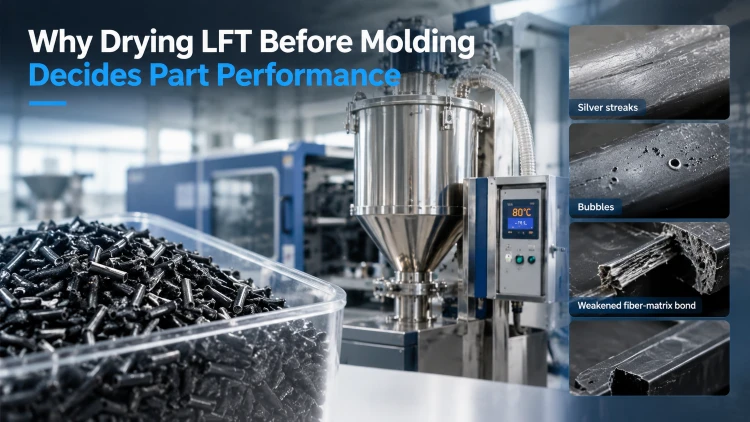
Why Drying LFT Before Molding Decides Part Performance
Moisture is the silent enemy of PA-based long fiber thermoplastics. Here's how to control it - and why it matters.
Polyamide-based LFT materials - PA6 and PA66 - are hygroscopic. They absorb moisture from the air. In the pellet, this moisture is harmless. But inside the injection molding machine, at melt temperatures above 250°C, water becomes a destructive force.
The result is not always obvious. Sometimes you see silver streaks on the surface. Sometimes you see bubbles. Sometimes the only symptom is a part that breaks earlier than it should - because the polymer chains have been cut by hydrolysis, and the fiber-matrix bond has been weakened.
Drying is not a formality. It's a critical process step that determines whether your LFT part performs like a long fiber composite - or like a compromised material. This guide covers the three variables that matter, the equipment required, and how to verify your process.
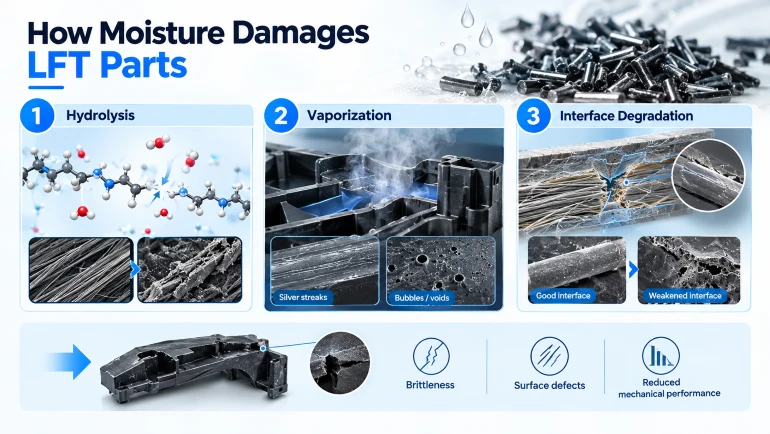
How Moisture Damages LFT Parts
Water affects LFT in three ways - all of them detrimental.
Hydrolysis. At melt temperature, water molecules attack the polyamide chains. The polymer backbones break, molecular weight drops, and the material becomes brittle. This is permanent damage - it cannot be reversed by post-processing.
Vaporization. When the melt enters the mold, residual moisture flashes into steam. This creates silver streaks on the surface, internal bubbles, and voids. Surface quality suffers, and the part may fail cosmetic or functional requirements.
Interface degradation. For long fiber composites, the fiber-matrix interface is critical for load transfer. Moisture attacks this interface, reducing the efficiency of stress transfer from the polymer to the fibers. The fibers are still there - but they can't do their job effectively.
The bottom line: Moisture in PA-based LFT leads to brittleness, surface defects, and reduced mechanical performance - even if the part looks acceptable at first glance.
Three Variables That Determine Drying Success
Drying is not simply heat the material. Three variables must be controlled simultaneously.
1. Temperature. The drying temperature must be high enough to drive moisture out, but low enough to avoid melting or degrading the pellets. For PA6-based LFT, the typical range is 80–100°C. For PA66-based LFT, 100–120°C. Always follow the material supplier's recommendation.
2. Time. Moisture must diffuse from the center of the pellet to the surface. This takes time. Typical drying times are 4–6 hours, depending on the initial moisture content and the drying equipment. Thin pellets dry faster; thick pellets require more time.
3. Dew point. This is the most overlooked variable. Dew point is the temperature at which air becomes saturated with moisture. The lower the dew point, the drier the air - and the more effective the drying process. For PA-based LFT, the drying air should have a dew point below -20°C.
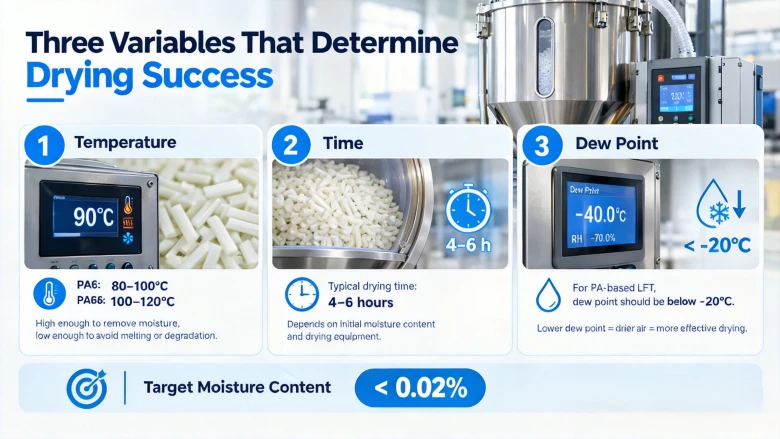
Target moisture content: Below 0.02% for optimal performance. This is not a suggestion - it's the threshold where hydrolysis and surface defects become negligible.
Why a Dehumidifying Dryer Is Essential
Not all dryers are equal. Hot-air dryers heat ambient air and circulate it over the pellets. They can reach dew points around 0°C. That is not sufficient for PA-based LFT.
Dehumidifying dryers remove moisture from the air before heating it. The result is air with a dew point of -20°C or lower. This dry air can absorb significantly more moisture from the pellets, driving the residual moisture content down to the required <0.02%.
For PA6 and PA66 LFT materials, a dehumidifying dryer is not optional. It is the only reliable way to achieve consistent, low-moisture material - batch after batch.
Rule of thumb: If your dryer cannot reach a dew point of -20°C, it cannot dry PA-based LFT properly. Check the dryer specification before processing.
How to Verify Your Drying Process
There are two ways to confirm that drying is working.
Observe the molding process.
If the material is properly dried, the melt should flow consistently, the part surface should be smooth, and there should be no silver streaks or bubbles. If you see any of these defects - and the barrel temperatures are correct - moisture is the likely cause.
Measure the moisture content.
A moisture analyzer provides a direct reading. The target is below 0.02%. This is the most reliable method and should be used periodically to validate the drying process.
Quick check: If the part shows silver streaks but the melt temperature is within specification, increase drying time or verify the dew point of the dryer. The problem is almost always moisture.
Storage Recommendations for LFT-G® Materials
Proper storage prevents moisture pickup before the material even reaches the dryer.
- Sealed foil bags - unopened LFT-G® material can be stored for up to 12 months.
- After opening - use the material promptly. Reseal any unused portion and place it in a dry cabinet or reseal with a desiccant.
- Exposure limit - if the material is exposed to ambient air for more than 2 hours, re-dry before use.
- Dry cabinet - storing opened material in a dry cabinet keeps it ready for use and extends the window before re-drying is needed.
The Takeaway
Drying is not a step you can skip or rush. For PA-based LFT, it's the difference between a part that performs as designed and one that underperforms for reasons that aren't always visible. Control the three variables - temperature, time, and dew point - and verify with a moisture analyzer. Your LFT parts will deliver the impact resistance, stiffness, and fatigue life they were specified to provide.
LFT-G® provides detailed drying guidelines for every material grade. Our technical team can help you set up the right drying process for your equipment and production environment. Reach out for support.
LFT team: ready to support your drying process
Xiamen LFT Composite Plastic Co., Ltd. is a global supplier of long-fiber-reinforced thermoplastics with 20+ years of innovation. We specialize in LFT‑PP, LFT‑PA, LFT‑PPS, and LFT‑Elastomers – offering high‑strength, lightweight alternatives to metal for automotive, aerospace, industrial, and consumer applications. Our engineering team provides material selection, drying guidelines, mold design review, and on-site technical support for customers worldwide. Reach out for a free consultation.