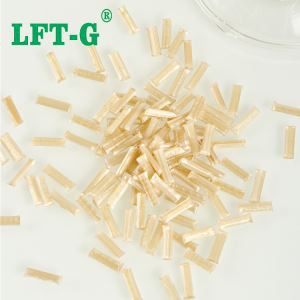

What Is The LFT Materials?
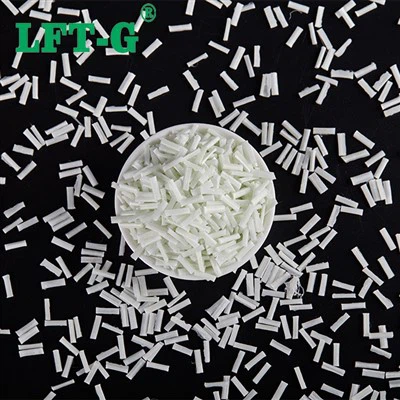
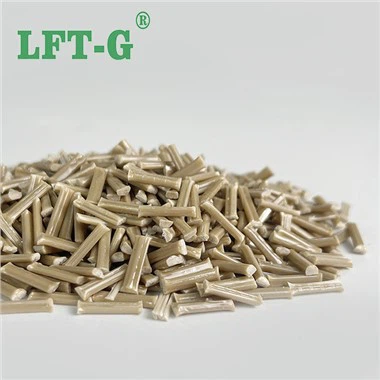
Long fiber reinforced thermoplastic materials refer to reinforced composite materials with fiber lengths ranging from 5 to 25 mm. They are made by fully impregnating continuous fiber bundles with molten thermoplastic resins (such as PP, PA, PBT, etc.) and then pelletizing them. Compared with short-fiber reinforced materials (fiber length <1 mm), it retains a more complete fiber structure, enabling the products to achieve performance close to that of continuous fiber composites.
In the contemporary field of materials science, long-fiber materials are gradually becoming the new favorite in industrial manufacturing due to their unique structural advantages and outstanding performance. This kind of composite material reinforced with continuous or long-cut fibers, through special process design, has achieved a qualitative leap in material performance while maintaining the integrity of the fibers.

How Are Our LFT PP LGF Pellets Made?
The preparation process is the decisive factor for the performance of long-fiber materials. Unlike the simple blending of traditional composite materials, the production of long-fiber materials pays more attention to the maintenance of fiber length and orientation control. The direct impregnation process precisely controls the temperature, pressure, and fiber tension of the resin melt, allowing the resin to fully impregnate the fiber bundles while minimizing fiber damage to the greatest extent.
This seemingly simple process actually requires addressing multiple engineering challenges such as resin viscosity, fiber testability, and uniformity of impregnation. Fortunately, with rich experience, we have been able to handle these problems well when manufacturing long-fiber materials.


Why Choose The LFT PP LGF Composites?
LGF PP material is added with continuous fibers, which can better disperse the force received. Under the same conditions, the impact resistance of LGF PP materials is even twice as strong as that of ordinary SGF PP materials.
LGF PP materials have good durability and also the advantage of being lightweight. If used on automotive parts, it can not only increase the lifespan of the parts but also reduce the overall weight of the car.

What is its Performance?
High mechanical strength
High rigidity
Chemical resistance
High impact resistance
Low warpage
Excellent creep resistance
Fatigue resistance
What is its application range?
1. Automotive parts: car front and back module, car handle, battery case, car mirror parts.
2. Home appliances: washing machine drum, cooling fan blade, water treatment components.
3. Sports equipment: sporting goods connector, cyclist change shifter, roller skate body etc.
4. Aerospace industry: mechanical parts.
5. Electronics and electrical components: power tools, tool housing, engine bracket.

The most remarkable advantage of long-fiber materials lies in their revolutionary strength-to-weight ratio. Compared with steel, the density of long-fiber composites is only one fifth of that, yet they can provide considerable tensile strength. The economic benefits brought by this light weighting are equally significant in the field of new energy vehicles. The battery range is directly related to the vehicle body weight, and the application of long-fiber materials is rewriting the performance standards of electric vehicles.
From the perspective of mechanical properties, the uniqueness of long-fiber materials lies in their excellent impact resistance and fatigue life. Unlike short fiber reinforced materials that are prone to brittle fracture when impacted, long fibers undergo multiple energy dissipation mechanisms such as fiber pulping and interfacial deboning during the failure process. During this process, compared with short-fiber pp materials, it can withstand a longer time.
At present, long-fiber PP materials have formed a complete industrial ecosystem. The supply of raw materials in the upstream is stable, the modification technology in the midstream is mature, and the application scenarios in the downstream are constantly expanding. From automotive interior parts to drone bodies, from home appliance shells to logistics pallets, its presence can be seen everywhere.

Why are more and more customers in various industries choosing pp materials nowadays?
Low cost: The raw material cost of long-fiber pp materials is lower than that of engineering plastics, and the production cycle is short with high production efficiency.
High mechanical properties: high impact resistance, high temperature resistance and good dimensional stability, with better product quality.
Recyclable: Long-fiber materials meet modern recycling standards. While being recycled, they can reduce the environmental burden and are in line with national policies.
Simple processing: No special equipment is required, it has good fluidity and can achieve one-piece molding.
LGF PP compound resin, with their outstanding cost performance, high performance, lightweight and environmental protection advantages, are becoming the core driving force for the transformation and upgrading of the manufacturing industry. It not only significantly reduces production costs and enhances product performance, but also demonstrates irreplaceable value in lightweight design and sustainable development. With the rapid development of industries such as new energy vehicles and smart home appliances, the application prospects of long-fiber PP materials will be even broader. In the future, with the continuous optimization of process technology and the improvement of the recycling system, long-fiber PP materials are expected to become the mainstream choice to replace traditional metals and engineering plastics, promoting the manufacturing industry to move towards a more efficient and environmentally friendly direction. The popularization of this material is not only a manifestation of technological progress, but also an important milestone for the sustainable development of the industry.