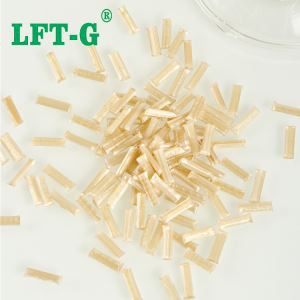

What is LFT? It stands for Long Fiber Reinforced Thermoplastic. But that name barely scratches the surface of what this incredible material can do. Forget everything you think you know about "standard" plastics. We're about to explore how adding a "hidden skeleton" to plastic creates a powerhouse composite that's changing the way we design and build the world around us.
This isn't just a materials science lesson. This is a look into the future of manufacturing, where strength, weight, and design freedom converge. Let's get into it.
First, Let's Break It Down: What Does "Long Fiber Reinforced Thermoplastic" Actually Mean?
 To really grasp the power of LFT, you need to understand its two core components. Think of it like reinforced concrete-you have the concrete itself and the steel rebar that gives it immense tensile strength. LFT works on a similar principle.
The "Thermoplastic" Matrix: The Re-moldable Base
The "thermoplastic" part is the base plastic polymer. Common examples you might know are Polypropylene (PP), Polyamide (PA, or Nylon), or PET. The "thermo" prefix means you can heat it to a melting point, mold it into a complex shape, and then cool it to a solid state. The best part? You can repeat this process. This makes thermoplastics highly recyclable and versatile compared to their "thermoset" cousins, which undergo an irreversible chemical change when cured (like epoxy).

The "Long Fiber" Reinforcement: The Hidden Skeleton
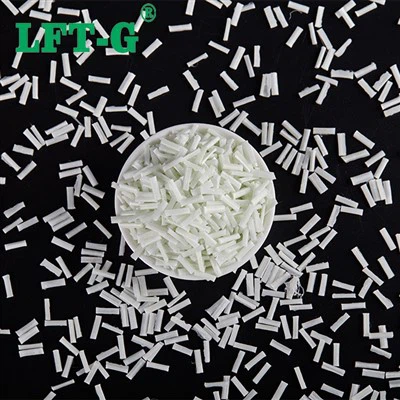
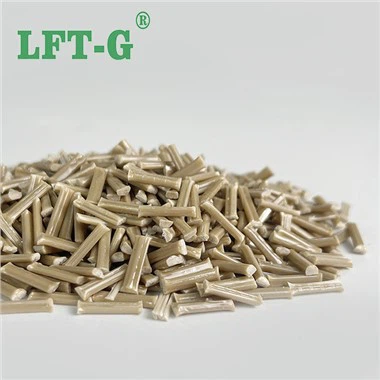
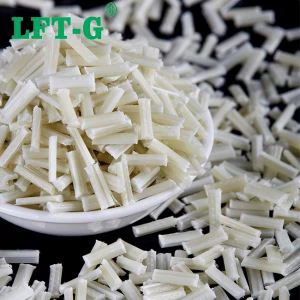
This is where the magic happens. The "long fiber" part refers to reinforcing fibers, typically glass (LGF) or carbon (LCF), that are significantly longer than those found in more common Short Fiber Thermoplastics (SFT).
- Short Fibers (SFT): 0.2mm - 1mm
- Long Fibers (LFT): Typically 10mm - 25mm
Why does this length matter so much? When LFT material is injection molded into a part, these long fibers interlock and form a robust, three-dimensional skeletal structure within the plastic. This internal "rebar" network is the key to LFT's incredible performance. It effectively transfers stress load from the weaker plastic matrix to the strong internal fibers, resulting in massive gains in strength, stiffness, and especially impact resistance.
How is LFT Made? A Quick Look at the Pultrusion Process
The secret to keeping the fibers long lies in the manufacturing process, known as pultrusion.
Imagine pulling a continuous bundle of fiber tows (like a thick string) through a bath of molten thermoplastic resin. The resin completely coats and impregnates the fibers. This combined material is then pulled through a die, cooled, and chopped into pellets, each containing long, aligned fibers.
This method is fundamentally different from the simple compounding used for SFT, where chopped fibers are mixed into molten plastic, a process that often breaks the fibers down even further. Pultrusion ensures the fibers remain at their optimal length, ready to form that critical internal skeleton in your final part.

LFT vs. The World: Why Go Long?
You might be thinking, "Okay, it's stronger. But is it worth it?" Let's put LFT head-to-head with its main competitors: short fiber plastics and metals like aluminum.
 LFT vs. Short Fiber Thermoplastics (SFT):
A Tale of Two Strengths
While SFTs are great for many applications, they simply can't compete when high mechanical performance is required. When you design a part with SFT, you're essentially relying on the plastic matrix itself to do most of the work. With LFT, you're designing with a composite.
The difference is most dramatic in impact strength. A part molded with LFT can absorb significantly more energy before failing. This makes it ideal for components that need to withstand drops, crashes, or sudden loads-think automotive bumpers, power tool housings, and safety equipment. Furthermore, the interlocking fiber network helps control dimensional stability and reduces warpage over large parts, a common headache with SFTs.
LFT vs. Metal (Like Aluminum): The Lightweight Champion
This is where LFT truly shines as a disruptive technology. For decades, designers defaulted to die-cast aluminum or steel for structural components. Today, an LFT composite like LFT-G® PP LGF30 (Polypropylene with 30% Long Glass Fiber) from leading manufacturers like LFT-G® offers a compelling alternative.
Let's look at the data.
|
Property |
LFT-G® PP LGF30 |
Standard PP SGF30 (SFT) |
Die-Cast Aluminum (A380) |
|---|---|---|---|
|
Density (g/cm³) |
~1.12 |
~1.13 |
~2.77 |
|
Tensile Strength (MPa) |
~115 |
~65 |
~324 |
|
Notched Izod Impact (J/m) |
~300 |
~70 |
~40 |
|
Strength-to-Weight Ratio* |
High |
Low |
Medium |
|
Corrosion Resistance |
Excellent |
Excellent |
Poor (Requires Coating) |
|
Design Freedom |
High (Complex Geo.) |
High (Complex Geo.) |
Limited (Draft Angles) |
*Strength-to-Weight is a relative comparison of Tensile Strength / Density.
As you can see, aluminum's density is more than double that of the LFT material. While aluminum is stronger in absolute terms, LFT's strength-to-weight ratio is exceptional. You get robust performance in a part that's 50% lighter. This weight saving is a game-changer, plus you gain corrosion resistance and the ability to consolidate multiple metal parts into a single, complex molded part, saving on assembly time and cost.
⇒More Details of PP LGF Material To Visit
Putting Theory into Practice: LFT-G® Solutions in the Real World
Understanding the data is one thing, but seeing how it solves real-world problems is another. At LFT-G®, we partner with engineers every day to replace traditional materials and unlock new design possibilities. Here are a couple of common scenarios.
Case 1: Revolutionizing the Automotive Front-End Module
The Challenge: An automotive Tier 1 supplier needed to design a new Front-End Module (the structural carrier behind the bumper that holds the headlights, radiator, and latch). Their existing design used a mix of steel stampings and SFT plastics. It was heavy, costly to assemble, and complex to manufacture. They needed to cut weight to improve fuel efficiency without sacrificing crucial crash-test performance.

The Solution: Our engineering team collaborated with them to re-design the entire module using a single material: LFT-G® PP LGF40. This material provided the extreme stiffness and impact strength needed to pass all safety simulations.
The Outcome:
- Part Consolidation: A 12-piece steel and plastic assembly was redesigned into a single, intricate injection-molded part.
- Weight Reduction: The final LFT-G® module was 30% lighter than the original multi-material design.
- Cost Savings: Assembly time was virtually eliminated, and tooling costs were simplified, leading to a significant reduction in the final part cost.
- Performance: The module exceeded all requirements for frontal and side-impact testing.
This is a classic example of how LFT isn't just a material swap; it's an enabler of smarter, more integrated design.
Case Study 2: An Expert Consultation with LFT-G® PP For Water Pump Part
Here's a typical conversation we have with clients looking to push the boundaries of their products.
Client (Design Engineer):
"Hi, we're developing a new industrial-grade chemical pump. The housing is currently made of cast iron, which is strong but incredibly heavy and requires a special coating to prevent corrosion. We tried molding it with a standard glass-filled nylon (SFT), but the part is warping near the flange, and it failed our drop test."
 LFT-G® Expert: "That's a very common challenge. The warpage you're seeing is likely due to differential shrinkage, which is more pronounced in SFTs because the short fibers don't create a stable internal network. And the impact failure is exactly where LFT excels. What are the key performance criteria?"
Client: "It needs to withstand continuous pressure, have high impact resistance for a demanding factory environment, and be resistant to a range of industrial fluids. And frankly, we need to make it lighter for easier installation and shipping."
LFT-G® Expert: "I'd recommend our LFT-G® PP LGF30 material. Let's break down why. First, the polypropylene (PP) matrix provides excellent chemical resistance, superior to what you'd get from many nylons, especially regarding moisture. Second, the long glass fiber skeleton will solve your two biggest problems. It will create an incredibly stable part that resists warpage, even with the thin-to-thick wall transitions in your pump housing. Most importantly, its impact strength is about 4-5 times higher than the SFT equivalent. It will pass your drop test with ease."
Client: "That sounds promising. How does it compare to the cast iron?"
LFT-G® Expert: "You'd be looking at a weight reduction of around 70-75% compared to the cast iron, while eliminating the need for any anti-corrosion coating. The design freedom of injection molding also means we could add features like molded-in brass inserts for the fittings, further reducing assembly steps. We can run some mold-flow analysis for you to show you exactly how the fibers will orient and how the part will perform." This consultative approach ensures you're not just buying pellets; you're getting a complete engineering solution.
Beyond Strength:
Why LFT is a Game-Changer for Today's Biggest Trends
The Drive for Lightweighting and the EV Revolution
In the world of Electric Vehicles (EVs), range is king. And the easiest way to increase range is to reduce weight. Every gram saved means less energy is needed to move the vehicle. LFT is at the forefront of this movement.

Automakers are using LFT for:
- Battery Enclosures: Creating large, complex, and impact-resistant trays that protect battery cells while saving critical weight.
- Structural Components: Replacing metal in parts like liftgates, seat structures, and underbody shields.
- Interior Components: Instrument panel carriers and door modules that are strong, lightweight, and squeak-free.
Sustainability and the Circular Economy: A Perfect Match?
As we all push for a more sustainable future, material choice is critical. This is where LFT's thermoplastic nature is a huge advantage. Unlike thermosets, LFT parts can be ground up, re-melted, and re-molded into new parts at the end of their life cycle, fitting perfectly into the principles of a circular economy. The ability to replace energy-intensive metals like aluminum and steel with a lighter, recyclable polymer composite significantly reduces the overall carbon footprint of a product over its lifetime.

Your Next Step into the Future of Materials
So, we come back to our original question: What is LFT?
It's not just another plastic. It's a high-performance composite that gives you the strength and impact performance to challenge metal, but with the lightweight and design freedom of a polymer. It's the hidden skeleton that makes your products tougher, lighter, more efficient, and more sustainable. It's the solution that bridges the gap between idea and reality.
Whether you're designing the next generation of electric vehicles, building more durable industrial equipment, or creating consumer products that last, LFT offers a clear, tangible advantage.
If you're ready to stop compromising and start innovating, it's time to talk to the experts. The team at LFT-G® has over 20 years of experience dedicated exclusively to Long Fiber Thermoplastic technology.
Ready to explore how LFT-G® can transform your next project?
Or contact our engineering team today (Candyhu@lfrtplastic.com) for a free consultation!