
 Overcoming the Brittleness of Short Fibers
Adding carbon fiber to Polyamide 66 (Nylon 66) creates a composite that is significantly stronger and lighter than aluminum. However, traditional Short Carbon Fiber (SCF-PA66) suffers from a fatal flaw in high-end engineering: extreme brittleness. When subjected to sudden impacts or continuous cyclic vibrations, SCF parts tend to shatter or snap without warning.
The Core Engineering Takeaway: Upgrading to Long Carbon Fiber (LCF-PA66) solves this brittleness. By retaining fiber lengths of 10mm to 12mm within the molded part (compared to SCF's <1mm), LCF creates an internal 3D skeletal network. This network absorbs kinetic energy, boosting Notched Impact Strength by over 150% and extending fatigue life by orders of magnitude, all while maintaining the extreme tensile modulus that carbon fiber is known for.

Figure 1: Modulus and Impact Strength Leap from SCF to LCF Polyamide 66.
Microstructural Differences: Chopped vs. Continuous Network
To understand why LCF-PA66 dramatically outperforms SCF-PA66, we must look under a scanning electron microscope at the fiber length distribution after the injection molding process.
- The SCF Structure: In short fiber composites, the carbon fibers are chopped aggressively during compounding. By the time they are molded into a part, the fibers are merely microscopic dust (often less than 0.5mm). They act as rigid fillers that increase stiffness, but when stress is applied, a crack can easily propagate through the weak polymer matrix right around these tiny fibers, causing sudden catastrophic failure.
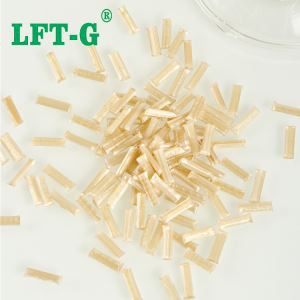
- The LCF Network: LFRT technology uses a pultrusion process that coats continuous carbon rovings in PA66 resin before cutting them into 12mm pellets. During low-shear injection molding, these long fibers bend and intertwine, forming an inseparable 3D skeleton. When a crack attempts to propagate, it hits this entangled network and is stopped. The energy must physically pull the long fibers out of the matrix (fiber pull-out), which absorbs massive amounts of energy and prevents shattering.
Performance Data Showdown: Modulus, Fatigue, and Impact
Let us compare the hard data for standard 30% weight fraction carbon fiber in a PA66 matrix.
| Engineering Metric (30% CF loading) | Unreinforced PA66 | SCF-PA66 (Short Fiber) | LCF-PA66 (Long Fiber) |
|---|---|---|---|
| Tensile Modulus (GPa) | ~ 3.2 | ~ 22.0 | ~ 26.0 (+18%) |
| Notched Impact Strength (kJ/m²) | ~ 5.0 | ~ 10.0 (Highly Brittle) | ~ 25.0 (+150% leap) |
| Fatigue Endurance | Poor | Moderate | Excellent |
| Dimensional Stability (Creep) | Poor | Good | Exceptional (Metal-like) |
When to Upgrade to LCF-PA66
If your current application using SCF-PA66 or die-cast aluminum is experiencing warranty claims due to cracking around bolt holes, fatigue failures from high-frequency motor vibration, or shattering from cold-weather impacts, you must upgrade to LCF-PA66.
Ideal Applications for LCF-PA66
- Aerospace & Drones: UAV skeletal frames that require absolute minimum weight but must survive hard landings without fracturing.
- Extreme Sports Equipment: High-end bicycle derailleurs and ski bindings subjected to massive torsional loads in sub-zero temperatures.
- Industrial Robotics: Robotic end-of-arm tooling (EOAT) where stiffness guarantees precision, but impact resistance is needed for accidental collisions.