Long Fiberglass vs. Long Carbon Fiber: How to choose the right reinforcement fiber?
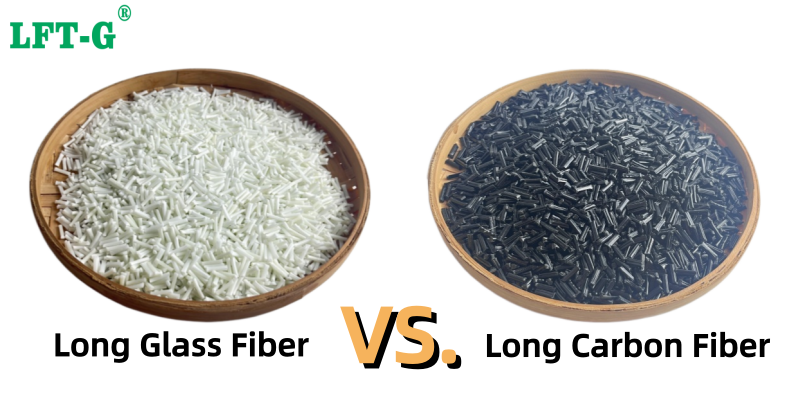
Long Glass Fiber (LGF) and Long Carbon Fiber (LCF) composites are engineered structural solutions, not just reinforcement fillers. Both use a continuous long-fiber architecture to create a 3D load-bearing network within the polymer matrix, delivering superior creep resistance, impact toughness, and dimensional stability compared with short-fiber alternatives.
But their material differences define clear performance boundaries: LGF balances high rigidity with cost efficiency for high-volume production; LCF delivers unmatched specific strength and ultra-lightweight performance for mission-critical applications.
This guide covers core material composition, quantifies key mechanical property differences, and maps out when to use long glass fiber vs long carbon fiber across automotive, aerospace, industrial, and consumer engineering scenarios.
What are Long Glass Fiber (LGF) & Long Carbon Fiber (LCF)?

🧊 Long Glass Fiber (LGF)
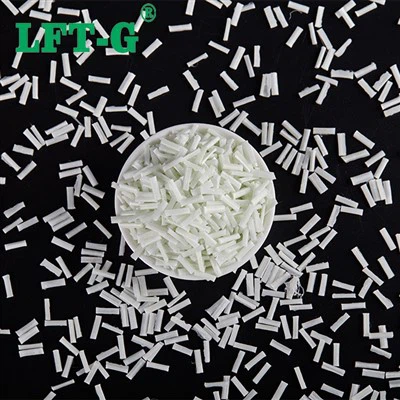
Long Glass Fiber (LGF) is a composite reinforcement where continuous glass filaments are fully impregnated into thermoplastic matrices such as PP or PA.
Unlike short glass fibers (0.2–0.4 mm), LGF forms a 3D reinforcing network inside molded parts, delivering superior impact strength and creep resistance.
During gentle injection molding, the long-fiber architecture is preserved, creating a continuous skeletal structure that improves load transfer, dimensional stability, and low warpage. This makes LGF an economical, high-performance solution for structural parts requiring balanced rigidity and toughness.
⚫ Long Carbon Fiber (LCF)
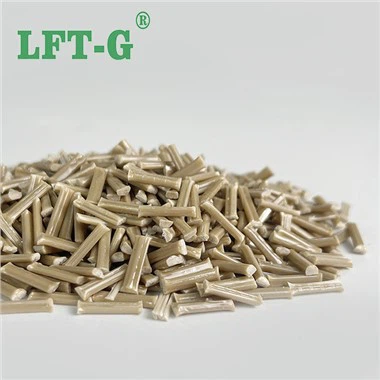
Long Carbon Fiber (LCF) is a high-performance reinforcement produced from polyacrylonitrile (PAN) precursors via stabilization and carbonization.
It forms an electrically conductive, ultra-rigid scaffolding with exceptional tensile strength and stiffness at a density below 1.8 g/cm³. Its anisotropic layered structure, combined with a long‑fiber skeleton, delivers a metal‑like flexural modulus and outstanding fatigue resistance.
Carbon fibers also exhibit a negative coefficient of thermal expansion, ensuring dimensional stability under extreme thermal cycling. This makes LCF the premium choice for lightweighting applications where every gram matters.
Performance Comparison
LFT-G® LGF vs LCF Core Advantages Comparison
Long Glass Fiber (LGF)
■ Cost-Effectiveness (40%)
■ Stiffness-to-Cost Ratio (30%)
■ Impact Resistance (20%)
■ Dimensional Stability (10%)
Long Carbon Fiber (LCF)
■ Specific Stiffness & Modulus (35%)
■ Fatigue Durability (30%)
■ Thermal Stability (20%)
■ Electrical Conductivity (15%)
Note: Percentages indicate the relative influence of each advantage in typical engineering material selection.
When evaluating long glass fiber versus long carbon fiber for an injection molded part, the choice largely depends on which performance attributes matter most for your application.
Long Glass Fiber is defined by its cost-effectiveness, favorable stiffness-to-cost ratio, good impact resistance, and reliable dimensional stability. These qualities make it a practical choice for high-volume structural components.
Long Carbon Fiber, in contrast, delivers superior specific stiffness and modulus, exceptional fatigue durability, excellent thermal stability, and inherent electrical conductivity. These attributes make LCF suitable for lightweight, high-performance, or electrically functional designs. Use this comparison as a starting point to match material strengths with your project requirements.
Cost‑benefit analysis
🧊LGF (Long Glass Fiber) Value performer
⚫LCF (Long Carbon Fiber) Premium performance
Fatigue & Impact Durability
💡This cost-benefit analysis of glass fiber vs carbon fiber thermoplastic makes it clear: long glass fiber is the ideal value performer for high-volume structural parts, while long carbon fiber stands out as the premium choice for projects requiring unmatched fatigue and impact durability.
Application Scenarios
📦 LGF (Long Glass Fiber)
✔ Cost-driven, high-volume production, good chemical resistance
✈️ LCF (Long Carbon Fiber)
- → Aerospace brackets, drone arms & structural ribs
- → High-performance automotive & racing components
- → Advanced robotics arms & precision machinery parts
- → Sports equipment
- → Medical imaging equipment & lightweight exoskeletons
- → ESD/EMI shielding housings for electronics
🚀 Lightweight, ultra‑high modulus, premium dynamic performance
Material Selection Compass
Choose LGF when:
- High stiffness is needed, but the budget is limited
- Large series production (automotive, white goods)
- Good dimensional stability and low warpage are required
- No electrical conductivity required
Choose LCF when:
- Maximum specific stiffness & strength/weight reduction
- High-end sectors: aerospace, motorsport, premium drones
- Conductive properties (ESD / EMI shielding) needed
- Higher thermal stability and fatigue resistance are essential
Pure insight: Long glass fiber remains the workhorse for cost‑efficient metal replacement, while long carbon fiber unlocks extreme lightweighting and structural performance - choose based on performance targets and budget.
More Than Materials – Engineering Support for Your Material Decisions
Unsure which long‑fiber reinforcement fits?
Collaborate for uncompromised performance.
Get in Touch with Our Engineers
|