
Long Fiber Thermoplastics and Total Cost of Ownership: A Guide to Material Selection
When selecting materials for an industrial component, comparing price per kilogram is a useful starting point. However, the purchase price of raw materials represents only one part of the overall manufacturing cost. Long fiber reinforced thermoplastics (LFT) may have a higher initial material cost than some conventional plastics, but their overall value depends on the application, component design, and production requirements.
The key distinction is that material price per kilogram is not the same as the cost of a finished component. A meaningful comparison should consider the complete manufacturing process, including tooling, processing, secondary operations, assembly, material utilization, and application-specific performance requirements.
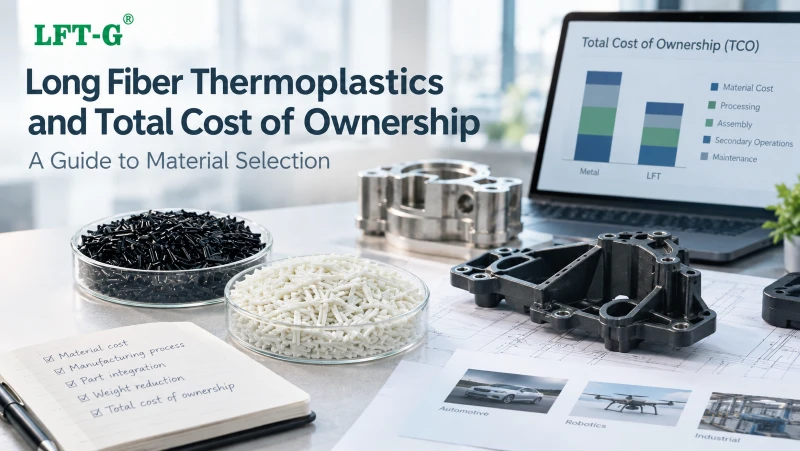
Manufacturing Cost: Evaluating the Complete Process
Depending on the design, metal components may require casting, machining, drilling, welding, surface treatment, or multiple assembly operations. Each additional step can add labor, equipment, energy, and quality-control costs. However, the actual process and cost structure vary by component and manufacturing method.
Injection molding with long fiber-reinforced thermoplastics can integrate multiple design features into a single component. Ribs, mounting bosses, and other functional geometries can often be incorporated directly into the mold, potentially reducing the need for separate components or additional machining. Cycle time and the extent of post-processing depend on the part, material, tooling, and production conditions.
For suitable applications, design integration can simplify production and reduce secondary operations or assembly requirements. Whether this offsets the material and tooling costs should be assessed using the target component design, production volume, and quality requirements.
| Cost Factor | Machined Metal | LFT Injection Molding |
|---|---|---|
| Primary Shaping | Casting, CNC machining | Single-step molding |
| Secondary Operations | May include machining, joining, or coating | May be reduced, depending on design |
| Assembly | Multiple parts joined | Integrated design |
| Labor Intensity | High | Low |
Weight Reduction and Structural Performance
Weight reduction can be an important design objective in automotive components, drones, robotics, and other applications where mass affects energy use or handling. Its commercial value depends on the component's function and the finished product's operating conditions.
Long fiber reinforced thermoplastics combine a thermoplastic matrix with reinforcing glass fibers to provide improved mechanical performance compared with the corresponding unreinforced polymer. Depending on the resin system, fiber content, component geometry, and design requirements, LFT may offer opportunities to reduce component weight compared with selected metal alternatives. Any weight advantage should be evaluated at the component level, accounting for wall thickness, load conditions, structural geometry, and safety factors.

Design consideration: Evaluate weight reduction alongside structural performance, durability, and the finished product's operating requirements.
Material Waste and Regrind Management
Machining metal components can generate chips and offcuts, while injection molding may produce runners, sprues, and rejected parts, depending on the process and mold design. The amount and cost of waste vary with production setup, material, part geometry, and scrap recovery practices.
Some thermoplastic molding waste can be collected and reprocessed under controlled conditions. For long fiber reinforced thermoplastics, repeated processing may shorten the reinforcing fibers and affect mechanical properties. Regrind use should therefore be evaluated and validated against the material specification and finished-part requirements.
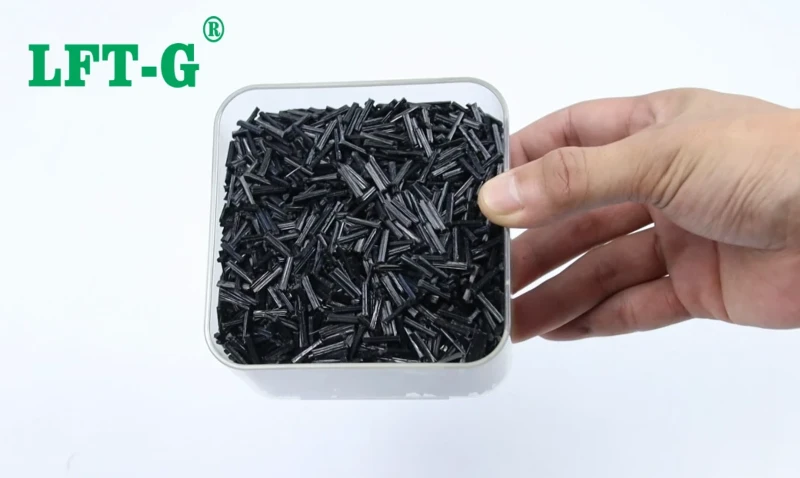
Design Integration and Part Consolidation
Some assemblies contain multiple metal or plastic parts joined by fasteners, welding, or other methods. Where design and performance requirements permit, long fiber-reinforced thermoplastics can enable several functions to be integrated into one molded component. Feasibility depends on load paths, fiber orientation, weld lines, dimensional stability, moldability, and service conditions.
Part consolidation may reduce the number of components, fasteners, assembly steps, and inventory items. Tooling investment, validation, production volume, and quality requirements should also be included when assessing the overall cost impact.
Evaluating Total Cost of Ownership (TCO)
A meaningful material comparison considers the complete cost of producing and using a component. For LFT, this may include material consumption, tooling, processing, secondary operations, assembly, scrap management, product performance, maintenance, and other application-specific lifecycle costs. Not every factor applies to every project, so comparisons should use equivalent component functions and service conditions.
LFT-G supplies long fiber reinforced thermoplastics for applications requiring a combination of mechanical performance, structural integrity, and weight optimization. Selecting a suitable grade requires consideration of resin type, fiber content, component geometry, processing conditions, and end-use requirements. For appropriate designs, LFT may offer opportunities to simplify manufacturing and improve overall component value.
Key takeaway: The most cost-effective material is the one that meets the component's technical requirements while delivering the best overall value across manufacturing and service life. Long fiber reinforced thermoplastics may be a strong option when their performance and design advantages align with the application.
Contact Us For The Latest Pricing
Xiamen LFT Composite Plastic Co., Ltd. specializes in long fiber reinforced thermoplastics, including LFT-PP, LFT-PA, LFT-PPS, and LFT-Elastomers. We support customers across a range of industrial applications with material solutions designed to meet specific performance and processing requirements.