
Creep Resistance in LFT vs. Short‑Fiber Compounds: Why Long Fiber Reinforcement Matters
When engineers design structural components, the question is rarely "Will this part withstand today's load?" The real question is: "Will this part withstand the same load five years from now - without loosening, leaking, or failing?"
This is the domain of creep - the slow, time‑dependent deformation of a material under sustained stress. It is one of the most critical long‑term reliability metrics for any plastic component, yet it is often overlooked in initial material selection. And it is precisely here that LFT (long fiber thermoplastics) demonstrate their most profound advantage over short‑fiber compounds.
What Is Creep - and Why Does It Matter?
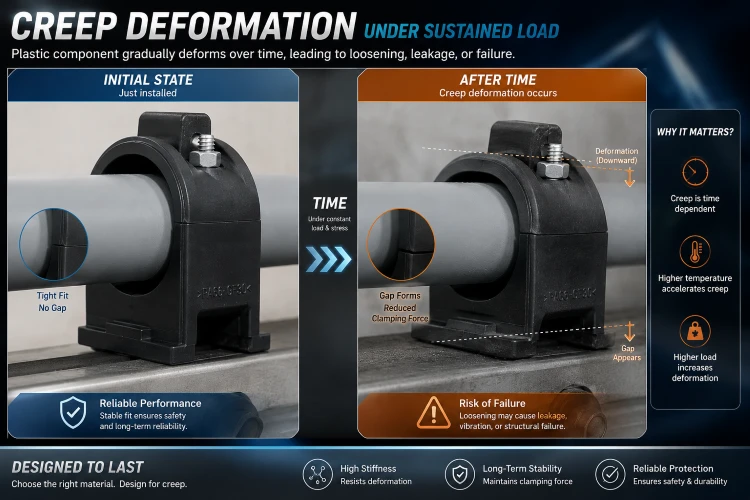
Creep is the time‑dependent, permanent deformation that occurs when a thermoplastic is subjected to a constant load over an extended period. Unlike elastic deformation, which recovers when the load is removed, creep is irreversible.
For structural components, creep manifests in ways that are often subtle at first but become catastrophic over time:
- Fastener loosening - bolts and clips lose preload as the surrounding plastic deforms
- Leakage paths - seals and gaskets lose compression, allowing fluid or gas to escape
- Dimensional drift - critical clearances close, causing interference or binding
- Structural failure - accumulated creep strain eventually exceeds the material's failure limit
Creep resistance is therefore not optional for components that must maintain their function over years of service - from under‑hood automotive brackets to pipe fittings, from industrial machinery to consumer products.

Why Short‑Fiber Compounds Struggle with Creep
Short‑glass‑fiber compounds - where fibers are chopped to less than 1mm during compounding - have served the industry for decades. They improve stiffness over unfilled resin at a reasonable cost. But under sustained load, their limitations become apparent.
In short‑fiber compounds, the tiny fibers disperse individually through the part. They provide localized reinforcement, but they do not form a continuous load‑bearing network. When the polymer matrix creeps under sustained stress, the short fibers offer limited resistance. The polymer between the fibers continues to move, and the fibers themselves are easily pulled out of the matrix.
Research has shown that fiber lengths below 1000 µm promote a planar arrangement of fibers, which enhances chain relaxation, fiber orientation, and creep strain. In other words, short fibers enable creep rather than resisting it.
The short‑fiber problem: The creep strength of short fiber‑reinforced thermoplastics is greatly affected by the nature of the stress transfer, which in turn is influenced by the critical fiber length and temperature. When the matrix creeps, the short fibers simply cannot keep up.
Why LFT Excels: The Three‑Dimensional Fiber Network
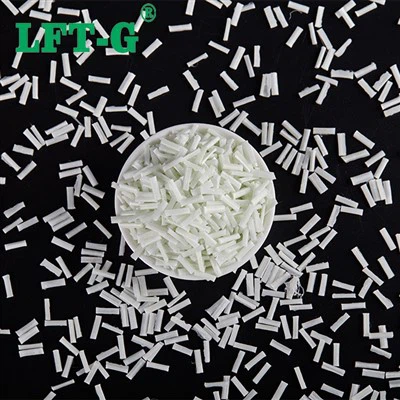
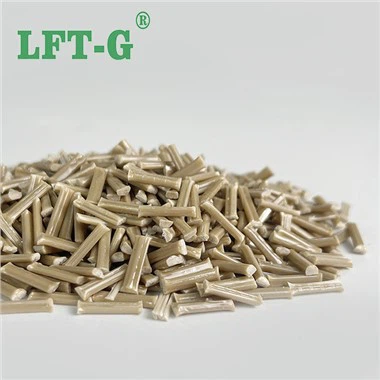
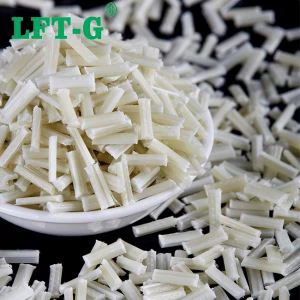
LFT materials are fundamentally different. Through a proprietary pultrusion compounding process, continuous fiber rovings are melt‑impregnated and then cut into pellets where fiber length equals pellet length - typically 10–12mm.
During injection molding, these long fibers overlap and entangle, forming a three‑dimensional skeletal network - like a steel cage inside concrete. This network:
- Distributes loads across a far larger volume than short fibers can
- Acts as a dimensional cage, dramatically reducing creep strain
- Resists crack propagation - long fibers bridge micro‑cracks before they can grow
- Maintains integrity at elevated temperatures, where short fibers lose effectiveness
The mechanism is well‑documented in the literature: continuous long fibers are more efficient than short fibers in reinforcing thermoplastic matrices, resulting in enhanced load‑bearing ability at elevated temperatures.

The Data: Quantifying the Creep Advantage
The performance gap is not theoretical - it is measurable and significant.

Longer fibers dramatically improve creep resistance. PA66 with 40% long fiber outperformed unfilled PA66 by 50% at room temperature and 35% even at 90°C. Higher fiber content delivers better creep resistance - PA66 with 40% LGF beat 10% LGF by 45%. Most tellingly, PP with 40% long fiber outperformed both PP with 40% short fiber and even PA66 with 30% short fiber in 1000‑hour tests.
The chart tells a consistent story: longer fibers reduce creep, and higher fiber content further improves creep resistance. The effect is not marginal - it is transformative.
The takeaway: Creep resistance of long-fiber composites is fundamentally higher than that of short-fiber composites due to greater load transfer from the resin to the fibers. This is not a small improvement - it is a different class of material behavior.
The Mechanism: Why Long Fibers Resist Creep
The superior creep resistance of LFT can be traced to three interconnected mechanisms:
1. Load Transfer and Load Partitioning
In LFT, the long fiber network takes on a significant portion of the sustained load, reducing the stress on the polymer matrix itself. This "load partitioning" means the matrix creeps less because it is carrying less of the load. The fibers assist in load transfer, especially at temperatures close to the polymer's melting point.
2. Reduced Chain Mobility
The three‑dimensional fiber network physically limits the mobility of polymer chains. Creep occurs when polymer chains slide past each other under stress. The LFT network creates physical barriers that restrict this sliding, effectively "locking" the matrix in place.
3. Sustained Performance at Elevated Temperatures
Perhaps most importantly, LFT maintains its creep resistance at temperatures where short‑fiber compounds fail. Fiber reinforcements are effective in reducing creep strain rate, as they help sustain higher creep resistance at elevated temperatures over the corresponding neat matrix. This is why LFT compounds are the preferred choice for under‑hood automotive applications, pipe fittings, and other high‑temperature structural components.
The Real‑World Impact: From Design to Service Life

For design engineers, the creep advantage of LFT translates directly into better designs, longer service life, and lower warranty risk.
- Pipe and fitting applications - LFT‑based pipes maintain seal integrity over decades of service, where short‑fiber pipes would creep and leak
- Automotive brackets and mounts - fasteners stay tight, components stay in position, and assemblies remain functional for the life of the vehicle
- Industrial equipment - moving parts maintain clearances, bearings remain aligned, and maintenance intervals are extended
- Consumer products - hinges stay tight, enclosures keep their shape, and products feel "solid" for years
In each of these applications, the difference between LFT and short‑fiber compounds is not a matter of degree - it is a matter of whether the part works at all over its intended lifetime.
Creep Resistance Is the LFT Difference
Short‑fiber compounds offer cost‑effective stiffness. LFT offers structural reliability over time.
The difference is not in the data sheet's "tensile strength" column - it is in the long‑term performance that engineers actually care about. When a component must maintain its function for years under sustained load, the choice between short‑fiber and LFT is not a choice at all. It is a decision between creep and confidence.
LFT‑G® has been engineering long‑fiber thermoplastics for over 20 years - delivering the creep resistance, dimensional stability, and long‑term reliability that structural applications demand.

Contact the LFT-G® technical team
Xiamen LFT Composite Plastic Co., Ltd is a global supplier of long fiber reinforced thermoplastics with 20+ years of innovation. We specialize in LFT‑PP, LFT‑PA, LFT‑PPS, and LFT‑Elastomers – offering high‑strength, lightweight alternatives to metal for automotive, aerospace, and industrial applications.