
Why Weld Line Control Is the Key to Reliable LFT Structural Parts
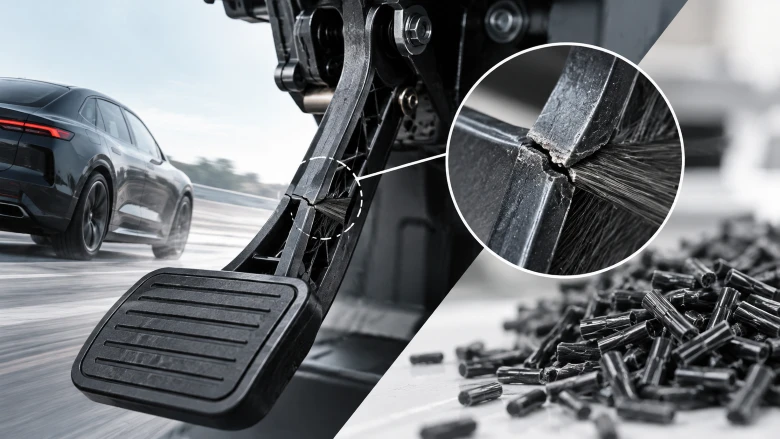
A recent emergency braking test on a luxury electric vehicle has generated widespread discussion after a brake pedal bracket fractured during high-speed stops. The failure occurred at a weld line-a region where two melt fronts meet inside the mold and where fiber reinforcement behaves differently than in the bulk material.
For engineers working with fiber-reinforced plastics, this event is a valuable reminder: weld lines are not a reason to avoid long fiber thermoplastics. They are a design variable you must understand and control. When managed correctly, LFT materials deliver exceptional structural performance - even in safety-critical applications.
Understanding Weld Lines: A Known Phenomenon
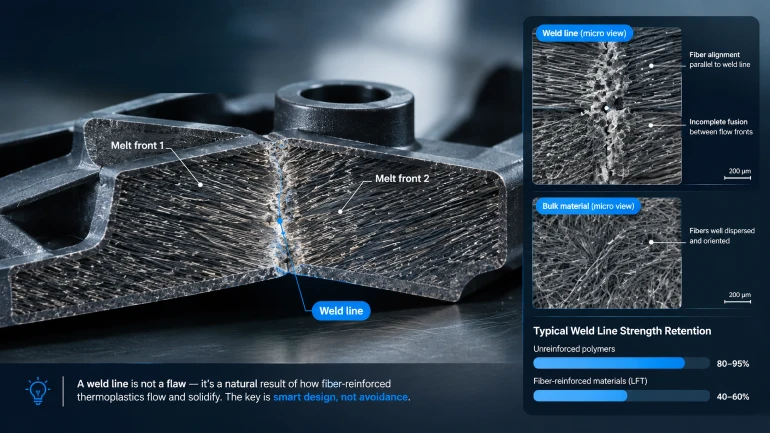
A weld line forms when molten plastic is split into multiple flow fronts inside the mold cavity - typically when the melt encounters an insert, a hole, a rib, or a change in wall thickness. When the separated fronts meet, they may not fully fuse, creating a three-dimensional region with different mechanical properties than the surrounding material.
This phenomenon is well understood in the composites industry. For unreinforced polymers, weld-line strength retention is typically 80–95% of bulk strength. For fiber-reinforced materials, the retention is lower - because long fibers cannot easily flex across the weld line and tend to align parallel to it. Tensile strength at a weld line can be 40–60% of the base material's strength.
This is not a flaw unique to any material. It is a fundamental characteristic of how fiber-reinforced thermoplastics flow and solidify. The key is not to avoid LFT materials - but to design parts and molds so that weld lines do not fall in critical stress zones.
The LFT-G® perspective: A weld line is not a reason to question the material. It is a signal that the mold design needs engineering attention. With the right approach, LFT parts can deliver the strength, durability, and reliability that structural applications demand.
Why LFT Materials Are Still the Right Choice for Structural Parts
It is important to keep the weld-line discussion in context. Long fiber thermoplastics offer a combination of properties that few other materials can match - and these advantages remain valid when weld lines are properly managed.
| Property | LFT-G® Advantage |
|---|---|
| Weight reduction | 30–50% lighter than aluminum, with comparable strength |
| Impact resistance | Up to 4× higher than short-fiber compounds |
| Creep resistance | Long fiber network restricts chain mobility under sustained load |
| Fatigue life | 10⁷ cycles at 70 MPa - comparable to metal |
| Design freedom | Complex, integrated geometries in a single molding step |
| Recyclability | Thermoplastic - remeltable and reprocessable |
These advantages are why LFT materials are increasingly specified for structural components in automotive, industrial, medical, and consumer applications. The weld-line challenge does not diminish these benefits - it simply requires that engineers apply the same discipline to mold design that they already apply to material selection.
How LFT-G® Helps Customers Manage Weld Lines
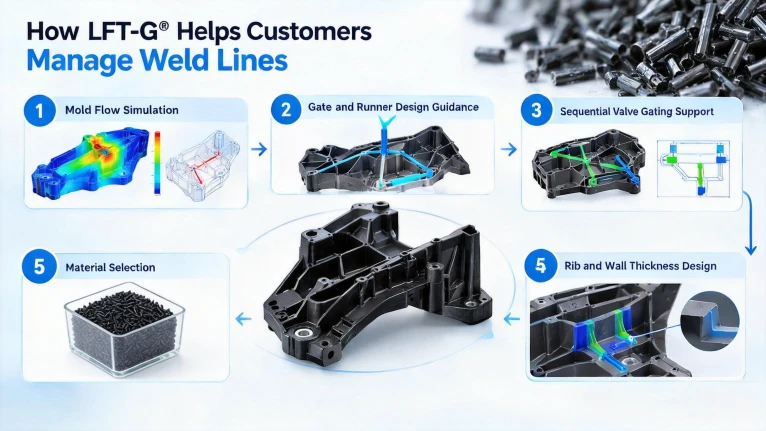
Weld-line control is one of the core areas where LFT-G® provides engineering support to customers. Our approach is proactive: we work with customers during the design phase to ensure that weld lines are identified, managed, and moved away from critical stress zones before tooling is cut.
-
Mold flow simulation
- We help customers predict weld-line locations and overlay them with stress analysis results, so that weld lines do not fall in high-load regions or near bolt holes.
-
Gate and runner design guidance
- Optimizing gate location and flow paths to minimize the formation of structural weld lines.
-
Sequential valve gating support
- For complex parts, we help evaluate whether sequential gating can eliminate weld lines from critical regions.
-
Rib and wall thickness design
- Balancing structural reinforcement with flow behavior to avoid forcing melt fronts to converge in load-bearing zones.
-
Material selection
- Matching fiber length, resin system, and reinforcement content to the specific structural demands of each application.
-
The LFT-G® difference: We do not just supply material. We work with customers from concept through production to ensure that the final part delivers the performance the application requires - including at weld lines.
Design Principles for Weld-Line-Safe LFT Parts
For engineers designing LFT structural components, the following principles help ensure that weld lines do not become the weakest link:
- Simulate before you cut steel. Mold flow analysis should be standard practice for every structural LFT part. It is far less expensive than re-tooling after a failure.
- Know where your weld lines are. Overlay predicted weld lines with stress analysis. If they coincide with high-stress regions, change the gate location or flow path.
- Design for redundancy. Safety-critical components should have multiple load paths, so that no single weld-line region is solely responsible for carrying the load.
- Test real parts, not just coupons. Validate the molded component under the load directions and conditions it will see in service.
- Partner with your material supplier. LFT-G® provides the engineering support needed to get weld-line management right the first time.
LFT-G® Is Ready for Structural Applications
The brake pedal failure is a reminder that fiber-reinforced plastics demand engineering discipline. But it is not a reason to avoid LFT materials. On the contrary - it is a validation of the approach that LFT-G® has championed for over 20 years: understand the material, design for its behavior, and manage the variables that affect performance.
Weld lines are one of those variables. Managed correctly, they are not a limitation - they are simply another design consideration that LFT-G® helps customers address.
If you are developing LFT structural parts and want to ensure your design accounts for weld-line behavior, contact our engineering team. We will help you get it right from the start.
Long fiber thermoplastics deliver exceptional structural performance - when the part and mold are designed with the material's behavior in mind. Weld-line control is not a weakness of LFT. It is a design capability that LFT-G® brings to every customer project.
Contact LFT-G® engineering team
Xiamen LFT Composite Plastic Co., Ltd is a global supplier of long fiber reinforced thermoplastics with 20+ years of innovation. We specialize in LFT-PP, LFT-PA, LFT-PPS, and LFT-Elastomers – offering high-strength, lightweight alternatives to metal for automotive, aerospace, medical, and industrial applications.