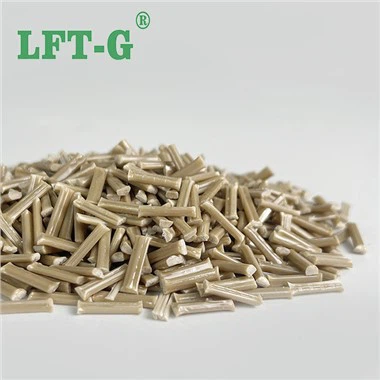


Long Glass Fiber PPS Engineering Plastic
GF PPS composite, or glass fiber reinforced polyphenylene sulfide, is a high-performance engineering plastic that combines PPS with glass fibers to enhance its already excellent properties. Glass fibers are also divided into two types: short fibers and long fibers. Long fibers can withstand greater impact and are generally used in components that require high quality. Let's explore the advantages of long glass fiber PPS materials. This composite material boasts high mechanical strength, stiffness, dimensional stability, and wear resistance, alongside superb chemical and heat resistance, making it ideal for demanding applications in the automotive, chemical, and electrical industries.
Glass fiber reinforcement improves on the already exquisite properties of PPS pellet. The most common reinforcement percentage is 40%, but grades are available with percentages ranging from about 20% to 60%.

High Mechanical Properties:
The addition of glass fibers significantly increases the material's stiffness, strength, and creep resistance, allowing it to withstand high static loads and temperatures for extended periods.
What is LGF PPS Material Good For?
Excellent Chemical Resistance:
Long glass fiber reinforced polyphenylene sulfide (LGF PPS) plastic pellet can resist virtually all chemical contact up to high temperatures, making it suitable for use in corrosive environments.
High Temperature Resistance:
It offers exceptional continuous service temperatures, with some grades performing well up to approximately 240 °C.
Superior Dimensional Stability:
The reinforcement from the glass fibers improves its dimensional stability, preventing warping and shrinking even under high stress and heat.
Good Wear Resistance and Hardness:
Glass fibers enhance the material's hardness and resistance to wear, an important factor for moving parts.
What is GF PPS Used For?
Due to its combination of high performance and durability, GF PPS composite is used in:
Automotive parts: Components for electric water and oil pumps, exhaust gas recirculation valves, and motor insulators.
Industrial Machinery: Parts for pumps, valves, gears, and other precision components requiring high strength and chemical resistance.
Electrical and Electronics components: High-voltage components, motor insulation parts, sockets, and connectors.
Chemical Processing: Corrosion resistance parts for handling acids and alkalis, such as valve pipes and fittings.
Although LGF PPS material has outstanding performance, it still encounters some challenges in practical applications. Engineers need to take these into account when designing and manufacturing.
Challenges of Injection Molding Process: Long fibers are prone to being sheared during the injection molding process, resulting in a weakened reinforcing effect. Therefore, special design of the injection molding machine screw and process parameters are required to maintain the fiber length to the greatest extent.
Surface finish: Due to the longer fibers, the surface of LGF PPS polymer products may exhibit "fiber exposure", which can affect the appearance. For components with high requirements for surface quality, subsequent painting or surface treatment may be necessary.
Design optimization: To fully utilize the performance of LGF PPS compound resin, the product design needs to take into account the flow and orientation of the fibers. Usually, it is necessary to predict the arrangement of the fibers within the mold to optimize the structural strength.
LGF VS. SGF
Fiber length and interlocking effect: SGF (typically with a length less than 1 mm) will be cut into smaller fragments during the injection molding process, mainly providing micro reinforcement. While LGF (typically with a length of more than 5 mm) can maintain its original length and form a three-dimensional, "skeletal" interlocking network structure within the polymer matrix.
Performance improvement path: SGF mainly enhances stiffness by increasing the volume modulus of the material. In contrast, LGF transmits stress through its unique network structure, significantly enhancing the material's impact toughness and fatigue strength, which is something SGF cannot achieve.
FAQ
Q: What is GF PPS composite? How is it different from pure PPS?
A: LGF PPS material is a glass fiber reinforced polyphenylene sulfide. It enhances the material properties by adding glass fibers to the PPS resin. Compared to pure PPS, LGF PPS plastic pellet significantly improves mechanical strength, stiffness and dimensional stability, making it more suitable for use as structural components.
Q: Why does GF PPS have excellent high-temperature resistance properties?
A: The high thermal stability of GF PPS material is attributed to its molecular structure and the reinforcing effect of glass fibers. The melting point of PPS polymer is relatively high, and the glass fibers can effectively prevent the material from deforming at high temperatures, enabling it to maintain splendid mechanical properties even under continuous high-temperature usage conditions.
Q: How is the chemical corrosion resistance of GF PPS plastic pellet?
A: GF PPS compound resin exhibits exceptional resistance to chemical corrosion. It shows high inertness towards a variety of chemical substances (including acids, bases, and solvents), and is therefore widely used in various corrosion-resistant components.
The LGF PPS material of LFT-G® comes in various contents and has diverse types. If you also want to know more about these details, please contact us to discuss together. Click below,
Hot Tags: gf pps engineering plastic, China, manufacturers, suppliers, factory, buy, customized