


Long Glass Fiber Polyphenylene Sulfide Composite
What is the full form of PPS fiber? Polyphenylene Sulfide. PPS fiber is a high-performance fiber that offers superb heat resistance, chemical resistance, hydrolysis resistance, flame retardant, and so on. It has a melting point of 285 degrees, and can withstand continuous use at 190 degrees.
What are long fiber composite materials? Long fiber composites are a type of composite material that utilizes long, continuous fibers as reinforcements. These fibers can be made of a variety of materials, including glass fiber, carbon fiber. The long fibers are typically embedded in a matrix material, which can be a thermoplastic material.
Therefore, long glass fiber PPS is a high-performance thermoplastic composite material that combines the excellent properties of PPS resin with the reinforcing effect of long glass fibers. What is the difference between long fiber PPS and short fiber PPS composite? Compared with short glass fiber reinforced PPS, it has higher mechanical properties, impact resistance and fatigue resistance, and is widely used in the automotive, electronic, aerospace and other fields.
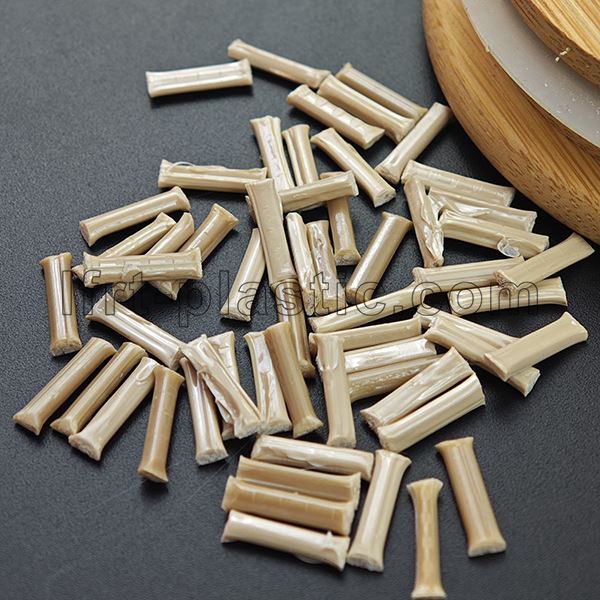
Why is Long Glass Fiber PPS Material better?
Ultra-high mechanical strength
Tensile strength: Higher than short glass fiber PPS, greater than 180mpa.
Flexural modulus: Up to 11,000 MPA (close to metallic aluminum, but lighter).
Creep resistance: The long-fiber network structure effectively resists deformation under long-term loads.
Outstanding impact resistance
Notched impact strength: Higher than short-fiber PPS (over 45KJ/m ²).
Fatigue resistance: Long fibers can effectively prevent crack propagation and extend the service life of parts.
Lightweight
Its density is only 1.5-1.8 g/cm³, which is lighter than that of aluminum alloy.
It is applicable to weight reduction demand fields such as automobiles and aerospace.

Excellent high-temperature resistance
Long-term operating temperature: 200-240°C (short-term up to 260°C).
Heat distortion temperature (HDT) : >260°C (under a load of 1.82MPa).
Maintaining strength at high temperatures: It can still retain a certain room-temperature strength at 200°C.
Excellent chemical resistance
It is resistant to acids, alkalis, fuel oil, engine oil, and organic solvents (such as ethanol and acetone), and has excellent stability within the range.
Low warpage & high dimensional stability
Long fibers are distributed more evenly, reducing injection molding shrinkage and deformation.
It has a low water absorption rate and is almost unaffected by humidity (suitable for precision parts).
Excellent flame retardant
UL94 V-0 flame retardant grade (can meet the standard at thin thicknesses).
Application Range of LGF PPS Plastic Pellet
Automotive Parts:
Engine periphery: turbocharger intake pipe, throttle body, cylinder head cover (high-temperature resistant, alternative to metal).
Transmission system: Gearbox bearing housing, clutch components (high rigidity, low creep).
New energy vehicles: Battery module housing, charging interface (insulation + resistance to electrolyte corrosion).
Industry Equipment:
Chemical pump impellers and valve liners (resistant to acid and alkali media).
Food machinery gears (conforming to certification standards).
Electronic Components:
5G/ communication equipment: Base station antenna covers (weather resistance + low dielectric loss), high-frequency connectors (low signal attenuation)
High-voltage electrical appliances: relay housing (arc resistance), circuit breaker components (flame-retardant V-0)
Motor/Electronics: Brushless motor end cover (insulation + temperature resistance), SMT surface mount components
FAQ
Q: Which is better, short fiber or long fiber composites?
A: Compared with short fibers, long fibers are easier to control in direction. As for short fibers, it is difficult to control their direction. Because short fibers are randomly oriented. Long fibers are arranged in an orderly manner, so the direction is better controlled.
Q: What are the advantages of fiber reinforced composites?
A: Fiber-reinforced polymer composite offers not only high strength to weight ratio, but also reveals exceptional properties such as high durability; stiffness; damping property; flexural strength; and resistance to corrosion, wear, impact, and fire.
Q: What is your lead time?
A: It depends on the order quantity and the season you place the order. Usually we can ship within 5–7 days for small quantity, large quantities of goods will ask you to agree on a time.
LFT-G® has already accumulated rich market experience in the production of long-fiber materials, and we are fully capable of providing you with even better assistance. If you are interested in this material and want to learn more about it, please contact our material experts, who can provide you with more relevant information.
LFT-PPS-NG04 Technical Data
LFT-G®PPS LGF40 NG04 material is a 40% long glass fiber reinforced polyphenylene sulfide(PPS) Composite polymer natural grade, developed for Injection molded applications. The glass fibers are chemically coupled to the PPS, resulting in high stiffness and strength. Added to the features is 94-V0 flame retardant Properties. General colors are natural and black, custom colors are also available.
Mechanical PropertiesProperty |
Value |
Unit |
Test Standard |
|---|---|---|---|
| Tensile Strength | 180-200 | MPA | ISO 527 |
| Tensile Modulus | 12500-13500 | MPA | ISO 527 |
| Elongation at Break | 1.0-3.0 | % | ISO 527 |
| Flexural Strength | 255-275 | MPA | ISO 178 |
| Flexural Modulus | 11000-12000 | MPA | ISO 178 |
| Notched Izod Impact Strength | 45-55 | kJ/m² |
ISO 180
|
| Notched Charpy Impact Strength | 40-50 | kJ/m² |
ISO 179
|
Other Properties
| Property | Value | Unit | Test Standard |
|---|---|---|---|
|
Molding Shrinkage
|
0.1-0.5 | % | ASTM D-955 |
| Melting Temperature | 300-350 | °C | |
|
Deflection Temperature (1.8 MPA) |
260-270 | °C |
ISO 75-2
|
| Mold temperature | 120-150 | °C |
Hot Tags: long fiber pps composite, China, manufacturers, suppliers, factory, buy, customized


