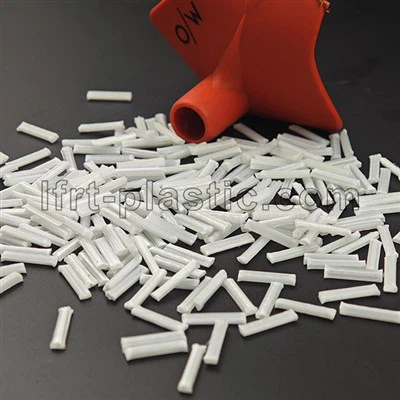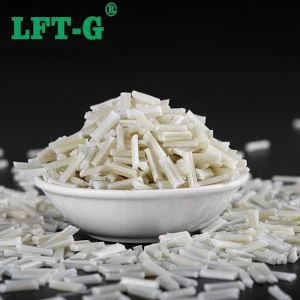

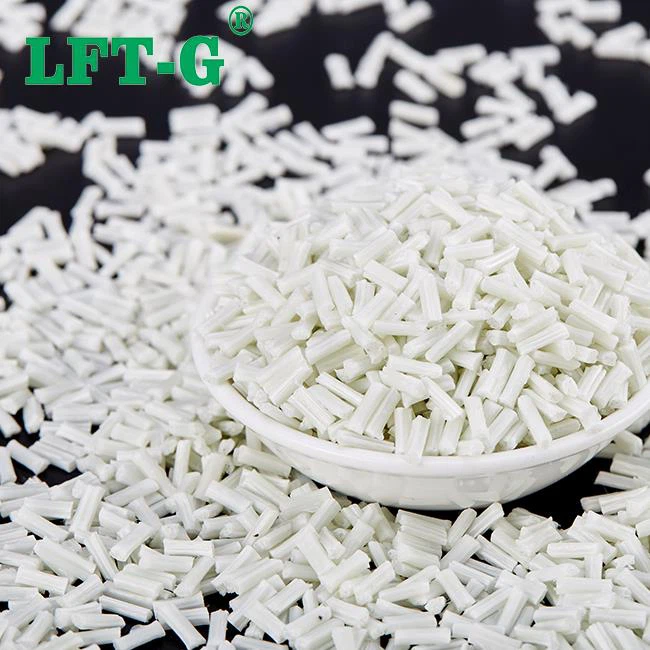
LGF40 PBT Plastic Pellet
LGF40 PBT is a high-performance engineering composite material that uses polybutylene terephthalate (PBT) as the base resin and is reinforced by a 40% long glass fiber (Long Glass Fiber, LGF) system.
Unlike short glass fiber reinforced PBT, the core feature of LGF40 PBT is not merely an increase in the "reinforcement ratio", but rather the continuous mechanical transmission network formed by the long fiber structure during the melt infiltration and molding process. This structure enables the material to exhibit significant improvements in mechanical properties, creep resistance, dimensional stability, and the ability to replace metals as structural components.
From the perspective of the engineering material system, LGF40 PBT is typically positioned as:
The design objective is not merely to "replace plastic", but to serve as an integrated material platform for both structure and function.
Medium and high-load structural components replacement materials
Metal weight reduction alternative solutions
Precise structural component materials requiring long-term dimensional stability
Structural plastics under dynamic load and thermal-mechanical coupling environments
Composition of LGF40 PBT
Matrix resin: The engineering basic characteristics of PBT
As a semi-crystalline thermoplastic polyester, PBT provides the following basic capabilities for the material:
High crystallization rate → Short injection cycle
Excellent dimensional stability → Strong consistency in shrinkage
Good chemical resistance → Resistant to oil, fuel oil, and various industrial media
Moderate heat resistance → Moderate heat deformation temperature
The advantage of PBT lies in the "balance between processability and stability", but its pure resin strength is limited, so the structural performance must be enhanced through an reinforcing system.

Enhanced System: 40% Long Glass Fiber Structure Logic
In the LGF40 system, the "40%" refers to the mass fraction. Its core value is not just the enhancement ratio, but rather:
Fiber Length Advantage
The long glass fibers retain a certain length after molding (much longer than short-cut fibers), resulting in:
Fiber bridging effect (crack bridging)
Enhanced continuity of stress transmission
Reduced local stress concentration
Three-dimensional orientation structure
During the injection molding process, the long fibers form:
The surface orientation layer (skin layer)
The intermediate randomly distributed layer
The core load-bearing framework layer
This structure is similar to a "natural composite beam", significantly enhancing the bending modulus.
Interface Integration System
The key performance of LGF40 PBT lies not only in the fibers themselves, but also in:
The interface coupling agent system (silane coupling agents)
The melt wettability of PBT
The control of fiber dispersion uniformity
The interface performance directly determines:
The retention rate of tensile strength
The stability of impact performance Fatigue life
LGF40 PBT: Key Performance
- High rigidity
- Creep resistance (small deformation under long-term load)
- Good fatigue resistance
- Heat resistance
- Good dimensional stability
- Chemical resistance
- Good environmental adaptability
Application industry


Automotive Industry
Headlamp Carrier Structure Frame
Front End Carrier Support Frame
Seat Structure Reinforcement
Air Conditioning System Shell and Support Frame
Auxiliary Support Structure for Battery Pack (Non-bearing Main Structure)
Appliance Structural Components Field
Washing machine structural support frame
Air conditioner outdoor unit structural components
Vacuum cleaner motor bracket
Electric Tools and Industrial Equipment
Motor housing support frame
Internal structure reinforcement framework
High-load gearbox housing (partial design)
FAQ
Q: Is LGF40 PBT suitable for high-temperature environments?
A: Suitable for medium-high temperature environments, but not suitable for long-term continuous operation under extremely high temperatures (>150°C).
Q: What is the main difference when compared to SGF PBT?
A: The core difference lies in the structural continuity brought about by the fiber length, which significantly enhances its rigidity and fatigue resistance.
Q: Is the surface quality of the material suitable for direct use as an exterior component?
A: LGF40 PBT is generally not suitable for direct use in high-requirement appearance components. Its surface may exhibit floating fibers or uneven textures. This is a typical characteristic of the long-fiber system. If the product also requires both structural performance and appearance quality, a secondary coating or surface treatment process is usually adopted to achieve functional separation.
Q: How is the material cost-effectiveness evaluated?
A: Although the unit price is higher than that of ordinary engineering plastics, by reducing the number of components as a whole and lowering the system costs caused by assembly and weight, it has a relatively high comprehensive cost performance in structural integration applications.
LGF40 PBT, as a long glass fiber reinforced engineering plastic, its core value does not lie in a single performance indicator, but rather in the fact that it has established a lightweight, highly rigid, and industrially scalable structural material platform.
In modern structural design, it is gradually becoming a key bridge material between metal structures and traditional short-fiber plastics. Click below,
Hot Tags: lgf40 pbt plastic pellet, China, manufacturers, suppliers, factory, buy, customized