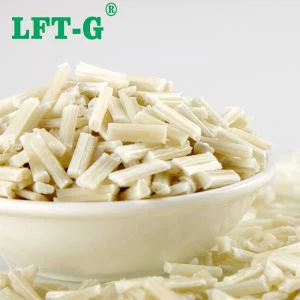


LGF PBT: Structural Thermoplastic Material
With the development trends of automotive electrification, industrial equipment integration, and high-power electrical systems, structural component materials are facing increasingly stringent comprehensive requirements. Traditional engineering plastics are gradually showing limitations in terms of strength, fatigue resistance, and long-term stability, while metal materials have obvious constraints in terms of weight, design freedom, and processing costs.
Against this backdrop, long glass fiber reinforced engineering plastics (LGF) have become an important direction for the upgrading of structural component materials.
LGF PBT is an engineering plastic composite material developed under this demand-driven context, which combines high mechanical performance, dimensional stability, and electrical reliability, and is suitable for key structural and functional components that require long-term service and safety and reliability.
The Significance of LGF PBT Material

LGF PBT compound resin is based on high-purity PBT (Polybutylene Terephthalate) resin. Through a dedicated process of long glass fiber impregnation and granulation, the glass fibers remain at a relatively high initial length within the material particles.
During the injection molding process, this structure can form a continuous and three-dimensional fiber-reinforced network inside the molded part, achieving the following at the material mechanism level:
More effective load transfer paths
Lower risk of stress concentration
Better resistance to fracture and fatigue
Compared with short glass fiber reinforced PBT, long glass fiber reinforced PBT not only maintains rigidity, but also significantly enhances toughness and structural safety redundancy. It is more suitable for load-bearing, connecting, and dynamically stressed components.
What are The Advantages of LGF PBT?
Structural strength and durability: In long-term stress, repeated vibration and impact conditions, LGF PBT plastic pellet can still maintain stable mechanical performance. The material has excellent fatigue resistance, which can effectively reduce the risk of performance degradation of structural components during their service life.
Dimensional stability and structural consistency: The PBT resin itself has the characteristic of low water absorption. After being reinforced with long glass fibers, the material can still maintain good dimensional stability in high-temperature and high-humidity environments, which helps to improve assembly accuracy and product consistency.
Thermal performance and environmental adaptability: LGF PBT material is capable of withstanding continuous heat loads and maintains stable performance in various industrial media. It is suitable for applications such as engine periphery, electric drive systems, electronic control modules, and internal structures of industrial equipment.:
Electrical performance reliability: The material has stable electrical insulation properties and can be used for a long time in complex electrical environments. It is suitable for use in electrical enclosures, power module supports, and high-reliability connection structures.
Design flexibility
LGF PBT is not only a high-performance material, but also a tool for optimizing structural design.
Compared to metal solutions, this material can achieve the following during the product design stage:
Integrated design of multi-functional structure
Synchronous molding of reinforcing ribs, installation positions and snap-in parts
Reduction of parts quantity and assembly processes
This highly integrated design capability gives LGF PBT significant advantages in terms of system-level cost control and product light weighting.
What is LGF PBT Used For?
LGF PBT is mainly targeted at application fields where there are clear requirements for structural reliability and service life, including:
Automobile structural supports, functional module enclosures
Components of the electric drive and electric control systems for new energy vehicles
Electrical equipment connection structure and supporting components
Internal framework and supporting components of industrial equipment
Engineering structural components that have been exposed to high temperatures, vibrations and loads for a long time
Comparison Between LGF PBT and Traditional Materials
VS SGF PBT:
Higher impact strength
Better fatigue performance
More suitable for load-bearing components
VS metal materials
It is lighter
It offers greater design flexibility
The overall manufacturing cost is lower
LGF PBT: Processing Adaptability
LGF PBT polymer is suitable for standard injection molding processes and can achieve stable mass production in mature industrial production systems.
While ensuring structural performance, the material exhibits excellent fluidity control and molding stability during the processing stage, making it suitable for the production of complex structures and medium-large components.
For customers who are seeking large-scale manufacturing, stable quality and controllable costs, LGF PBT compound resin is an engineering plastic solution that combines performance with manufacturing efficiency.
FAQ
Q: Why choose PBT reinforced with long glass fibers?
A: Compared with short glass fiber PBT, long glass fibers can form a more continuous internal reinforcing structure.
This makes LGF PBT more suitable for structural applications in terms of load-bearing capacity, impact resistance and fatigue resistance.
Q: How does LGF PBT compare with other LGF engineering plastics?
A: Compared with the LGF PA series materials, LGF PBT has advantages in terms of dimensional stability, electrical performance and moisture resistance; However, in applications that emphasize heat resistance, strength and structural safety, LGF PBT is a very balanced choice for engineering plastics.
Q: What advantages does using LGF PBT bring to product design?
A: LGF PBT plastic pellet supports integrated design of the structure. This helps reduce the number of components, enhance structural stability and improve assembly efficiency.
LGF PBT plastic granules, a long glass fiber reinforced engineering plastic, demonstrates balanced performance in mechanical strength, dimensional stability, heat resistance, electrical properties, and long-term reliability. It is one of the most competitive structural materials in the current engineering plastic system.
With the development trends of automotive light weighting, electrification, and high-integration of industrial equipment, the application potential of LGF PBT in structural component materials will continue to expand, becoming one of the important choices for metal substitution and the upgrade of high-performance engineering plastics.
Hot Tags: lgf pbt: structural thermoplastic, China, manufacturers, suppliers, factory, buy, customized