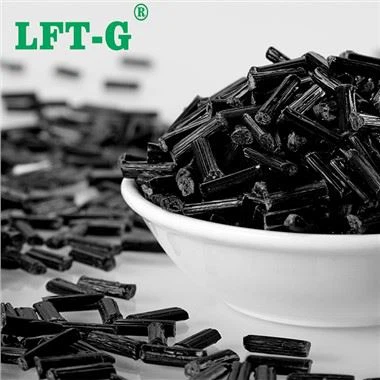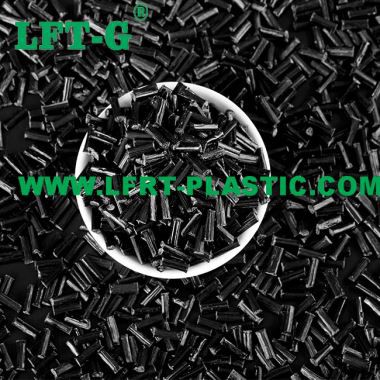


TPU LCF30 – 30% Long Carbon Fiber TPU
Description
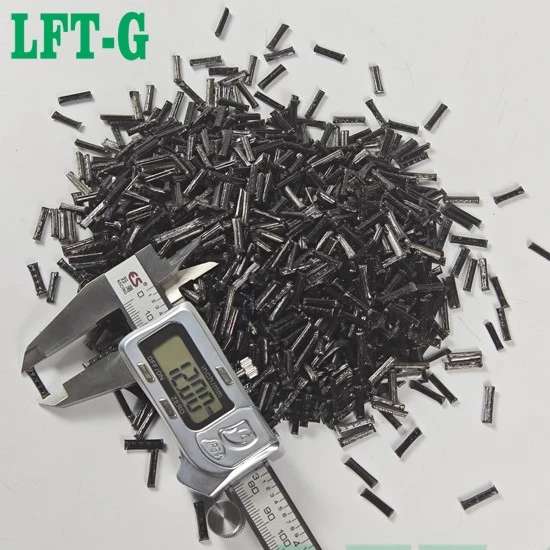 LFT-G® TPU LCF30 is a 30% long carbon fiber reinforced thermoplastic polyurethane (TPU) compound designed for demanding engineering applications. The continuous-fiber architecture delivers outstanding mechanical strength, thermal stability, and electrical conductivity - outperforming standard short-fiber compounds in load-bearing and ESD-sensitive environments.
Ideal for metal-replacement initiatives, TPU LCF30 combines the toughness and flexibility of TPU with the rigidity and conductivity of long carbon fibers, offering a unique balance of performance and processability.
Key Advantages
High Strength-to-Weight
Exceptional mechanical performance with low density, enabling lightweight structural components without compromising durability.
Thermal Stability
Maintains properties up to 135°C (HDT), with excellent heat resistance for under-hood and high-temp industrial applications.
Electrical Conductivity
Volume resistivity < 10³ Ω·cm provides reliable ESD protection, ideal for electronics and sensitive equipment.
Dimensional Precision
Low warpage, excellent mold replication, and consistent shrinkage ensure tight tolerances for complex injection-molded parts.
Performance Edge: Long Fiber vs. Short Fiber
TPU LCF30 (long carbon fiber) vs. TPU CF30 (short carbon fiber) - same 30% loading, dramatically different performance.

Technical Data Sheet
| Property | Value | Unit | Test Method |
|---|---|---|---|
| Density | 1.28 | g/cm³ | ISO 1183 |
| Tensile Strength | ~125 | MPa | ISO 527 |
| Tensile Modulus | ~8 200 | MPa | ISO 527 |
| Elongation at Break | ~3.2 | % | ISO 527 |
| Flexural Strength | ~185 | MPa | ISO 178 |
| Flexural Modulus | ~7 800 | MPa | ISO 178 |
| Charpy Impact (23°C) | ~48 | kJ/m² | ISO 179-1eU |
| Charpy Notched (23°C) | ~14 | kJ/m² | ISO 179-1eA |
| HDT (1.8 MPa) | 135 | °C | ISO 75-2 |
Processing Guidelines – Injection Molding

Drying
80–100°C · 4–6 h
Moisture < 0.02%
Injection
190–220°C melt
Medium–high speed
Hold Pressure
50–80% of injection
Pressure · 3–8 s
Cooling
Mold 40–60°C
Even cooling
Demolding
Gentle ejection
Draft angle ≥ 1°
TPU LCF30 Applications

Automotive
Lightweight structural inserts, pedal modules, brackets, and under-hood components requiring high strength and thermal resistance.

Aerospace
Interior structural parts, clips, brackets, and ESD‑safe components for cabin equipment and avionics housings.

Electronics
ESD‑safe enclosures, connectors, shielding frames, and precision parts for semiconductor and consumer electronics manufacturing.

Industrial
High‑performance gears, bearings, pump components, and wear‑resistant parts for heavy machinery and automated equipment.

Contact: Emily
Email: sale04@lfrtplastic.com
WhatsApp / Mobile: +86 188 5034 4811
Hot Tags: tpu lcf30 impact-resistant composite material, China, manufacturers, suppliers, factory, buy, customized