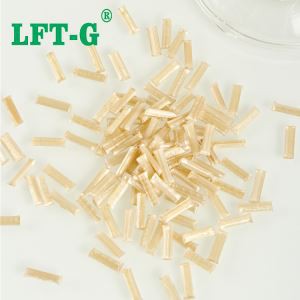

Why Are Long Fiber Reinforced Plastics Used in Structural Components?
Introduction: Why Do Structural Components Need Advanced Materials?
Structural components-such as automotive brackets, mechanical supports, and robot arm joints-operate under continuous mechanical stress. They must withstand tensile forces, bending loads, vibration, and fatigue without failing or deforming excessively.
Conventional unreinforced plastics often lack the necessary stiffness and strength for these demanding applications. On the other hand, metals provide excellent strength but come with a significant weight penalty, which is a critical disadvantage in modern lightweight engineering.
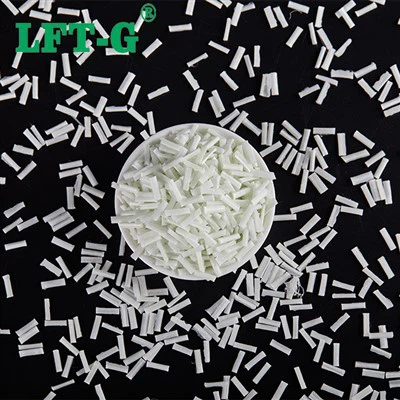
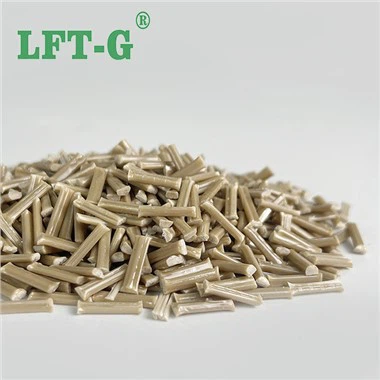
Long fiber reinforced thermoplastics (LFRT) offer a compelling alternative. By combining the processing flexibility of thermoplastics with the structural reinforcement of long glass fibers, these materials create new possibilities for engineers and product designers.
How Do Long Fibers Improve Structural Performance?
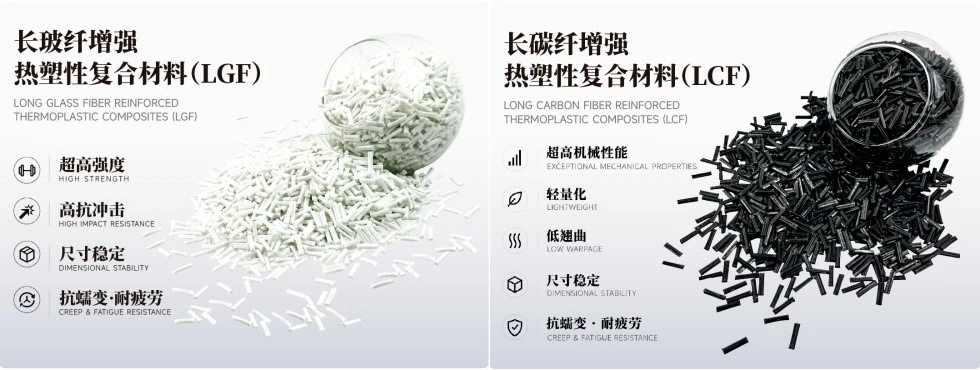
The core mechanism of long fiber reinforcement is relatively straightforward. Long glass fibers are embedded within the polymer matrix and act as a load-bearing skeleton. When an external force is applied, the polymer matrix transfers the stress to the reinforcing fibers.
Compared to conventional short-fiber reinforcement, long fibers can form a more interconnected network within the material, provided that appropriate material formulations and processing conditions are used. This interlocking network helps to distribute stress more evenly across the part.
However, it is important to note that final performance depends on a combination of factors, including fiber length retention, fiber orientation, glass fiber content, interfacial bonding between the fiber and the resin, and the injection molding process. When optimized, these factors contribute to improved tensile strength, flexural strength, flexural modulus, and impact resistance.
Key Advantages in Structural Applications
The reinforcement mechanism translates into several practical engineering advantages for structural components:
1. High Strength-to-Weight Ratio. Long glass fiber reinforcement helps improve mechanical performance without the heavy weight associated with metal parts. This is particularly relevant for lightweight structural design, where reducing mass is critical for fuel efficiency or dynamic performance.
2. Improved Stiffness and Load-Bearing Performance. The addition of long fibers significantly increases the material's stiffness. This helps components resist deformation under mechanical loads, maintaining dimensional stability and ensuring the part functions as designed.
3. Design Flexibility. Because LFRT materials are injection-moldable, engineers can integrate ribs, mounting features, and complex geometries into a single molded component. This reduces the need for secondary assembly operations and allows for highly optimized, organic structural designs.
4. Potential for Metal Replacement. Long fiber reinforced thermoplastics can serve as viable alternatives to selected metal components. This is possible when the mechanical, thermal, durability, and safety requirements of the specific application are fully satisfied. It offers a path to consolidate parts and reduce overall system weight.
Where Are Long Fiber Reinforced Plastics Used?
These materials are being evaluated and adopted across several demanding sectors:
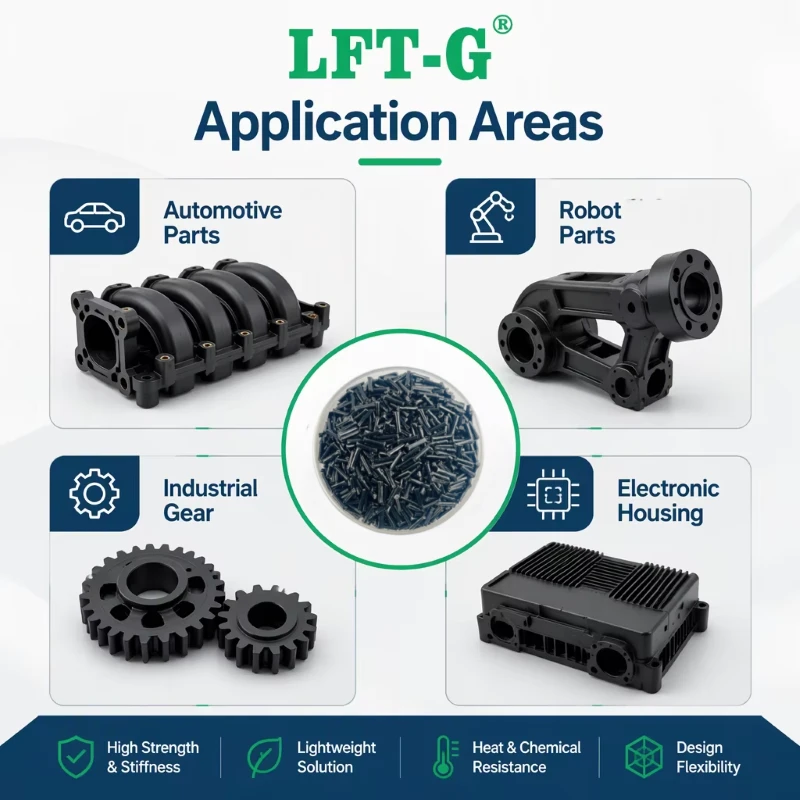
Automotive Industry: Used for structural brackets, seat support components, battery support components, and under-the-hood structural parts. The focus here is on lightweighting, stiffness, mechanical strength, and design integration.
Industrial Equipment and Machinery: Applied in equipment support brackets, mechanical structural housings, structural connectors, and various load-bearing components. These applications demand high stiffness, mechanical durability, and long-term structural reliability.
Robotics and Automation: Utilized in robot arm structural components, mounting brackets, and lightweight support structures. Reducing the weight of moving parts is crucial in robotics to improve speed, accuracy, and energy efficiency.
Long Fiber Reinforced Plastics vs. Conventional Plastics and Metals
Understanding the general differences between material classes helps guide initial design choices. The table below outlines a high-level comparison.
Note: Actual performance depends heavily on the specific material grade, component design, and operating conditions. LFRT is not a universal replacement for all metals, but a powerful engineering option when properly specified.
How to Select the Right Long Fiber Reinforced Thermoplastic?
Selecting the optimal LFRT grade requires an understanding of your application's demands and the available material systems. Here are the general selection considerations:
Polymer Matrix Selection:
- PP LGF (Polypropylene): Can be considered for applications requiring a balance of lightweight design, stiffness, and cost-efficiency.
- PA6 LGF (Polyamide 6): Suitable for structural applications requiring enhanced mechanical performance. However, moisture absorption and its effect on dimensional stability must be carefully evaluated.
- PA66 LGF (Polyamide 66): Can be considered for applications requiring a higher balance of mechanical performance and heat resistance.
Glass Fiber Content: Different contents (such as LGF30, LGF40, LGF50) will significantly influence mechanical properties, density, impact performance, and processing behavior. Note that higher glass fiber content does not automatically guarantee better overall performance-it often trades impact toughness for stiffness.
Application Requirements: Material selection must be driven by the specific conditions of use. Engineers must evaluate tensile strength, flexural strength/modulus, impact strength, operating temperature, moisture exposure, component geometry, and the injection molding conditions.
LFT-G's System: We provide long glass fiber reinforced thermoplastics across multiple polymer bases, including PP, PA6, and PA66. This allows engineers to select the right combination of resin and fiber content to meet specific structural and environmental requirements.
Conclusion
Long fiber reinforced thermoplastics are a compelling choice for structural components that demand a delicate balance of strength, stiffness, and lightweight design. By understanding the reinforcement mechanisms and accurately evaluating the operating environment, engineers can leverage LFRT to replace heavier metal parts, consolidate complex assemblies, and push the boundaries of product design.
At LFT-G, we specialize in supplying high-performance long glass fiber reinforced thermoplastics based on PP, PA6, PA66, and other polymer systems. Our team is dedicated to helping you navigate the complexities of material selection, ensuring that your structural applications perform reliably.
If you are evaluating materials for your next structural project, we invite you to contact the LFT-G technical team for personalized material selection support and technical guidance.
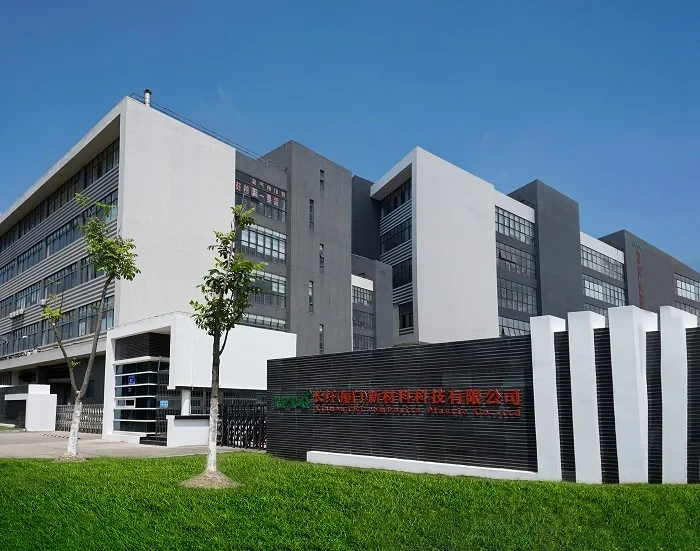
Xiamen LFT Composite Plastic Co., Ltd. is a global supplier of long-fiber-reinforced thermoplastics with 20+ years of innovation. Our engineering team provides material selection, process support, and on-site technical service for customers worldwide.