
Tensile Strength vs. Flexural Strength: What's the Difference in Plastic Materials?
In real-world applications, a single plastic part may experience a complex mix of forces. For example, automotive structural parts may experience constant pulling forces (tensile loads), while brackets and support structures often bear bending forces (flexural loads).
Therefore, choosing the right material requires looking at both Tensile Strength and Flexural Strength. This article explains what these two properties mean, how they differ, and how long fiber reinforcement can improve them.
What Is Tensile Strength?
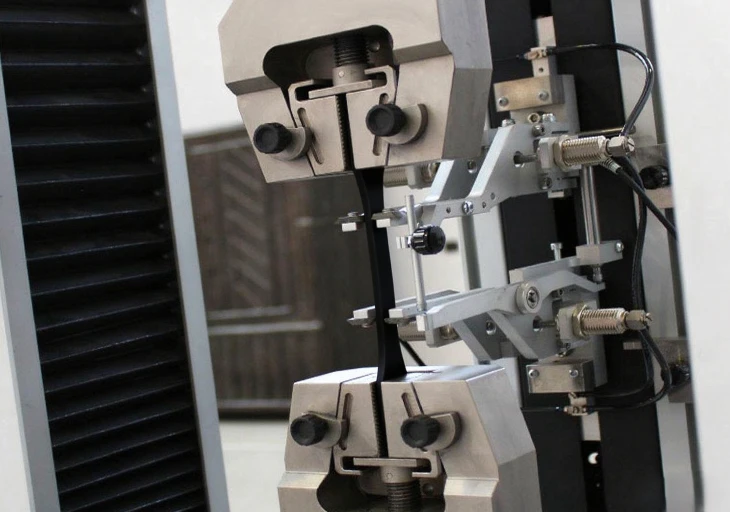
Tensile strength is the maximum tensile stress a material can withstand before failing. In simple terms, it measures how hard you can pull the material before it breaks.
During testing, a specimen is clamped at both ends and pulled along its length in opposite directions until it reaches its breaking point. This property is highly relevant for components such as connectors, fasteners, and structural parts that primarily bear pulling forces.
What Is Flexural Strength?
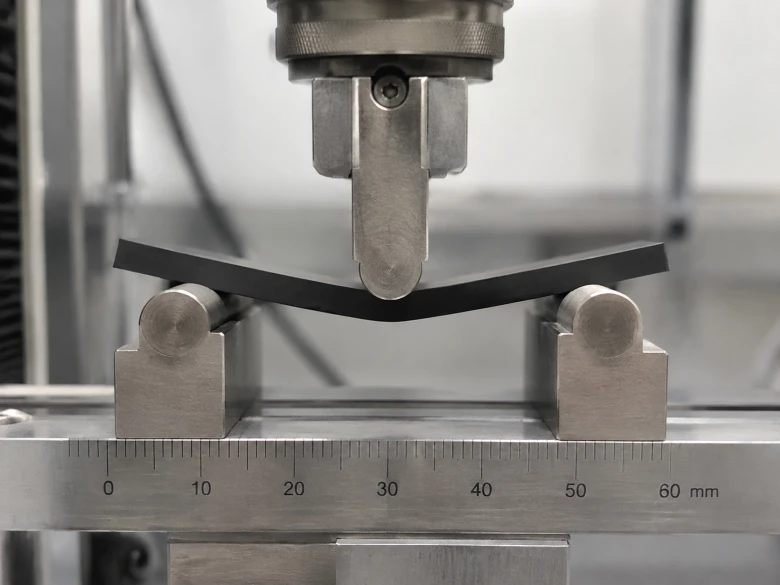
Flexural strength is the maximum bending stress a material can withstand. It measures how well the material resists breaking when a force is applied to bend it.
Testing is typically done using a three-point or four-point bending setup. The specimen rests on supports and a downward force is applied, subjecting the material to bending. This property is important for brackets, housings, and support structures that need to resist bending.
Important technical note: Flexural strength is not the same as flexural modulus. Flexural strength measures strength (how much stress the material can take before breaking), while flexural modulus measures stiffness (how much it resists deformation).
Tensile Test

Flexural Test

What Are the Key Differences?
Although both properties describe the mechanical strength of a material, they measure its performance under different loading conditions.
A material with high tensile strength does not necessarily have equally high flexural strength. Both properties must be evaluated independently based on the actual load conditions of the part.
How Do Long Glass Fiber Reinforced Plastics Improve These Properties?
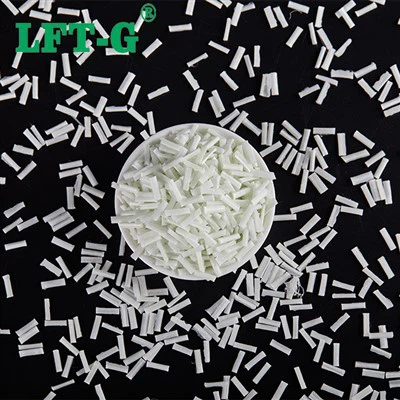
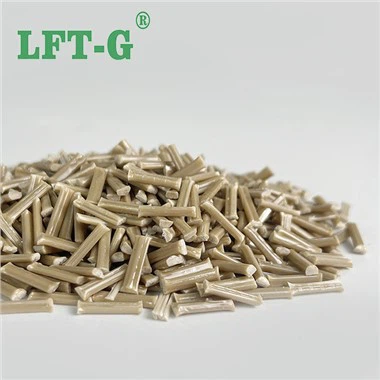
This is where material selection becomes a powerful design tool. Long glass fiber-reinforced thermoplastics (LFT) are specifically engineered to enhance mechanical performance through their internal structure.
Improved Load-Bearing Capability
Long glass fibers reinforce the resin matrix by carrying and transferring loads, helping improve both tensile and flexural strength compared to unreinforced plastics.
Enhanced Structural Stiffness
Long fiber reinforced materials typically exhibit high stiffness. This helps reduce part deformation under external forces, maintaining dimensional stability and performance.
Better Structural Performance in Applications
For components that must withstand mixed loads - tension, bending, and impact - LFT-G long fiber reinforced thermoplastics provide a broader range of material options.
Different resin systems offer different mechanical performance profiles. PP-based long glass fiber reinforced materials are often considered for applications requiring a balance of stiffness, strength, and lightweight design. PA6 and PA66-based long glass fiber reinforced materials may be suitable for applications where higher mechanical performance and heat resistance are required.
The appropriate choice depends on the specific loading conditions, operating temperature, moisture exposure, and other application requirements.
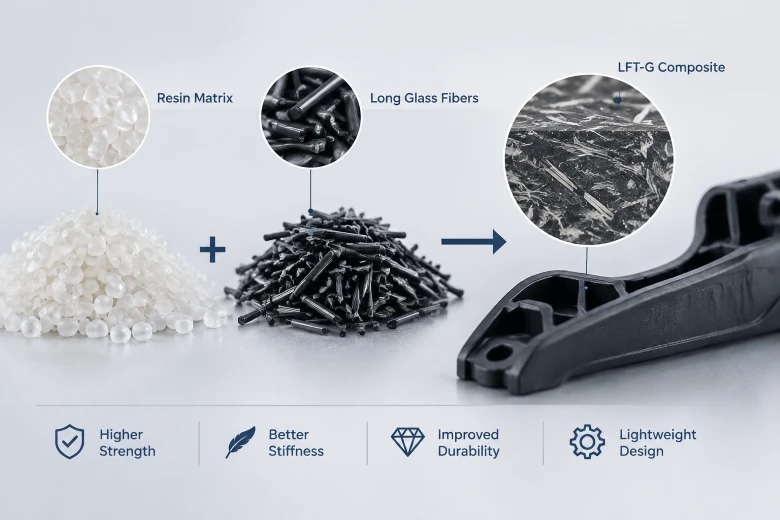
Key technical insight: Compared to short glass fiber materials, long glass fiber materials can retain greater fiber length under proper processing conditions, which supports a more effective reinforcement network. However, final performance still depends on the resin type, glass fiber content, fiber orientation, and processing conditions.
How to Choose the Right Material for Your Application?
Selecting the right material requires a systematic approach. Here are four practical steps:
- Consider the loading conditions: Does the part mainly bear tensile loads, bending loads, or a combination of both?
- Evaluate multiple mechanical properties: Do not rely solely on tensile strength. Also consider flexural strength, flexural modulus, and impact strength.
- Consider the base resin: Different resins (PP, PA6, PA66, etc.) offer different balances of properties and environmental resistance.
- Check actual test data: Always verify the material data sheet (TDS) for the specific grade you are considering to ensure it meets your application requirements.
At LFT-G, we provide long fiber-reinforced thermoplastic materials based on different resin systems, including PP, PA6, PA66, and other engineering plastics. By considering the mechanical requirements and processing conditions of each application, we help customers identify suitable material solutions for their components.

Summary: Balance is Key
Tensile strength and flexural strength reflect how a material performs under different mechanical loads. Neither property should be considered in isolation when selecting engineering plastics.
For applications requiring a combination of strength, stiffness, and structural reliability, long fiber reinforced thermoplastics offer additional material design possibilities. Choosing the right grade starts with understanding the actual requirements of the component.
Xiamen LFT Composite Plastic Co., Ltd. is a global supplier of long-fiber-reinforced thermoplastics with 20+ years of innovation. We specialize in LFT–PP, LFT–PA6, LFT–PA66, LFT–PPS, and LFT carbon fiber reinforced thermoplastics – offering high–strength, lightweight alternatives to metal for automotive, aerospace, industrial, and consumer applications. Our engineering team provides material selection, process support, and on-site technical service for customers worldwide.