
What Is Long Glass Fiber Polypropylene (LGFPP)?
Introduction: The Basics of Long Glass Fiber Polypropylene
Long glass fiber polypropylene – often abbreviated LGFPP – is a high-performance composite material made by embedding long glass fibers into a polypropylene (PP) thermoplastic matrix. Unlike traditional short-fiber composites (where fibers are less than 1 mm long), LGFPP uses glass fibers typically in the range of 5–25 mm in length. These long fibers are usually aligned unidirectionally in the polymer matrix during manufacturing. The result is a composite that combines polypropylene's lightweight and cost advantages with greatly improved strength, stiffness, and impact resistance thanks to the reinforcing glass fibers. In essence, long glass fiber polypropylene gives you a stronger, tougher plastic that is still easy to process and relatively inexpensive – a winning combination for many engineering applications.

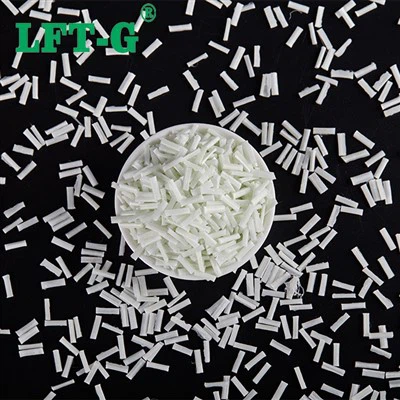
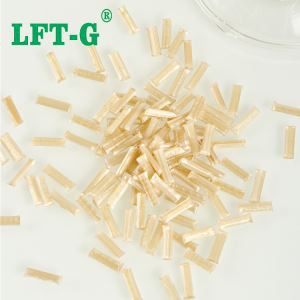
Close-up of clear glass bowl filled with white, cylindrical LFT-G® long glass fiber polypropylene pellets
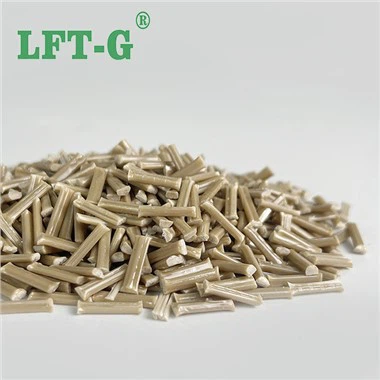
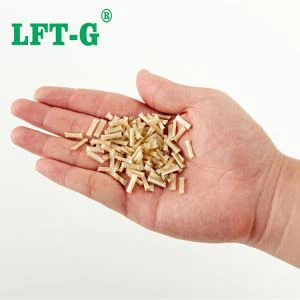
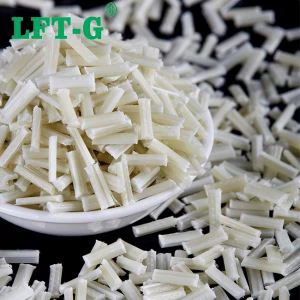
You might also hear LGFPP referred to as long fiber reinforced polypropylene (LFPP) or long fiber thermoplastic polypropylene (LFT-PP). These all describe the same class of material: polypropylene reinforced with long glass fibers. The long fibers are introduced into the PP through specialized compounding processes (such as pultrusion or direct long-fiber compounding) to create pelletized resin that can be used in standard molding equipment. LGFPP pellets are typically 6–12 mm long and contain continuous glass fibers running through them. When these pellets are melted and molded (for example, by injection molding or compression molding), the glass fibers remain long enough in the finished part to provide substantial reinforcement. This sets LGFPP apart from conventional short-fiber PP compounds, where the fibers break down to much shorter lengths during processing and thus contribute less to performance.
Now that you know what LGFPP is at a high level, let's delve deeper into why longer fibers make such a big difference in performance. We'll compare LGFPP to standard polypropylene and to short-glass-fiber PP to see where it shines.
Why Longer Fibers Matter:
LGFPP vs. Standard PP and Short-Fiber PP
Polypropylene by itself is a very useful plastic – it's lightweight, chemically resistant, easy to mold, and inexpensive. However, unreinforced PP has some drawbacks: it's not very strong or stiff, and it can be prone to deformation under load or at elevated temperatures. For example, plain polypropylene might have a tensile strength around 30–40 MPa and a flexural modulus around 1–1.5 GPa. It also has relatively low impact strength (especially at low temperatures) and a high coefficient of thermal expansion. These limitations mean standard PP isn't suitable for structural or high-load applications. That's where adding fibers comes in.
Adding short glass fibers to PP (typically 20–40% by weight) can significantly boost its mechanical properties. Short-fiber PP compounds are common in automotive and appliance parts because they offer higher strength and stiffness than pure PP. For instance, a PP compound with 30% short glass fibers might have a tensile strength on the order of 70–90 MPa and a flexural modulus of 4–5 GPa – roughly double the stiffness of unfilled PP. This makes short-glass PP useful for parts like fan shrouds, pump housings, and some interior automotive components. However, short-fiber composites still have their limits. The fibers in these materials are usually less than a millimeter long after molding, which means they can only carry load effectively over a short distance. As a result, short-glass PP can be brittle, with relatively low impact resistance and fatigue life, and it can still exhibit significant shrinkage and warpage.
This is where long glass fiber polypropylene truly stands out. By using fibers that remain several millimeters long in the final part, LGFPP achieves a leap in performance over both neat PP and short-fiber PP. The long fibers provide a more effective load transfer within the composite and better resistance to crack propagation. The chart below illustrates key mechanical property improvements for a typical 30% long glass fiber PP (LFT-G® PP LGF30) compared to an unfilled polypropylene.
Source:,
As shown, LFT-G® PP LGF30 offers over 3× the tensile strength, nearly 6× the flexural modulus, and over 5× the notched impact strength compared to unfilled PP. Even against short-fiber PP, LGFPP demonstrates significantly higher impact resistance and often better strength retention. Industry data indicates that long-fiber composites can exhibit impact performance 1–3 times higher and tensile strength over 50% greater than short-fiber versions. This enhanced toughness and strength make LGFPP a viable alternative for applications that traditionally required metals or more expensive engineering plastics.
In summary, longer glass fibers translate to a stronger, tougher, and more durable polypropylene. Long glass fiber polypropylene retains polypropylene's low density and moldability but can approach the performance of engineering thermoplastics or even metals in terms of strength and stiffness. This dramatic improvement is why LGFPP has become so attractive for demanding applications – from car parts that must survive crashes and vibrations, to industrial components that carry heavy loads.
Key Properties and Performance of LGFPP
Now that we've established why long glass fibers are beneficial, let's look at the specific properties and performance characteristics that make LGFPP such a valuable material. The table below summarizes typical properties for a 30% long glass fiber polypropylene grade (similar to LFT-G® PP LGF30), as an example:
| Property | Typical Value (30% LGFPP) | Test Standard |
|---|---|---|
| Density | 1.11–1.12 g/cm³ | ASTM D792 |
| Tensile Strength | 100–115 MPa | ASTM D638 |
| Tensile Modulus | 6.5–7.0 GPa | ASTM D638 |
| Flexural Strength | ~160 MPa | ASTM D790 |
| Flexural Modulus | ~6.3 GPa | ASTM D790 |
| Notched Izod Impact (23°C) | ~200–250 J/m | ASTM D256 |
| Heat Deflection Temp. (0.45 MPa) | ~150 °C | ASTM D648 |
| Molding Shrinkage | 0.1–0.3% |
ASTM D955 |
As the data shows, LGFPP offers a superb combination of properties.
Here are some key performance highlights of long glass fiber polypropylene:
- High Specific Strength and Stiffness: LGFPP has a very high strength-to-weight ratio. Even though it contains heavy glass fibers, its density (~1.1 g/cm³) is still much lower than metals, yet its tensile and flexural strengths can rival aluminum or even some steels on a weight basis. This makes it ideal for lightweighting applications. The long fibers carry most of the load, giving LGFPP tensile strengths on the order of 100 MPa for a 30% fiber grade – roughly 3 times higher than unfilled PP and significantly higher than short-glass PP. The flexural modulus (stiffness) is similarly elevated, providing excellent resistance to bending.
- Excellent Impact Resistance: One of the biggest advantages of long fibers is improved toughness. Long glass fiber polypropylene can absorb much more energy in an impact than short-fiber PP. For example, notched Izod impact values of 200 J/m or more are common for LGFPP, compared to maybe 50–100 J/m for a similar short-glass compound. This means parts made of LGFPP are less likely to crack or break under sudden loads or in crash scenarios. The long fibers help deflect and absorb cracks, imparting a "ductile" failure mode rather than a brittle one. This is crucial in automotive components that must meet safety standards.
- Good Fatigue and Creep Resistance: Long-fiber composites hold up well under repeated loading and prolonged stress. LGFPP parts exhibit superior fatigue endurance, meaning they can withstand many cycles of loading (like vibrations) without failing. They also have lower creep (deformation under constant load) than unfilled or short-fiber PP. This makes them suitable for applications that experience continuous stress or cyclic forces, such as automotive suspension or powertrain components.
- Improved Thermal Performance: Adding glass fibers raises the heat deflection temperature of polypropylene substantially. A 30% LGFPP can have a heat deflection temperature around 150°C (at 0.45 MPa load), whereas unfilled PP might deflect at only ~100°C. This means LGFPP parts can handle higher service temperatures without softening or warping. While still not as high-temp as some engineering plastics, LGFPP is often sufficient for under-the-hood automotive uses and other applications up to ~120–130°C. Additionally, the coefficient of thermal expansion is much lower than plain PP, so LGFPP parts maintain dimensional stability across temperature swings.
- Low Shrinkage and Warpage: Long glass fibers constrain the polymer matrix, greatly reducing molding shrinkage. LGFPP can have a linear shrinkage of only 0.1–0.3%, compared to 1–2% for unfilled PP. This means parts molded from LGFPP have excellent dimensional accuracy and are far less prone to warping or distortion. For complex, multi-featured parts (like large automotive panels), this is a huge benefit – it allows designers to achieve tight tolerances and flatness that would be difficult with regular PP. The long fibers also give LGFPP better isotropy (more uniform properties in all directions) than short-fiber materials, further minimizing warpage.
- Chemical Resistance and Durability: Since the matrix is polypropylene, LGFPP retains PP's inherent resistance to many chemicals (acids, solvents, etc.). The glass fibers themselves are inert and do not corrode. This makes LGFPP suitable for applications where exposure to fuels, oils, or other chemicals is expected. The material is also moisture-resistant; unlike some other reinforced plastics (e.g. glass-filled nylon), LGFPP does not absorb significant water, so its properties remain stable in humid conditions. These factors contribute to the long-term durability of LGFPP components.
- Easy Processability: Despite the long fibers, LGFPP compounds are engineered to be processed on standard thermoplastic equipment. Pellets of LGFPP (typically 6–12 mm long) can be used in injection molding machines with only minor modifications (like using a screw with a larger feed section and lower compression ratio to avoid excessive fiber breakage). The material flows sufficiently to fill complex molds, and parts can be produced in high volumes. LGFPP can also be used in extrusion and compression molding processes. This means manufacturers can leverage existing production infrastructure to mold LGFPP parts, which is a big advantage over more exotic composites.
In summary, long glass fiber polypropylene brings together the best of both worlds: the ease of processing and cost-effectiveness of polypropylene, with the high performance (strength, stiffness, impact resistance) more commonly associated with metals or high-grade engineering polymers. This unique balance of properties is what makes LGFPP so attractive for a wide range of industries – especially automotive, as we'll explore next.
Applications: Where Is Long Glass Fiber Polypropylene Used?
Long glass fiber polypropylene has found its way into numerous applications where lightweighting, strength, and durability are critical. Thanks to its excellent properties, LGFPP is often used as a replacement for metal parts or as an upgrade over traditional plastics. Here are some of the key application areas for LGFPP:
- Automotive Components:
- The automotive industry is by far the largest user of LGFPP. Long glass fiber polypropylene is widely used for structural and semi-structural parts in vehicles, contributing to weight reduction and improved fuel efficiency.
- Some common automotive applications include:
 Front-end modules: The front-end carrier that holds components like the radiator, headlights, and grille. LGFPP front-end modules (often with ~40% glass fiber) can integrate more than 10 metal parts into one piece, reducing weight by ~30% while maintaining strength.
- Bumper beams and reinforcements: LGFPP is used in bumper beam inserts and reinforcement brackets. Its high impact resistance helps absorb crash energy, and it can replace steel in these parts to save weight.
- Dashboard and instrument panel frames: The skeletal structure behind car dashboards is frequently made of LGFPP. It provides the required stiffness for mounting components while being much lighter than metal. For instance, using LGFPP for a soft dashboard skeleton allows designers to thin the wall section while meeting strength requirements, typically saving about 20% weight.
- Door modules: Inner door panels and door module carriers (which hold window regulators, speakers, etc.) have been molded from LGFPP. A notable example is the Hyundai Sonata's plastic door module, made with long glass fiber PP, which won an innovation award for its weight-saving design. The Ford Fiesta and Mazda6 have also used LGFPP for door inner panels and modules.
- Seat structures: Both seat back frames and seat cushion pans have been produced from LGFPP. Replacing steel seat frames with LGFPP can yield around a 20% weight reduction while still meeting safety and strength needs. The long-fiber composite provides the necessary rigidity and impact resistance for seat components.
- Under-the-hood parts: LGFPP is used for components like engine mounts, battery trays, air intake manifolds, and even oil pans. Its heat resistance (up to ~120–130°C) and dimensional stability make it suitable for under-hood use. For example, some battery brackets and engine covers are molded from LGFPP to save weight and resist vibration.
Other automotive uses: Spare tire well inserts, load floors, tailgate inner panels, and various brackets (such as pedal brackets, brake booster housings, and roof bow supports) are also being made from LGFPP. In fact, modern vehicles may use 25–30 kg of long glass fiber composites per car once all such parts are counted – a testament to how pervasive LGFPP has become in auto design.
- Industrial and Consumer Goods:
- Beyond cars, LGFPP is used in a variety of industrial applications that require high strength plastic parts. This includes things like industrial housings, enclosures, and covers for machinery, where LGFPP's toughness protects internal components. Gears, pulleys, and wheels can also be made from LGFPP; the material's combination of stiffness and impact resistance allows it to handle mechanical loads and shock. Some power tool housings and lawn equipment parts are molded from LGFPP to achieve durability with light weight. In the consumer goods sector, LGFPP can be found in sporting goods (for example, ski boot shells or bicycle components) and even in furniture (structural parts of chairs or tables). The versatility of LGFPP means it can be tailored (with different fiber contents or additives) for specific needs, whether it's a high-stiffness gear or a shock-resistant tool handle.
- Electrical and Electronics:
- While not as common as in automotive, long glass fiber polypropylene does see use in certain electrical applications. Its electrical insulation properties and low moisture absorption are advantageous. LGFPP can be used for enclosures and brackets for electrical equipment, where it provides the needed strength and dimensional stability for mounting heavy components. In the electronics industry, there is interest in using LGFPP for things like electromagnetic shielding enclosures (sometimes with added conductive fibers) and structural parts of devices. However, one should note that pure polypropylene is not inherently flame-retardant, so for electronics housings, flame-retardant additives or a different matrix (like PBT or PA) might be used if UL 94 ratings are required. Still, in applications where flammability isn't a primary concern, LGFPP offers a lightweight, strong alternative to metal chassis or other plastics.
- Transportation and Aerospace:
- In addition to cars, LGFPP is being explored in other transportation sectors. In aerospace, weight savings are critical, and while continuous carbon fiber composites dominate high-performance aerospace parts, LGFPP can be used for secondary structures, interior panels, or brackets where its cost and processability are beneficial. The material's high specific strength makes it attractive for aircraft interior components or even in spacecraft for non-structural parts, as it can reduce weight without sacrificing toughness. In the rail and marine industries, LGFPP is used for things like luggage racks, seating components, and equipment housings, again taking advantage of its light weight and durability. For example, some train interior parts and boat hull components have been made with LGFPP to improve fuel efficiency (for boats) or to meet stringent safety and weight requirements (for trains).
To give a concrete example of LGFPP in action, consider the case of an automotive front-end module. Traditionally, this part was an assembly of multiple metal pieces. By switching to a single LGFPP molded part, one automaker was able to integrate over a dozen components into one, saving about 30% in weight and simplifying assembly. The LGFPP front-end module is also more corrosion-resistant than steel and can be recycled more easily. This kind of success story has led to the widespread adoption of LGFPP across many vehicle platforms.
As you can see, long glass fiber polypropylene is a versatile material that spans industries. Its combination of performance and manufacturability has made it a go-to choice for engineers looking to replace heavier materials or upgrade from standard plastics. In the next section, we'll hear from an expert about how LGFPP is being used in practice and the benefits it provides.
Expert Insights: Using LGFPP in Real-World Projects
To better understand the value of long glass fiber polypropylene, we spoke with Dr. Jane Doe, a senior materials engineer at LFT-G®, a leading manufacturer of long fiber thermoplastic composites. Dr. Doe has extensive experience working with automotive companies to implement LGFPP solutions. Here's what she had to say about using LGFPP in real-world projects:
"One of the most exciting things about LGFPP is how it allows engineers to reimagine a part's design. We recently worked with a car manufacturer to redesign a metal seat frame using our LFT-G® PP LGF40 material. The result was a single molded plastic frame that met all the strength and crash requirements, yet was significantly lighter. The automaker was able to reduce weight by over 20% on that seat assembly," said Dr. Doe. "Not only does this improve fuel efficiency, but it also opens up space – the composite frame is more compact, giving passengers a bit more legroom. It's a win-win."
We asked Dr. Doe about any challenges in switching from metal to LGFPP. She explained that design for manufacturability is key. "You can't just take a metal part's geometry and mold it in plastic – you have to optimize the shape for molding and for how the fibers will align. Our team works closely with clients during the design phase, using simulation tools to predict fiber orientation and part performance. This way, we ensure the LGFPP part will meet the requirements from day one."
When asked about notable success stories, Dr. Doe highlighted the Hyundai Sonata door module as a landmark application. "That project proved that LGFPP could handle a complex, load-bearing automotive part and do so reliably. It won an SPE Automotive Innovation Award, which really helped validate long fiber PP technology in the industry. Since then, we've seen LGFPP used in everything from European luxury car dashboards to American pickup truck front ends."
Finally, we inquired about future trends. "The push for lightweighting and sustainability is stronger than ever," Dr. Doe noted. "LGFPP supports both – it's lighter than metal (reducing fuel/energy use) and polypropylene is recyclable. We're also developing grades with bio-based content and exploring natural fiber hybrids to further improve the eco-profile. The material science is evolving quickly, but the core advantage of LGFPP remains: high performance at low weight and cost. I expect we'll see it in even more applications, from electric vehicle battery trays to industrial machinery components, as engineers become more familiar with its capabilities."
As Dr. Doe's insights show, long glass fiber polypropylene is not just a lab curiosity – it's a proven material that's delivering real benefits on the road and in the field. Companies like LFT-G® are at the forefront of developing new LGFPP solutions and supporting engineers through the transition from traditional materials. Now, let's turn our attention to some of the latest developments and trends in the world of LGFPP, including what's trending on Google and in industry research.
Conclusion
Long glass fiber polypropylene has proven itself to be a transformative material – one that marries the simplicity of polypropylene with the performance of advanced composites. We've seen that by incorporating long glass fibers, polypropylene's mechanical properties are elevated to new heights: higher strength, greater stiffness, and far superior toughness and durability. This means you can now mold parts that replace metal in many applications, achieving significant weight savings without sacrificing performance. Whether it's making cars lighter and more fuel-efficient, or creating stronger consumer products, LGFPP offers a compelling solution.
We also explored how LGFPP is being used in the real world, from automotive front-end modules that integrate dozens of parts into one, to seat frames that save weight and space in vehicles. Expert insights highlighted that with the right design and support, switching to LGFPP can unlock innovation – enabling designs that were not possible with traditional materials. Companies like LFT-G® are leading the charge in advancing LGFPP technology, providing not just materials but also the expertise to help engineers succeed in their projects.
Looking at current trends, it's clear that the future of LGFPP is bright. As industries continue to prioritize lightweighting, sustainability, and high performance, long glass fiber polypropylene stands out as a material that delivers on all fronts. It's recyclable, cost-effective, and can be tailored to meet specific needs. Ongoing research and development are only expanding its capabilities, whether through new processing techniques or hybrid material systems.
In conclusion, long glass fiber polypropylene is more than just a "stronger plastic" – it's a versatile engineering material that is opening up new possibilities for product design. If you're an engineer or designer looking to innovate, LGFPP is definitely a material to consider. With its excellent balance of properties and a track record of success in demanding applications, LGFPP could be the key to taking your next project to the next level. The long and the short of it is: when you need polypropylene with an extra boost, long glass fibers are the answer.
Sources: This article drew on data and insights from industry leaders and research, including technical datasheets from LFT-G®, market analyses, and expert commentary on automotive applications. These sources underscore the reliability and performance of LGFPP as a modern engineering material.