
Unlocking LGF PBT Structural Power
In the vast sea of engineering plastics, PBT is often regarded as a "standard component" - it is a connector, a relay housing, and that "useful but prone to warping" crystalline polymer. However, when we introduce the variable "long glass fiber" into the lattice world of PBT, a wonderful qualitative change occurs in chemistry and physics.
Today, we will not discuss the dull ASTM testing standards, but instead, through three unconventional perspectives of bone remodeling, environmental competition, and processing art, we will re-examine the actual positioning of LGF PBT composite in contemporary industry.
LGF PBT: The Art of Creation
To understand the uniqueness of LGF PBT compound resin, one must first trace its origin.
Ordinary short glass fiber (SGF) PBT pellet is "mixed" together: short fibers and resin are subjected to intense shearing and kneading in a twin-screw extruder, resulting in fibers that resemble gravel scattered on concrete, with a length of only 0.2-0.4 mm.
The LGF PBT plastic granules are "immersed" in this process. It is a technique known as Melt Impregnation.
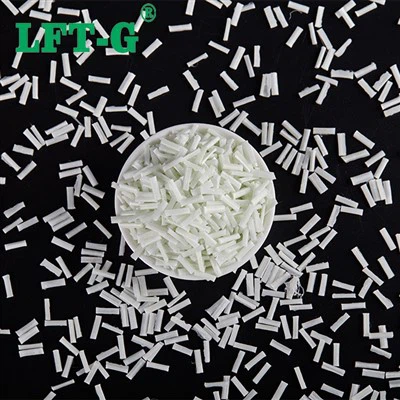
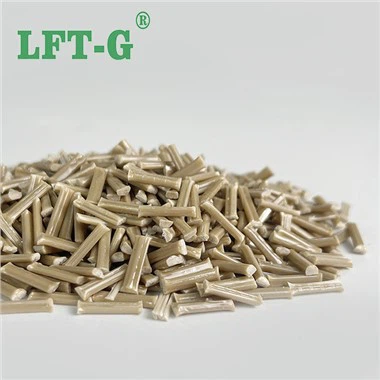
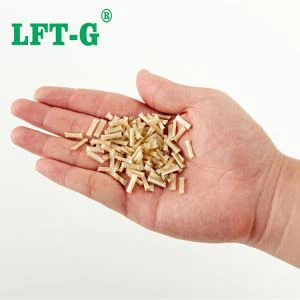
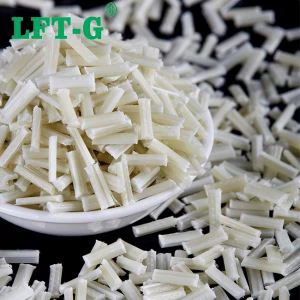
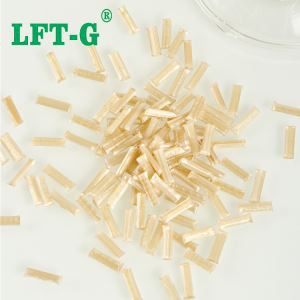
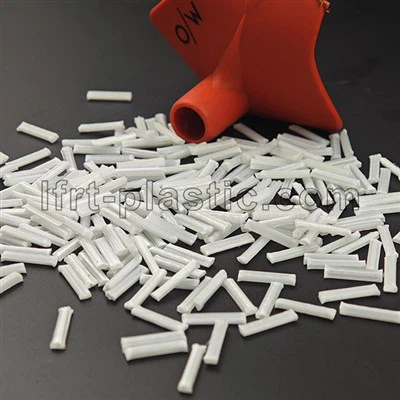
Imagine a continuous bundle of glass fibers being pulled through a molten PBT resin channel like a cable. The resin must completely penetrate each individual filament within an extremely short period of time, using capillary action. This is not just a physical encapsulation, but also a chemical bonding at the interface. After cooling and granulation, the length of the particles is the same as the length of the fibers (usually 10-12 mm, with a range up to 5-25 mm).
Industry Insight: This technological difference determines the inherent advantages of LGF PBT materials. It is not merely a combination of "plastic and glass fibers"; it is a pre-made micro-composite material. If SGF is like individual soldiers, LGF is like a well-organized army, always ready to deploy within the injection molding.
Microscopic engineering of GF PBT Material
When LGF PBT is injection-molded, a microscopic engineering revolution occurs within its internal structure.
Bird's Nest Effect
In SGF PBT compound resin, the fibers are isolated and floating. While in LGF PBT, although the long fibers are broken in the screw, ideally they still retain a length of 2-5 mm. These fibers interlock and intertwine with each other within the mold cavity, forming a three-dimensional interlocking network resembling a "bird's nest".This network endows the material with self-supporting capabilities. At high temperatures (close to the melting point of PBT), the matrix resin has softened, but this fiberglass framework still enables the product to maintain its macroscopic shape. This is why the heat distortion temperature (HDT) of LGF PBT polymer can approach the melting point of the resin.
Pull-out Work and Fracture Mechanism
When an external force impact occurs, SGF PBT composite often exhibits brittle fracture - once a crack forms, it quickly penetrates the matrix. However, LGF PBT introduces a complex energy dissipation mechanism. During the expansion of the crack, it encounters the obstruction of the long fibers and is forced to turn, bifurcate. More importantly, to destroy this structure, it is necessary to forcibly "pull out" the wound fibers from the matrix. This "fiber pull-out work" requires much greater energy than simply breaking the fibers.
Application Insights: This is also the reason LGF PBT plastic pellet can replace metals in the front module of cars or the frame of the impact bar – it is not only hard but also has a ductile failure mode, which can absorb kinetic energy during a collision instead of causing shattering splashes.
What Should We Pay Attention to?
The most challenging aspect of implementing LGF PBT compound resin is not the material formula, but the restraint in the processing technique. This is the greatest paradox faced by injection molding engineers. We spent a lot of money on long fibers, but it was very easy to turn them into short fibers during the processing.
To achieve uniform plasticization, traditional processes prefer high rotational speed, high back pressure and high shear force. But this is devastating for LGF. The shear force is like a pair of scissors, which will instantly shred the fibers. Processing LGF PBT requires a gentle rhythm:
Low back pressure: Only the screw needs to be pushed backward.
Low rotational speed: Reduces mechanical shearing.
Deep screw groove: Provides space for fiber flow.
Wide gate: The traditional needle-point gate is prohibited. Open nozzles and side gates must be used to allow the fibers to flow smoothly into the mold cavity.
LGF Composite: Final Frontiers
When we talk about LGF PBT, we are actually referring to the "deep water zone" of light weighting in the automotive industry.
In the 1.0 era, light weighting was achieved by using plastics for interior components. In the 2.0 era, LGF PBT compound resin is replacing the territory that was originally occupied by metals: door module systems, sunroof frames, and windshield wiper motor housings.
In these areas, the competitors are cast aluminum-magnesium alloys. The key strength of LGF PBT plastic granules lies in its resistance to creep.
Metals hardly undergo creep. Ordinary plastics will gradually deform like dough when subjected to long-term stress. However, LGF PBT, thanks to its internal framework network, exhibits astonishing dimensional retention strength under high temperatures (such as 80 °C - 120 °C) and long-term loading. This means that when metal inserts (nuts, bushings) are inserted into LGF PBT material, even after years of vibration and thermal cycling, they remain firmly in place without loosening.
LGF PBT plastic pellet is not a universal material. It is more expensive than ordinary PBT, more difficult to process, and its surface is not as shiny.
However, by sacrificing processing convenience and surface aesthetics, it has gained extremely valuable structural rigidity, dimensional stability, and fatigue resistance. In those areas that require the lightness and insulation of plastic but also desire the reliability of metal, LGF PBT is currently one of the few engineering materials that can perfectly fill the gap.