
TECHNICAL WHITE PAPER
From Fiber to Final Part: A Deep Dive into the LFT Manufacturing Process
An essential guide for engineers, designers, and material specifiers on the science and precision behind creating high-performance Long Fiber Thermoplastic composites.
Executive Summary
The extraordinary mechanical properties of Long Fiber Thermoplastics (LFT) are not an inherent material trait alone; they are the direct outcome of a meticulous, multi-stage manufacturing process engineered to preserve the single most critical asset: fiber length. The integrity of the long fiber skeletal network within a final molded part is the cornerstone of LFT's renowned superiority in impact strength, creep resistance, and dimensional stability over short-fiber counterparts. This technical document provides a comprehensive examination of the three pillars of the LFT manufacturing value chain: 1) Pultrusion and Impregnation, 2) Cooling and Pelletizing, and 3) Specialized Injection Molding. It aims to illuminate the critical process parameters, the underlying material science, and the quality control measures at each stage that are essential for unlocking the full performance potential of these advanced composite materials. Understanding this process is key to leveraging LFT for robust, lightweight, and cost-effective component design.
Key Takeaways for Engineers:
- Process control directly dictates final part performance.
- Preserving fiber length is the primary objective at every stage.
- Specialized molding equipment and techniques are non-negotiable for achieving optimal LFT properties.

Fig. 1: The end-to-end LFT manufacturing process, from raw fiber to finished component.
The Three Pillars of LFT Manufacturing
Stage 1: Pultrusion & Impregnation
This foundational stage transforms raw materials into a continuous composite profile. The process begins with thousands of continuous fiber rovings (typically E-glass or carbon) being drawn from spools and carefully guided through a proprietary impregnation die. This is the "pultrusion" (pull-extrusion) aspect. Simultaneously, the thermoplastic matrix polymer (e.g., PP, PA6, TPU, PPS) is melted in a high-precision extruder and injected into the same die under controlled pressure. The primary technical objective is to achieve flawless and complete wetting (impregnation) of every single fiber filament by the molten polymer. Incomplete wet-out creates dry spots and voids, which become failure points. The viscosity of the polymer, line speed, and residence time within the die are meticulously controlled to ensure full saturation without placing excessive shear stress on the fibers, which could lead to premature breakage. A strong interfacial bond, often enhanced by chemical sizing on the fibers, is critical for effective stress transfer from the matrix to the reinforcing fibers in the final part.

Stage 2: Cooling & Pelletizing
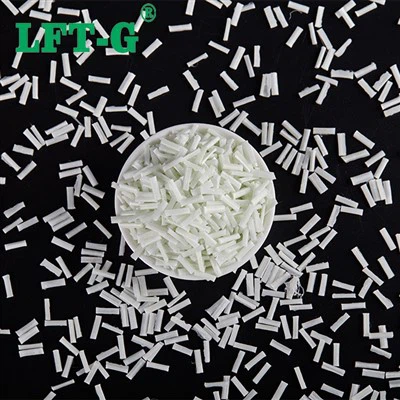
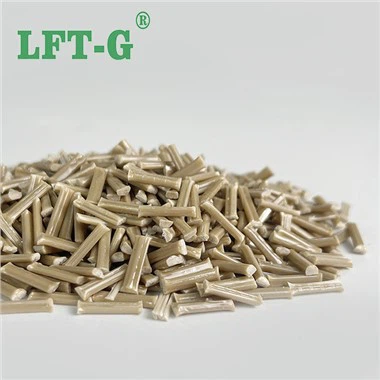
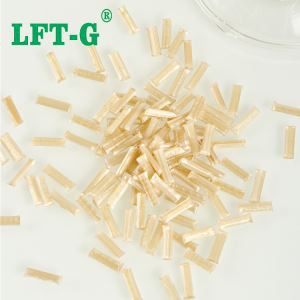
Once the fully impregnated profiles-now called strands-exit the die, they are immediately conveyed through a cooling line. This stage uses either a water bath or chilled air to rapidly and uniformly solidify the thermoplastic matrix, locking the now-protected fibers in place. This controlled cooling is vital to manage crystallinity and prevent residual stresses. The cooled, continuous composite strands are then fed into a high-speed, precision cutter, or pelletizer. This machine uses a rotor with sharp blades to cleanly chop the strands into cylindrical pellets of a specified length, typically 12mm (1/2 inch), but sometimes ranging from 10mm to 25mm. This step is of paramount importance: the length of the pellet dictates the initial length of the fibers that will enter the injection molding machine. Each pellet contains thousands of perfectly aligned, unidirectional fibers, all sharing the same length as the pellet itself. This ensures that the maximum potential fiber length is carried forward to the final molding stage.

Stage 3: Specialized Injection Molding
The final transformation from pellet to part occurs via injection molding, but this is a highly specialized process far removed from standard molding of unfilled plastics. The primary goal is to minimize fiber attrition (breakage). Both the machine and the mold are optimized for this purpose. The injection molding machine is equipped with a specially designed low-shear screw and a free-flow check valve to gently melt and convey the pellets without aggressively chopping the fibers. Back pressure is kept to a minimum. The mold tooling is equally critical, featuring large, full-round runners and large gate sizes (e.g., tab or fan gates) to allow the molten composite to flow into the cavity with minimal restriction. As the material injects, the long fibers flow, orient, and entangle, ultimately forming an interlocking, three-dimensional skeletal network throughout the part. This network is what provides the exceptional mechanical properties. The precise control of injection speed, pressure, and mold temperature is vital to influence the final fiber orientation, manage weld line strength, and ensure consistent, high-performance parts shot after shot.

Why Process Control is the Key to Performance
The preceding stages illustrate a critical truth in LFT technology: the process *is* the product. A failure at any stage has a cascading effect on the final part's integrity. For example, poor impregnation in Stage 1 leads to weak points that no amount of molding expertise in Stage 3 can fix. Similarly, an aggressive, high-shear screw in the molding machine can instantly nullify the benefits of the careful pultrusion and pelletizing work by breaking the fibers down to short-fiber lengths. True mastery of LFT manufacturing lies in understanding and controlling the intricate interplay between these stages. It is this end-to-end process control that ensures the formation of the robust internal fiber skeleton, which directly translates to superior impact resistance, reduced creep, and enhanced structural reliability that customers depend on.
Key Quality Control Checkpoints
| Process Stage | Critical Parameter to Control | Direct Impact on Final Part Quality |
|---|---|---|
| Pultrusion & Impregnation | Fiber Wet-Out Percentage & Polymer Viscosity |
Ensures a powerful fiber-matrix bond for optimal stress transfer; prevents internal voids and weaknesses. |
| Cooling & Pelletizing | Pellet Length Consistency & Absence of Fines |
Guarantees uniform material feed and consistent melt behavior for repeatable, high-quality molding cycles. |
| Injection Molding | Screw Shear Rate, Gate Size & Back Pressure |
The most critical stage for preserving fiber length. Directly controls the final mechanical properties, especially impact strength and stiffness. |
Leverage Our Process Expertise.
Mastery of the LFT manufacturing process is the key to delivering components that meet the highest standards of strength, consistency, and reliability. Partner with a supplier who understands the science behind the strength. Contact our technical team to discuss how our rigorous process control can elevate your next application.
Discuss Your Project with an Engineer