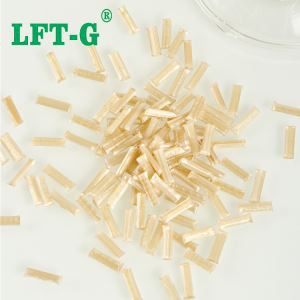

Reinventing the "Plastic Substitution For Steel" LGF PA6 Material
In-depth exploration of the material characteristics and technical advantages of LGF PA6 (long glass fiber reinforced nylon 6). We comprehensively analyze from aspects such as the long glass fiber preparation process, the three-dimensional framework structure principle, the comparison of anti-creep and fatigue resistance performance, as well as key application scenarios such as automotive front modules. We thoroughly explain why LGF PA6 has become the preferred solution for metal replacement and light weighting in new energy vehicles.
A Technological Revolution Surpassing Short Glass Fibers
LGF PA6 composite, which stands for Long Glass Fiber Reinforced Nylon 6, is a high-performance representative of the LFT (Long Fiber Reinforced Thermoplastic) family. Unlike the simple twin-screw mixing and shearing process of traditional short glass fibers (SGF), LGF PA6 employs an advanced melt impregnation pultrusion process.
Core of the process: Continuous glass fiber bundles are completely covered and immersed in molten PA6 resin in a special mold, and then cooled and granulated.
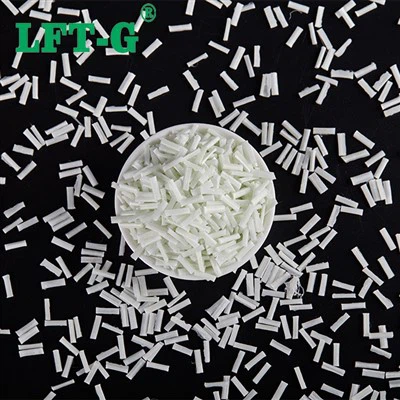
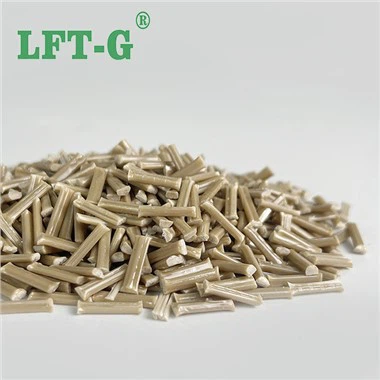
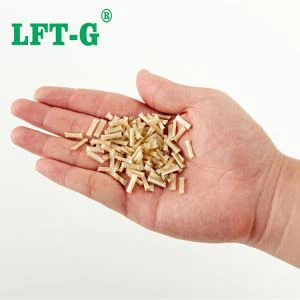
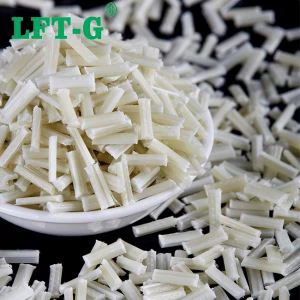
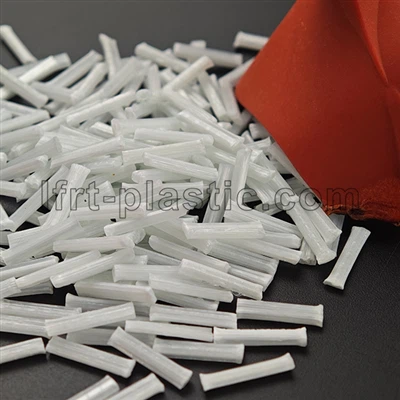
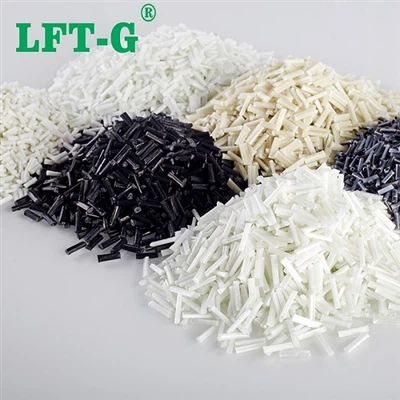
Key difference: The final particles are typically 10 mm - 12 mm in length (even longer), and the length of the glass fibers within the particles is consistent with the length of the particles. In contrast, the fiber length of SGF is usually less than 0.5 mm, and this order of magnitude difference is the physical basis for the performance improvement.
LGF Nylon 6: Unique Fiber Structure
Why is LGF PA6 referred to as a structural-level thermoplastic material?
The key lies in the microstructure after injection molding.
During the injection molding process, if the process control is proper, the long fibers will intertwine and interweave with each other inside the part, forming a three-dimensional framework network structure.
Energy absorption mechanism: When the part is subjected to external force impact, the short glass fibers often simply detach and come out directly; while the withdrawal of the long glass fibers (Fiber Pull-out) requires overcoming huge friction resistance and even causes fiber breakage, thereby absorbing 2-5 times more impact energy than the short glass fibers.
Solve the Problems in the Design of Structural Components
For the common failure modes in automotive components and industrial manufacturing, LGF PA6 offers solutions that surpass those of traditional engineering plastics:
Excellent Creep Resistance
Challenges: Plastic components will undergo permanent deformation (creep) over time under constant loads, leading to assembly failure.
Analysis: The long fiber network of LGF effectively restricts the slip of PA6 molecular chains. In high-temperature and high-load environments, LGF PA6 has only a minimal deformation, which is the prerequisite for using plastic to replace steel for functional components.
Extremely high fatigue resistance
Challenges: Components such as car pedals and fan blades are subjected to millions of cycles of alternating stress, making them prone to fatigue fractures.
Analysis: Long fibers can effectively prevent the initiation and propagation of microcracks. In alternating stress tests, the fatigue resistance of LGF PA6 plastic pellet is exponentially superior to that of short glass fiber materials.
Improved isotropy and low warpage
Problem: Short glass fibers tend to align along the flow direction, resulting in significant differences in transverse and longitudinal shrinkage rates. Large thin-walled parts are prone to warping.
Analysis: The interwinding of long fibers within the mold reduces the degree of orientation, making the shrinkage rates in the flow direction (MD) and the perpendicular direction (TD) more similar, thereby ensuring the dimensional accuracy of large structural components (such as door modules).
Industry Application Overview
Automotive Industry
Front-end Module: Utilizing highly rigid integrated headlight brackets and radiator frames to achieve modular supply and weight reduction.
Dashboard Frame: Replacing steel tubes and magnesium alloys to reduce costs and enhance shock absorption and energy absorption performance.
New Energy Battery Pack Components: Battery trays, module end plates. Need to be combined with flame-retardant modification to meet UL94 V-0 standards, while providing structural support.
Functional Structural Components: Shift base, accelerator/brake pedal brackets, sunroof frame.
High-end industrial and consumer electronics
Industrial pump bodies and impellers: Replace stainless steel and brass to solve corrosion issues, and the injection-molded surface is smoother, improving fluid efficiency.
Electric tool casings: Resistant to drops and impacts, with strong color customization capabilities. Sports equipment: Ski bindings, bicycle accessories, archer's handle (requires extremely high dynamic modulus).
"Protective Length" is A Decisive Factor
The performance of LGF PA6 directly depends on the remaining fiber length within the molded product. The core objective of the injection molding process is to minimize fiber breakage to the greatest extent possible.
Screw selection: High shear screws must not be used. General-purpose or LFT-specific screws with low compression ratio and deep screw grooves should be selected.
Nozzle: Use an open Nozzle, with the flow channel aperture > 6 mm.
Back pressure and speed: Low back pressure is crucial. Only ensure stable metering is necessary; combined with low speed, reduce melt shear heat.
The strategic value of LGF PA6 Material
In the context of carbon neutrality, LGF PA6, with its low density (approximately 1.0–1.5 g/cm³), high specific strength, and recyclability, has become the best alternative to die-cast aluminum and short glass fiber reinforced materials. For manufacturing enterprises that pursue high performance, light weighting, and cost balance, mastering the application technology of LGF PA6 compound resin is equivalent to grasping the core competitiveness of the next-generation structural component design.