
Introduction to properties of long fiber reinforced composites
Long fiber reinforced thermoplastic composite refers to a fiber length greater than 10mm reinforced thermoplastic, reinforced fiber to glass fiber, carbon fiber, and other fibers mainly, the most used resin substrate is PP(polypropylene), followed by PA(polyamide), other such as PPS(polyphenylene sulfide), TPU(polyurethane) and other resins, According to the type of resin with appropriate fiber surface treatment, can achieve better results.
Adding fiber materials into the resin can greatly improve the overall material properties. Fiber composite materials absorb external forces in three ways: fiber pulling out, fiber breaking, and resin breaking. With the increase in fiber length, fiber pulling out needs more energy, which is conducive to the improvement of impact strength. In composite materials, the end of the fiber is often the initiation point of crack growth, and the number of long fiber ends is small, which also improves the impact strength. Long fiber mixes intertwine, turn and bend each other when filling the mold, instead of lining up along the flow direction like short fiber mixes. Therefore, compared with the same molding parts of short fiber mixes, the long fiber mixed molded products have higher isotropy, better flatness, and smaller warpage, so the size is more stable. The thermal deformation temperature of long-fiber-reinforced thermoplastics is also higher than that of short-fiber-reinforced thermoplastics. Therefore, long-fiber composites exhibit better performance than short-fiber composites and can improve rigidity, compressive strength, bending strength, and creep resistance. Thermoplastic composites are divided into long-fiber reinforced and short-fiber reinforced.
Forming of long fiber reinforced thermoplastic composites
Granulation injection molding method

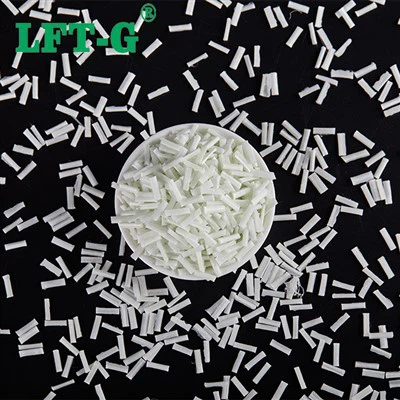
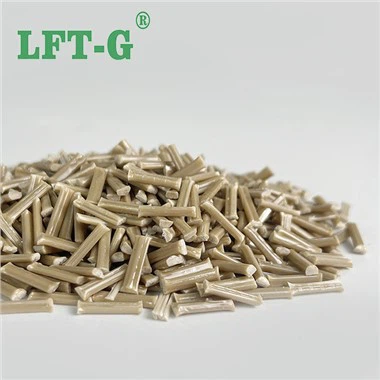
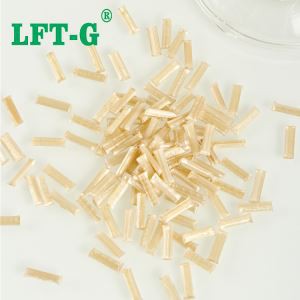
The method is to cut the prepreg material obtained by melting impregnation to obtain 6-10mm particles. The length of the particle is consistent with the length of the fiber, and the fiber is evenly distributed in the resin so that the material has high impact strength and modulus, the warpage is reduced, the shrinkage rate is reduced, the dimensional stability is increased, and the fatigue resistance of the product is improved.
The particles can be heated by an injection molding machine and injected into the mold, and then heated and pressurized in the mold. According to the type of thermoplastic resin and the product shape of the composite material, the temperature, pressure, and time of the process parameters are adjusted. The injection molding method can prepare products with complex shapes, which greatly expands the field of application.
Molding by molding

The simplest molding method is to take the resulting fiber-reinforced thermoplastic prepreg, multilayer superposition, superposition method is two adjacent layers 0/90°, and then in the pressing plate for hot pressing, to obtain sheet or another simple shape. This method is the most commonly used method for preparing sheets and sheets. In order to improve the working efficiency, double roll and three rolls calendering can also be used for molding.
In addition, the prepreg sheet is cut according to the size of the mold and heated in the heating furnace to a temperature higher than the melting of the resin. Then it is sent into the pressing die for rapid hot pressing and cooling to obtain the product. The forming cycle of this method is short. It is suitable for products with large thickness and density changes, complex shapes such as convex, concave, or radian, and also for products with embedded metal parts. This method has low energy consumption and production cost, but high production efficiency.
Pultrusion forming method

This method is a typical manufacturing process that can produce composite materials continuously and economically. Pultrusion molding technology is a continuous, automatic production process for high fiber content, high performance, and low-cost composite materials. In this method, the long fiber is impregnated with resin, then passes through the forming mold with a certain cross-section shape, and makes it solidified in the mold, and then the product is pulled out of the mold-forming process. The extrusion molding process has the following advantages: such as resin viscosity can be adjusted at any time, fiber content can be up to 80%; Automatic control of the production process, high production efficiency; The longitudinal and transverse strength of the product can be adjusted arbitrarily to meet the requirements of different mechanical properties of the product; Product quality is stable, repeatability is good, the length can be cut off arbitrarily; There is no corner waste in the production, and the product does not need post-processing, so it saves labor, materials and energy consumption compared with other processes.
Application of long fiber reinforced thermoplastic composites
Long fiber reinforced thermoplastic composites as structural materials can be used in industrial, civil, military and other fields, has been applied in aerospace, automotive, electrical equipment, communications, sports equipment, and other fields.
The automobile and high-speed rail
"Environmental protection, energy saving, and automotive lightweight" promote the rapid development of long fiber reinforced thermoplastic composite preparation, component design, and application. Long glass fiber-reinforced thermoplastic composites based on polypropylene (PP) have been widely used in automotive terminal parts. Data show that 80% of the demand for long glass fiber reinforced thermoplastic composites comes from the automobile industry (spare parts), which has been widely used in European brand cars. The special requirements of high performance and diversification of automobile parts also make long fiber-reinforced thermoplastic composites have more choices for fiber and resin. Long fiber-reinforced thermoplastic composites are used in the following parts: front end module, instrument panel, door module, body, bottom plate, and other complex shaped parts, including the complex parts obtained by the injection molding process, doors and Windows, body bottom plate, instruments and so on, or as the laminate materials such as the carriage guard plate and ceiling of box trucks. And the use of carbon fiber composite materials in high-end cars or sports cars, and racing cars is also increasing, and even the appearance of the entire carbon fiber composite vehicle.
The development of high-speed rail in China has more demands for long fiber reinforced thermoplastic composites, and the performance of different parts is different, which also makes the long fiber reinforced thermoplastic composites of high-speed rail show rich and colorful development.

Protective products
High-performance fibers such as aramid, ultra-high molecular weight, high strength, and high modulus polyethylene fiber and carbon fiber are molded into thermoplastic composite materials, which can be used for body armor, shields, helmets, and so on. High-performance long fiber and resin-reinforced thermoplastic composites can also be used in tanks, armored vehicles, and other armor.

Aerospace
Aviation has a special demand for advanced and high-performance materials, and different products in this field have diversified requirements for long-fiber reinforced thermoplastic composites, among which carbon fiber composites are the most prominent. Fiber composites are widely used in rockets, missiles,s and high-speed aircraft for their unique and excellent physical and chemical properties. For example, the use of carbon fiber and plastic composite materials made in aircraft, satellites, rockets, and other space vehicles, not only large thrust, low noise; And because of their lightweight, so less power consumption, can save a lot of fuel.

Building materials
The use of long fiber reinforced thermoplastic composite material in the field of high-grade building materials is mainly based on a plate, mainly with glass fiber reinforced PP, lightweight, high specific strength, specific modulus, corrosion resistance, good water resistance, easy to use, low cost, can be cut according to need, can be installed with screws, rivets, can also be hot melt welding and other advantages, It can be used as wall board, wall lining board, and building template. Continuous long fiber-reinforced thermoplastic composites can also be used to make high-quality plastic pipes.