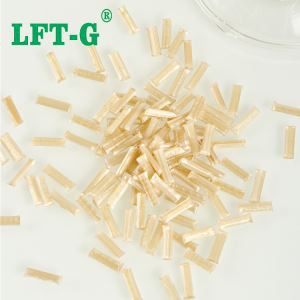

1. Influence of glass fiber filling specification on PA6 engineering plastics
We can find from the application and experiment that the content index is often one of the biggest influencing factors in fiber-reinforced composites.
With the increase in the glass fiber content, the number of glass fibers per unit area of the material will increase, which means that the PA6 matrix between the glass fibers will become thinner. This change determines the impact toughness, tensile strength, bending strength, and other mechanical properties of glass fiber-reinforced PA6 composites.
In terms of impact performance, the increase of glass fiber content will greatly increase the notched impact strength of PA6. Taking long glass fiber (LGF) filling PA6 as an example, when the filling volume increases to 35%, the notched impact strength will increase from the original 24.8J/m to 128.5J/m.
But the glass fiber content is not more is better, short glass fiber (SGF) filling volume reached 42%, and the impact strength of the material reached the highest 17.4kJ/㎡, but continuing to add will let the gap impact strength show a downward trend.
In terms of bending strength, the increase in the amount of glass fiber will make the bending stress can be transferred between the glass fiber through the resin layer; At the same time, when the glass fiber is pulled out of the resin or broken, it will absorb a lot of energy, thus improving the bending strength of the material.
The above theory is verified by experiments. The data show that when the LGF (long glass fiber) is used to fill up to 35%, the bending elastic modulus increases to 4.99GPa. When the content of SGF (short glass fiber) is 42%, the bending elastic modulus reaches 10410MPa, which is about 5 times that of pure PA6.

2. Influence of glass fiber retention length on PA6 composites
The fiber length of the glass fiber also has an obvious effect on the mechanical properties of the material. When the length of the glass fiber is less than the critical length (the length of the fiber which can make the material have the tensile strength of the raw fiber), the interface binding area of the glass fiber and the resin increases with the increase of the length of the glass fiber. When the composite material is broken, the resistance of the glass fiber pulled out of the resin is also greater, so as to improve the ability to bear the tensile load.
When the length of glass fiber exceeds the critical, the longer glass fiber can absorb more impact energy under the impact load. In addition, the end of the glass fiber is the initiation point of crack growth, and the number of the end of the glass fiber with a longer length is relatively less, and the impact strength can be significantly improved.
The experimental results show that the tensile strength of the material increases from 154.8MPa to 164.4MPa when the glass fiber content is kept at 40% and the length of the glass fiber increases from 4mm to 13mm. The bending strength and notched impact strength were improved by 24% and 28%, respectively.
Moreover, the research shows that when the original length of the glass fiber is less than 7mm, the material performance increases more obviously. Compared with short glass fiber, long glass fiber reinforced PA material has better warping resistance, and can better maintain mechanical properties under high temperature and humidity conditions.

3. The influence of glass fiber types on PA6 composites
The type and strength of glass fiber will have a difference in the overall strength of the material. At present, the main types of glass fiber have no alkali glass fiber, high strength glass fiber alkali resistant glass fiber, and so on.
Among them, the glass fiber with higher monofilament strength has a stronger bearing capacity, and the experimental results show that the high-strength glass fiber-reinforced PA6 has better mechanical properties than the ordinary non-alkali fiber-reinforced PA6.
It can be seen that the selection of glass fiber with high strength, high length, and appropriate filling amount can effectively help the material improve toughness, impact resistance, and other mechanical properties.

4. Influence of glass fiber addition process on PA6 composites
In the process of twin-screw modified granulation, the influence of the feeding position on the material properties in the blend of glass fiber and resin was studied. It was found that if the glass fiber was added earlier, the fiber would be easily destroyed and the length of the residual glass fiber would be smaller. When added late, the glass fiber is difficult to blend with the resin uniformly, and the combination is weak. Both of these conditions will make the overall performance of the material less than good results.
Using side feeding to add glass fiber is more convenient to control the content of glass fiber, and can reduce the fiber break. At the same time, in the process of extrusion granulation, increasing the extrusion temperature and reducing the extrusion pressure can improve the length of GF to a certain extent.

5. Influence of the extrusion process of modified granulation on glass fiber reinforced PA material
Experimental results show that low extrusion temperature is not conducive to the coating infiltration of the glass fiber, and high temperature will reduce the performance of the material itself. Therefore, when the amount of glass fiber is higher, it is better to increase the extrusion temperature to achieve better results.
When the twin-screw extrusion mechanism is used to prepare glass fiber reinforced particles, the tensile modulus, tensile strength, bending strength, bending modulus and other indicators of the material are gradually increased with the increase of the host speed from 70r/min to 300r/min. When the host speed is increased to 450r/min, the properties of the material have little change or slightly decreased.
In addition, the feeding speed will affect the residence time of the material in the screw. The tensile modulus, tensile strength, flexural modulus, flexural strength and even impact strength of the composites gradually decrease with the feed speed increasing from 8r/min to 26r/min at the same speed of the main engine.
Therefore, in the actual preparation process, it is necessary to make an appropriate choice between the material performance and the yield, so as to obtain the product with large yield and relatively good performance.

6. Effect of injection molding process on properties of glass fiber reinforced PA materials
In the process of injection molding, such as cylinder mold temperature, screw speed, injection pressure, holding pressure, back pressure, injection speed and other factors will affect the performance of molding products.
It is found that the tensile strength of glass fiber reinforced PA6 material is directly proportional to the temperature of the feed port, and inversely proportional to the injection speed and screw speed. The fracture of glass fiber will be aggravated with the increase of injection speed. But generally speaking, the change of injection process has no great influence on the mechanical properties of glass fiber reinforced PA6 injection parts.