

Why PP LGF40 Prevents Anisotropic Warping
Standard short glass fiber polypropylene compounds (PP GF40) fail in heavy-duty bumper assemblies because their short fiber lengths (typically <1mm) align along injection flow pathways. This high alignment causes severe differential mold shrinkage rates, resulting in structural warpage and dimensional deviations that prevent clean vehicle assembly.
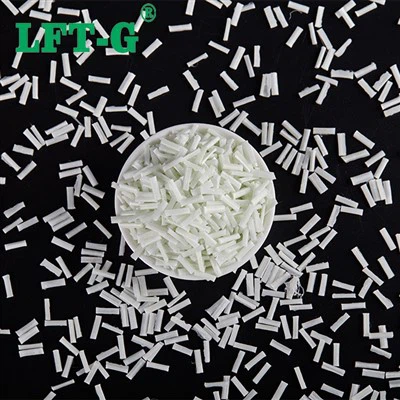
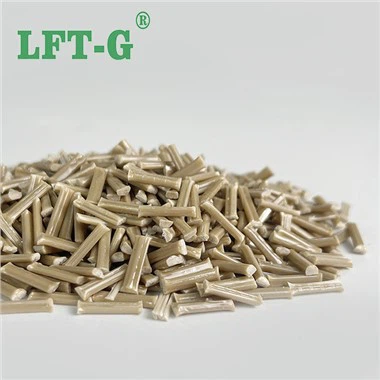
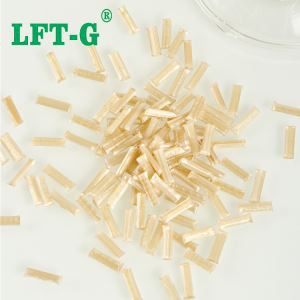
LFT-G® PP LGF40 preserves a continuous 12mm glass fiber length within each pellet. During molding, these fibers distribute in a random 3D interlocking network. This internal fiber skeleton ensures uniform shrinkage in all directions (isotropic cooling), delivering exceptional dimensional accuracy and preventing part deformation under heavy load cycles.
Material Data Verification: PP LGF40 vs. Traditional Compounds
The following technical data profile compares LFT-G® PP-LGF40-BG04 against standard short-fiber polyamide (PA6-GF40) under dry and wet (conditioned) states, highlighting the structural stability of long-fiber polypropylene.
| Mechanical Properties (Typical) | Test Standard | PP LGF40 (Dry / Wet) | PA6 GF40 (Dry State) | PA6 GF40 (Wet / Conditioned) |
|---|---|---|---|---|
| Density (g/cm³) | ISO 1183 | 1.21 (Constant) | 1.36 | 1.36 |
| Water Absorption (%) | ISO 62 | < 0.01% | 1.8% | 6.5% - 8.5% (Max Saturation) |
| Tensile Strength (MPa) | ISO 527 | 135 | 190 | 129 (42% Drop) |
| Tensile Modulus (MPa) | ISO 527 | 9,200 (Constant) | 1,1500 | 6,700 (41% Drop) |
| Notched Izod Impact (kJ/m²) | ISO 180 | 35.0 | 11.0 | 13.0 |
| Mold Shrinkage Range (%) | ISO 294-4 | 0.10% - 0.25% (Isotropic) | 0.35% - 0.85% | 0.45% - 1.20% (Anisotropic Warp) |
Field Proven Case Study: Carbon Steel Bumper Beam Replacement on Utility Trucks

The Challenge
An international commercial utility truck manufacturer used heavy, welded carbon steel bumper reinforcement beams. The 18 kg steel assembly was prone to low-frequency fatigue cracks and rust in harsh coastal and environmental conditions. The manufacturer evaluated cast aluminum, but it exceeded production cost limits and required extensive, costly post-molding machining.
The Solution
The design team replaced the metal beam with an injection-molded structural component using LFT-G® PP-LGF40-BG04 (40% long glass fiber reinforced polypropylene). The continuous fiber matrix offered metal-like bending stiffness, while consolidating 5 separate steel brackets into 1 integrated molded part.
The Results
- 42% Weight Reduction: Component weight dropped from 18 kg to 10.4 kg, directly increasing payload capacity.
- Parts Consolidation: Consolidated 5 separate steel brackets and reinforcement plates into 1 single molded part.
- Zero Warping & Distortion: Outstanding dimensional stability prevented sagging and warp under cyclic vehicle vibration.
- 100% Rustproof Performance: Polypropylene's native chemical resistance eliminated the need for external rustproof coatings.
Design Freedom and Component Integration
Welded carbon steel structures limit automotive designers to simple geometry, requiring multiple reinforcement brackets to handle localized stresses. Each weld line introduces potential failure points and labor-intensive assembly steps.
Using LFT-G® PP LGF40 allows engineers to mold complex, ribbed geometries directly. Reinforcement ribs, mounting tabs, and fastener holes are integrated into a single injection-molding step, eliminating secondary stamping, welding, and threading.

Processing Guidelines for 40% Long Glass Fiber Polypropylene
Because PP LGF40 has a high loading of continuous glass fiber, improper injection parameters can shear the fibers, turning the material into a standard short-fiber compound. The manufacturing team must adjust machinery setups according to these three guidelines:
Melt Temperature
Set barrel heating zones between 210°C and 240°C. Elevated temperatures reduce matrix viscosity, protecting the long fibers from mechanical shear breakage.
Nozzle & Gates
Avoid restrictive gates. Gates must have a minimum diameter of 4.0mm, and full round runners are highly recommended to prevent premature fiber breakage.
Screw Configuration
Utilize a low-compression ratio screw (1.2:1 to 1.5:1) with a deep feed zone. High-compression barrier screws degrade continuous fiber skeletons immediately.