
 PP-LGF30 vs. PA6-GF30: The Ultimate Engineer's Guide
In the world of engineering plastics, 30% glass-filled Polyamide 6 (PA6-GF30, or Nylon) has long been the established workhorse for structural components demanding high strength and stiffness. Its reputation is built on decades of use. However, relying on this legacy material often means designing around a critical, inherent flaw: moisture absorption. Engineers are forced to account for a material whose mechanical properties and dimensions are a moving target, constantly fluctuating with ambient humidity.
 What if there was a smarter alternative that eliminates this unpredictability? Enter Long Fiber Polypropylene (PP-LGF30), a high-performance challenger that offers not only robust mechanical properties but also near-zero moisture absorption, superior dimensional stability, significant weight savings, and a more favorable cost-performance ratio. This isn't just a simple material swap; it's a strategic upgrade.
This definitive guide provides a head-to-head, data-driven comparison of PP-LGF30 and PA6-GF30. We will move beyond surface-level data sheets to provide clear insights into real-world performance, processing advantages, and application suitability, empowering you to make a more informed and reliable material selection for your next project.
Decision Factor Scorecard
| Key Decision Factor | Winner | Critical Insight |
|---|---|---|
| Performance in Wet/Humid Environments | PP-LGF30 | PP is hydrophobic; its properties are stable. PA6 is hygroscopic; it absorbs water, losing stiffness and dimensional stability. |
| Lightweighting Potential (Density) | PP-LGF30 | PP-LGF30 is ~15-20% less dense than PA6-GF30, enabling significant weight savings. |
| Cost-Performance Ratio & Processing | PP-LGF30 | Lower material price combined with no need for pre-drying offers a lower total cost of ownership. |
| High-Temperature Strength (HDT) | PA6-GF30 | The polyamide matrix inherently has a higher melting point, giving PA6 a distinct advantage in high-heat applications. |
| Impact Strength (Toughness) | TIED / It Depends | PP-LGF30 has excellent impact. Conditioned PA6 is also very tough, but dry-as-molded PA6 is more brittle. |
Moisture: The Achilles' Heel of PA6
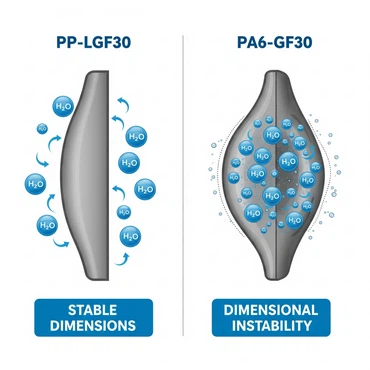
The single most critical factor to understand when comparing these materials is hygroscopy. PA6 (Nylon) is hygroscopic, meaning it readily absorbs moisture from the atmosphere. PP is hydrophobic-it repels water. This isn't a minor detail; it fundamentally changes how the material behaves in the real world.
What Happens When PA6 Absorbs Water?
- It Swells: A PA6-GF30 part can increase in size by 0.5% to 1.5% from its "dry-as-molded" state to a fully saturated state. This can ruin tight tolerances and cause assembly issues.
- It Gets Weaker & Softer: Water acts as a plasticizer in PA6, reducing its tensile strength and stiffness (modulus) by as much as 30-40%.
- It Gets Tougher: The trade-off is that moisture increases PA6's ductility and impact strength. A "dry" part is more brittle, while a "conditioned" part is tougher.
The result? A PA6 part's properties are constantly changing with the ambient humidity. In contrast, PP-LGF30's performance is stable and predictable, regardless of the environment.
The Data: PP-LGF30 vs. PA6-GF30 (Dry & Conditioned)
To make an accurate comparison, we must look at PA6 in two states: "Dry-As-Molded" (DAM) and "Conditioned" (at 50% relative humidity, ~2.5% moisture content). Notice how PA6's properties shift dramatically, while PP's remain constant.
| Property (Test Method) | PP-LGF30 (Stable) | PA6-GF30 (Dry) | PA6-GF30 (Conditioned) |
|---|---|---|---|
| Specific Gravity (ISO 1183) | 1.19 g/cm³ | 1.36 g/cm³ | ~1.38 g/cm³ |
| Tensile Modulus (ISO 527) | 7,300 MPa | 8,900 MPa | 6,700 MPa |
| Tensile Strength (ISO 527) | 118 MPa | 147 MPa | 113 MPa |
| Izod Notched Impact (ISO 180) | 38 kJ/m² | 12 kJ/m² | 25 kJ/m² |
| HDT @ 1.8 MPa (ISO 75) | 155 °C | 210 °C | ~190 °C |
Visit To More PP LGF Grade Material
Download Complete LFT PP LGF30 Data Sheet PDF
Application "Sweet Spot" Visualization & Analysis
 A simple data table tells part of the story, but a visualization helps crystallize the complex trade-offs involved in material selection. The radar chart below maps out the performance "sweet spot" for each material across five critical engineering and business axes. It clearly illustrates that while one material may excel in a single niche, the other often provides a more balanced and robust solution for a wider array of real-world challenges.
Interpreting the Results: Why PP-LGF30's Sweet Spot is Larger
The chart reveals that PP-LGF30 offers a significantly larger and more well-rounded performance profile, making it the optimal choice for a majority of new and existing structural applications. Here's a breakdown:
- √ Dominance in Wet Performance & Stability: This is PP-LGF30's greatest strength. Its hydrophobic nature means its mechanical properties and dimensions remain constant, whether the part is in a dry factory in Arizona or a humid port in Singapore. This predictability is invaluable for global product platforms and parts exposed to automotive fluids, cleaning agents, or outdoor weather.
- √ Superior Cost-Performance Ratio: PP-LGF30 consistently wins on total cost of ownership. The lower raw material price, combined with the elimination of costly and energy-intensive pre-drying steps required for PA6, provides a compelling economic advantage without a significant compromise on functional strength for most applications.
- √ Excellent Lightweighting Capability: The axis for "Lightweighting" (inverse of density) would show PP-LGF30 as a clear leader. Its ~15-20% lower density is a critical factor in the automotive industry for improving fuel efficiency and EV range, and in consumer goods for better ergonomics and lower shipping costs.
When to Specify PA6-GF30: The High-Temperature Niche
To build trust, it's essential to be transparent. PA6-GF30's smaller "sweet spot" is concentrated in one key area: extreme thermal resistance. Its higher melting point gives it a superior Heat Deflection Temperature (HDT), making it the necessary choice for a specific subset of applications, such as:
- Components mounted directly on or very near an engine block or exhaust system.
- High-temperature industrial connectors, housings, and gears operating continuously above 130°C.
However, this performance comes with a critical caveat: it is only reliable provided that the application environment has low humidity, and its higher total cost is justified by the extreme temperature requirement. For the vast majority of structural components that operate below this thermal threshold, the risks associated with PA6's moisture sensitivity often outweigh its thermal benefits.
A radar chart helps visualize the trade-offs. PP-LGF30 excels in cost-effectiveness and performance stability in all environments, while PA6-GF30's strength is its raw thermal resistance, provided humidity is controlled.
Beyond Price-per-Kilo: Total Cost of Ownership
Focusing solely on the raw material price is a common mistake. A true cost analysis reveals PP-LGF30's financial advantages:
- Lower Material Cost: Polypropylene is inherently a more cost-effective polymer than Polyamide.
- No Pre-Drying Required: PA6 must be meticulously dried for hours before processing to prevent hydrolysis. PP requires no such step, saving significant energy, time, and equipment cost.
- Faster Cycle Times: PP generally has a lower processing temperature and faster setup time than PA6, leading to higher manufacturing throughput.
- Weight Savings: With a 15-20% lower density, a part designed in PP-LGF30 requires less material by weight to fill the same volume, directly translating to cost savings.
Ready to Ditch the Instability of Nylon?
Stop designing around the unpredictable nature of moisture-sensitive materials. PP-LGF30 offers the robust, stable, and cost-effective performance modern engineering demands. Our team can help you convert your PA6 applications to high-performance LFT-PP.
Request a PA6 Conversion AnalysisFrequently Asked Questions
Q: Can PP-LGF30 truly replace PA6-GF30 in under-the-hood automotive applications?
A: In many cases, yes. For applications where the continuous operating temperature is below 120-130°C and impact strength is critical, PP-LGF30 is an excellent replacement. It offers better chemical resistance to automotive fluids and is not affected by humidity. For components very close to the engine block with higher temperature spikes, high-temperature resistant PA grades might still be necessary. However, for a wide range of structural components like front-end modules, battery trays, and HVAC units, PP-LGF30 provides a more stable and cost-effective solution.
Q: What does 'conditioning' mean for PA6?
A: 'Conditioning' is the process of allowing a 'dry-as-molded' Polyamide (Nylon) part to absorb ambient moisture until it reaches equilibrium (typically 2.5-3.5% moisture content at 50% relative humidity). This process is crucial because moisture acts as a plasticizer in PA6, making the part more ductile and tougher (higher impact strength) but also reducing its stiffness (modulus) and tensile strength.