

Primary Types of Fiber Used in High-Performance Composites
1. Glass Fiber (Fiberglass)
There are many different varieties of fiberglass, but for composites, two are the most common. E-glass fiber is the standard type in almost all fiberglass-reinforced products, while S-glass fiber (also known as R-glass or T-glass fiber) has significantly better tensile strength. S-glass fiber is usually smaller than E-glass fiber, has better adhesion in the resin matrix, and the impact performance is improved. But it costs a lot more. S-2 glass fiber is a higher-strength commercial S-glass fiber, which has twice the tensile strength of typical E-glass fiber and also has about 10-20% higher stiffness. But for almost all applications, E-glass fiber is sufficient.
Fiberglass is made by extruding molten (1700℃) mineral products (silica, aluminum and calcium oxide, etc.) through small diameter holes. Typically, E-glass fibers are about 10-25 microns in diameter, making them larger than carbon fibers.
2. Carbon Fiber
Carbon fibers come in many varieties, with varying mechanical properties and costs. The carbon fiber is not extruded directly from the molten material but is made by heat treatment of the precursor fiber, including pre-oxidation in an air atmosphere and carbonization in an inert atmosphere. Under tension, the carbon structure within the fiber aligns, helping to maximize tensile strength and stiffness.
The most common precursor used for carbon fiber is polyacrylonitrile (PAN) fiber. At present, the most common standard and medium modulus carbon fiber are based on PAN precursor. The modulus of carbon fiber prepared by the asphalt (pitch) precursor system is usually higher. A single carbon fiber is typically smaller than a glass fiber, just 5 microns in diameter. Modulus carbon fiber is often classified with Standard modulus, Intermediate modulus (IM), High modulus (HM), and Ultra-high modulus carbon fiber.
Other Specialty Reinforcing Fibers in Industry
Beyond traditional glass and carbon, specialized applications require unique fiber architectures:
- Kevlar Aramid Fiber: A synthetic aramid fiber developed by DuPont. Other commercial aramid fibers include Twaron, Technora, and Nomex. As a reinforcement fiber for composite materials, aramid fiber is mainly used for applications with high tensile strength and puncture, wear, and breakage resistance. They are often used in combination with carbon fiber or glass fiber.
- Basalt fiber: Made by using a melting and extrusion process similar to glass fiber. Its tensile strength and modulus are slightly higher than E-glass fiber but less than carbon fiber. The density is similar to that of E-glass fiber. The price is between E-glass fiber and carbon fiber.
- Ultra-high Molecular weight Polyethylene: Both Dyneema and Spectra are fibers made from ultra-high molecular weight polyethylene (UHMWPE) or high modulus polyethylene (HMPE) extruded filament. UHMWPE is rugged, durable, and frequently blended with carbon fibers to enhance composite toughness and impact energy absorption.
- High Molecular weight polypropylene: Innegra is a fiber made from high molecular weight polypropylene (HMPP). While not as strong as Kevlar or Dyneema, Innegra is tough and resistant to impact and breakage at a lower cost.
- Plant fibers: Oldest structural reinforcing fibers are wood and plant fibers (such as flax and jute). While offering ecological benefits, plant fibers struggle with moisture absorption and exhibit a wider range of mechanical inconsistency compared to engineered E-glass.
- Ceramic fibers: Used in ceramic matrix composites (CMC) for extremely high-temperature resistance. Non-oxide boron fibers possess incredible compressive strength, while Silicon carbide (SiC) fibers offer supreme hardness.

Transitioning Raw Fibers into Structural Solutions: The LFT Difference
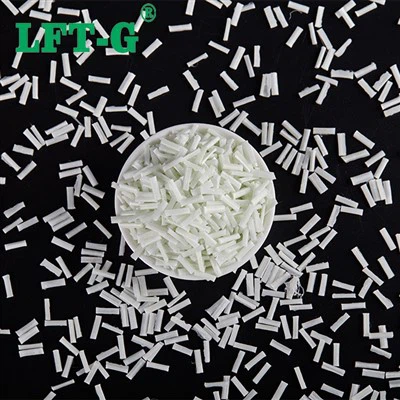
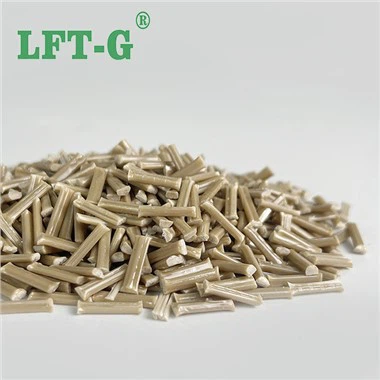
Simply mixing raw fibers with plastics is not enough for heavy-duty structural applications. Standard short-fiber compounds use chopped fibers under 1mm, which act as particulate fillers but fail to transmit mechanical stress efficiently. This is where Long Fiber Thermoplastics (LFT/LFRT) become essential.
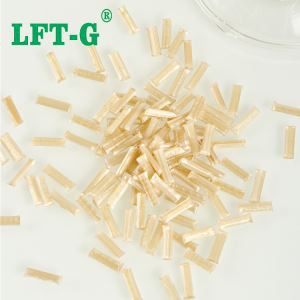
By utilizing continuous pultrusion compounding technology, LFT-G® aligns E-glass fibers or PAN carbon fibers inside polymer matrices (like PP, PA6, PA12, PPS, PEEK). In the final injection-molded component, these fibers retain a 10-12mm length, establishing a 3D interlocking skeleton network. This internal skeleton dramatically improves:
- Impact Resistance: Absorbs mechanical shock and prevents crack propagation.
- Dimensional Stability: Decreases mold shrinkage and eliminates warping.
- Metal Replacement Capabilities: Replaces heavy aluminum and steel components, reducing part weight by up to 50%.