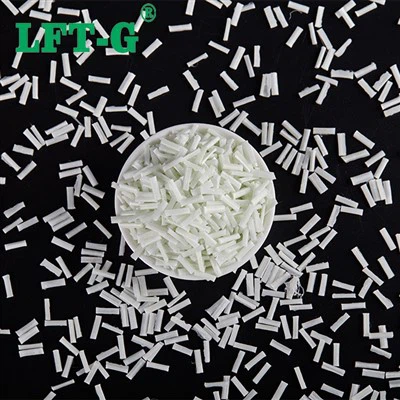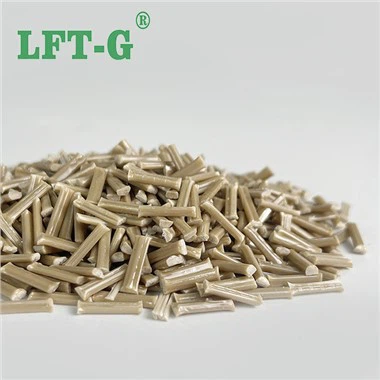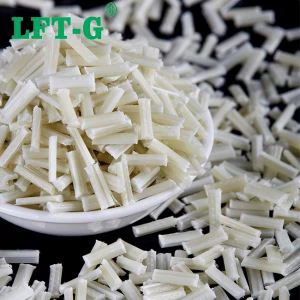

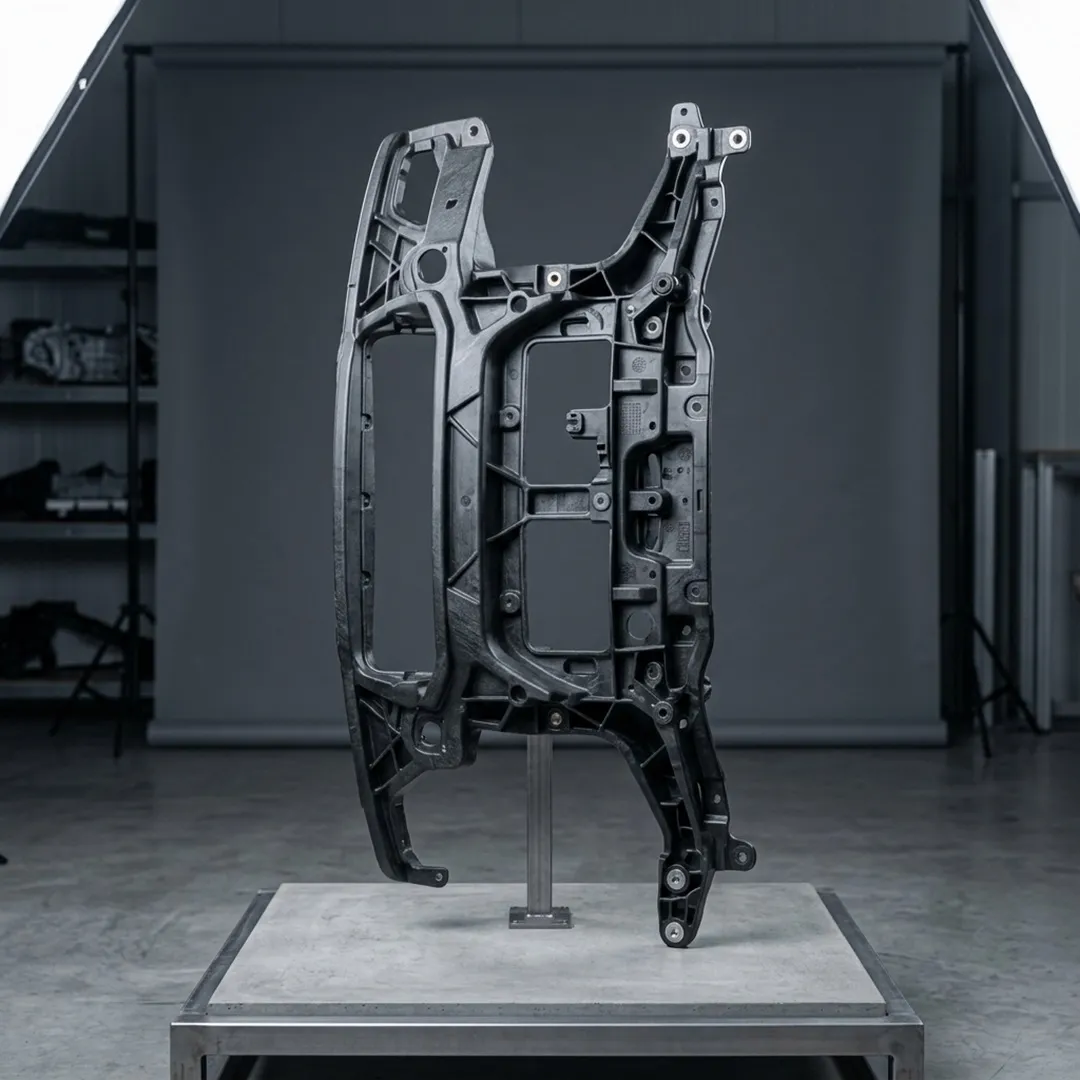
In the automotive sector, modular platform construction and lightweighting are primary pathways to lower carbon emissions and increase range, particularly for Electric Vehicles (EVs). The Front-End Module (FEM) is a critical integrated structural component, housing headlights, radiators, fans, condenser, intercooler, and hood locks. While moving from steel to Long Glass Fiber Reinforced Polypropylene (PP-LGF) yielded huge weight savings, integrating Microcellular Injection Molding (MuCell) technology pushes the boundaries of lightweighting and dimensional precision even further.
1. Introducing MuCell Foaming to Front-End Modules
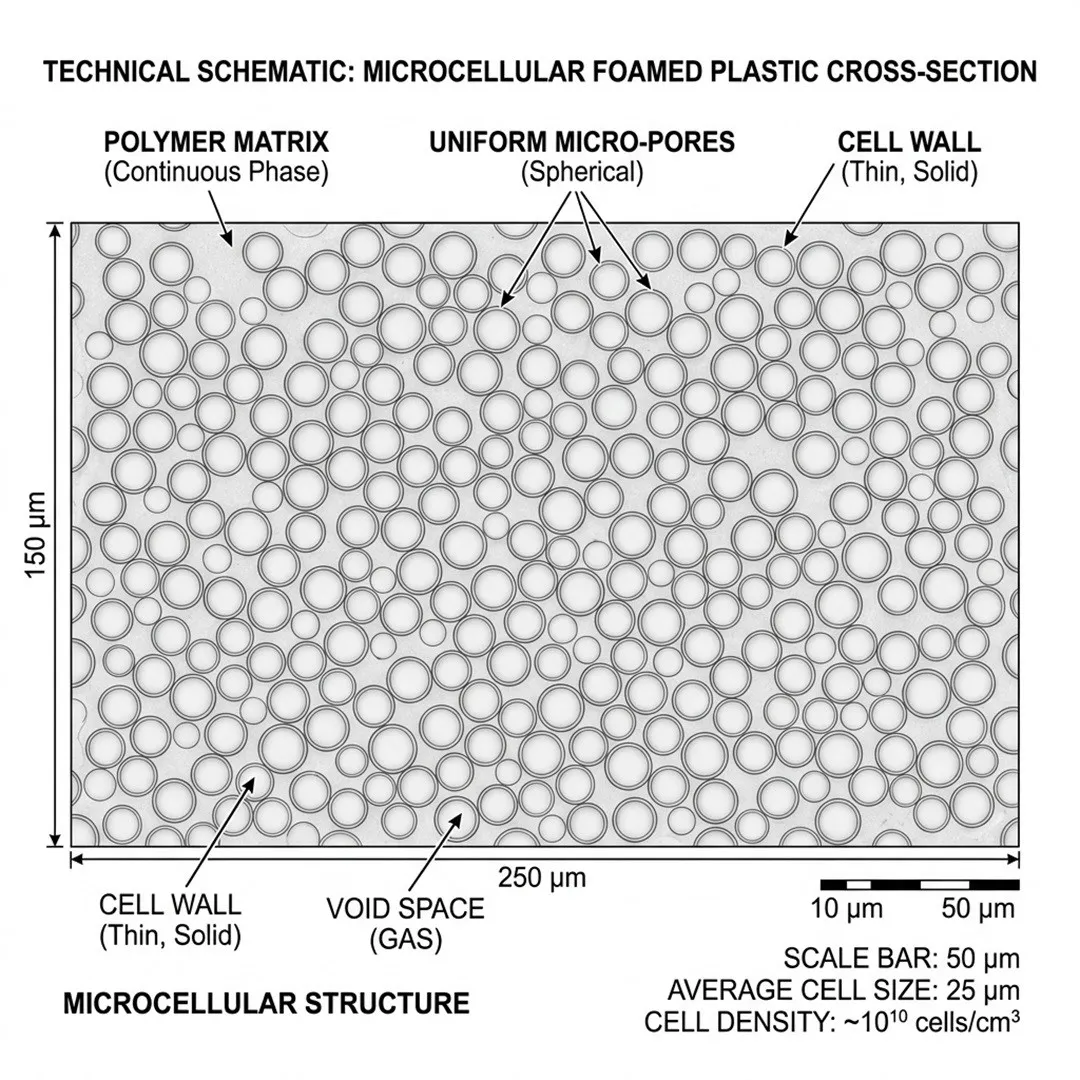
Microcellular foaming, pioneered as MuCell technology, relies on introducing a physical blowing agent-typically supercritical Nitrogen (SCF-N2)-directly into the polymer melt. Under high pressure, the gas dissolves, creating a single-phase melt solution.
Once injected into the mold cavity, the sudden drop in pressure triggers thermodynamic instability, causing the dissolved nitrogen to nucleate into millions of micro-cells. For Front-End Modules, combining PP-LGF with MuCell provides a dual lightweighting effect, reducing clamp pressure requirements, eliminating sink marks, and decreasing molding cycles.
2. The Chemistry of Foaming Rates and Cell Uniformity
The physical foaming rate determines both weight reduction and final structural integrity. Engineering research confirms that setting a 10% foaming rate offers the most uniform cell distribution inside PP-LGF parts.
If the foaming rate is pushed to 15% or higher, the micro-pores tend to expand excessively and merge (coalesce), forming large air pockets that act as localized stress concentrators. A uniform 10% foaming rate reduces part weight by approximately 11% while maintaining robust structural integrity across the entire surface of the module.
3. Mechanical Synergy: LGF Content & Fiber Orientation
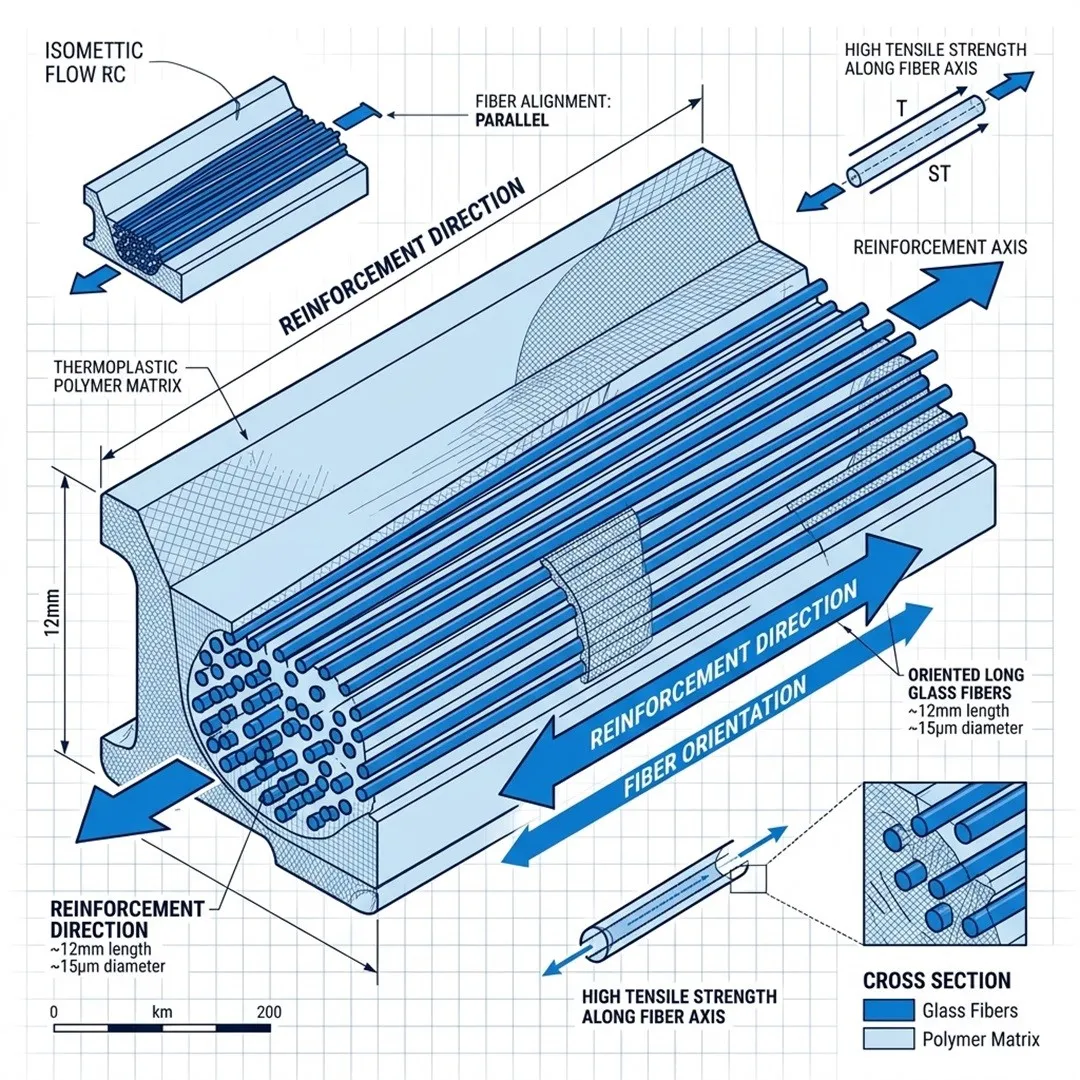
Since microcellular foaming introduces tiny voids into the structural component, it naturally reduces the load-bearing strength of the base polymer. To compensate for this mechanical drop, structural engineers increase the fiber volume fraction. Moving from 30% long glass fiber (PP-LGF30) to 40% long glass fiber (PP-LGF40) offsets the strength degradation caused by the foaming voids. The resulting foamed PP-LGF40 part delivers comparable or superior stiffness to unfoamed PP-LGF30 parts, but at a significantly reduced weight.
Furthermore, the mechanical behavior of LGF composites is highly anisotropic, governed by the orientation of the glass fibers. During the injection stage, the melt flow aligns the glass fibers.
Mechanical testing shows that when the fibers align parallel to the direction of stress (a 0° fiber orientation), the tensile strength and toughness reach their absolute peak. At 45° and 90° orientation, performance declines significantly. This law remains true in foamed components. Designers must align mold gates to orient fibers along primary load paths.
4. Environmental Temperature Factors
Automotive Front-End Modules operate in demanding environments, positioned directly in front of the high-heat engine compartment. At standard room temperatures (23°C), the micro-foamed PP-LGF40 behaves with excellent rigidity. When exposed to elevated temperatures up to 85°C, all polymers exhibit a degree of modulus reduction and increased creep.
However, the 3D long-fiber skeleton in PP-LGF40 provides much stronger creep resistance and retains high rigidity compared to short glass fiber PP. Even when foamed, the long glass fiber structure remains entangled, keeping heat-induced deformation to a minimum, ensuring radiator and hood latch alignments remain secure throughout the lifetime of the vehicle.
5. Conclusion and Design Recommendations
Integrating microcellular injection molding (MuCell) with PP-LGF40 is a highly effective design decision for modern automotive components. In summary, it enables design engineers to achieve:
- ✓ Weight Reduction: 11% to 19% additional weight savings over standard solid parts.
- ✓ Dimensional Accuracy: Massive reductions in volume shrinkage and part warpage.
- ✓ Processing Efficiency: Shorter cooling times and significantly lower mold clamping requirements.
For professional LFT composite formulation support and detailed CAE mold-flow simulation assistance, contact the technical team at LFT-G®. We provide high-performance LGF PP grades optimized for microcellular foaming applications.
With LFT Expert Connect in the Follow: