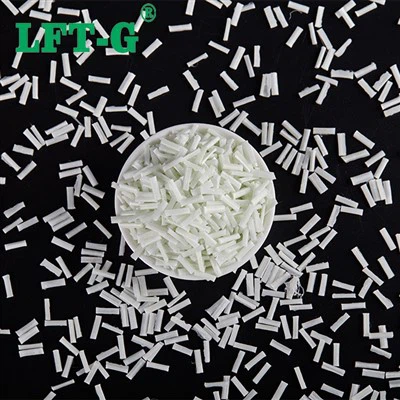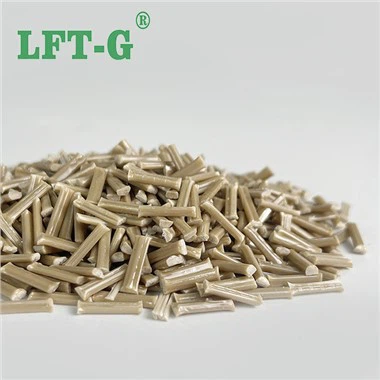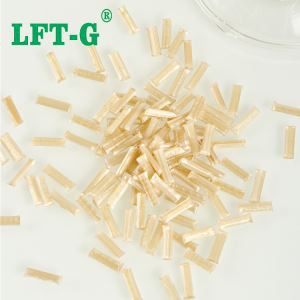

LCF PA6: The Remodeling of Material Genes
In the contemporary engineering field, the pursuit of "light weighting" has evolved from an optional choice to a core strategy. However, engineers have long been engaged in a difficult struggle among the "performance triangle" - namely, strength - weight - cost. The emergence of long carbon fiber reinforced polyamide 6 (LCF PA6) is precisely a crucial variable in this struggle. This article will deeply explore how LCF PA6 achieves a leap in macroscopic performance through its unique microstructure, and how it exerts its distinctive advantages in the automotive, aerospace, and industrial automation sectors.
Decomposition of LCF PA6 Material
To truly understand the revolutionary nature of LCF PA6 composite, we must go beyond the simple addition of "carbon fiber + nylon". Its core competitiveness stems from the three-dimensional long-fiber interlocking framework formed within the molded components.
Unlike the discrete and disordered distribution of fibers in short-fiber (SCF) materials, the LCF process (whether injection molding or extrusion) aims to maximize the length of the carbon fibers (typically within the range of 5-25 mm). During the melting and filling process, these long fibers interlock and overlap with each other. After the molten PA6 resin matrix cools and solidifies, a continuous stress transfer network runs through the entire component.
This microscopic form brings about a qualitative change in three major macroscopic properties:
Detail 1: When an LCF PA6 component is subjected to a high-speed impact, the weak points (fiber ends) of the short fiber material will quickly become the starting point of the crack. In an LCF structure, as the crack expands, it will encounter this three-dimensional "framework". LCF PA6 has an extremely efficient energy dissipation mechanism, giving LCF PA6 material extremely high impact toughness, especially in low-temperature working conditions where traditional nylon materials tend to become brittle.
Detail 2: LCF PA6 composite exhibits outstanding fatigue resistance and creep resistance. The internal fiber framework functions similarly to "pre-stressed steel bars". When the component is subjected to long-term cyclic loads, most of the stress is borne by the extremely rigid carbon fiber framework, while the PA6 matrix merely serves as a medium for stress transmission. This ensures that the component will hardly undergo permanent deformation, thereby guaranteeing its service life and accuracy under high-frequency vibration or long-term loading conditions.
Detail 3: The major weakness of PA6 (nylon 6) is its hygroscopic - when absorbing moisture, it undergoes swelling, resulting in dimensional changes and significant degradation of mechanical properties (especially stiffness). Carbon fibers, on the other hand, hardly absorb water and have a nearly zero coefficient of linear thermal expansion (CLTE). In LCF PA6 plastic pellet, the high content of carbon fiber matrix physically "locks" the PA6 matrix, significantly inhibiting its moisture absorption swelling and thermal expansion and contraction. This enables LCF PA6 components to maintain high precision dimensional stability even in humid or temperature fluctuating environments (such as the engine compartment of a car).
Mechanical PropertiesProperty |
Value |
Unit |
Test Standard |
|---|---|---|---|
| Tensile Strength | 260-280 | MPA | ISO 527 |
| Tensile Modulus | 30000-31000 | MPA | ISO 527 |
| Flexural Strength | 375-395 | MPA | ASTM D-790 |
| Flexural Modulus | 21000-22000 | MPA | ASTM D-790 |
| Specific Gravity | 1.0-1.5 | g/cm³ | ASTM D-792 |
Challenges and Prospects: The Layout of LCF PA6 Composite
Although LCF PA6 compound resin is highly performant, its promotion is not without challenges, and these challenges themselves indicate the future direction of innovation.
Challenges: The "double-edged sword" of anisotropy
The performance of LCF PA6 material largely depends on the orientation of the fibers. During the injection molding process, the fibers tend to align along the direction of the melt flow.
Innovation points: This is no longer a purely "material selection" issue, but an "integration of process and design" problem. Advanced CAE mold flow analysis software is dedicated to more accurately predicting the orientation distribution of long fibers. Engineers must utilize this "anisotropy" in the design stage - aligning the fiber's advantageous direction with the main stress direction of the component - to achieve a "customized" performance layout as per requirements.
Preview: Hybrid Molding and Sustainability
Hybrid Materials: The next step for LCF PA6 plastic pellet is "synergistic" integration with other materials. For instance, embedding metal in-mold inserts in specific areas (such as screw holes) to enhance local pressure-bearing capacity; or using it in a secondary injection process with continuous fiber-reinforced thermoplastic composites patches to achieve ultimate reinforcement with "continuous fibers" at critical stress points, while leveraging the complex shape molding capabilities of LCF PA6 composite in other areas.
Sustainability: As a thermoplastic composite material, LCF PA6 polymer has inherent advantages in recallability and circular utilization compared to thermosetting materials (such as epoxy resin-based ones).
LCF PA6 plastic granules is by no means a "stronger nylon". It is a high-performance engineering solution. Through its unique microfiber framework, it successfully achieves a new balance among strength, toughness, weight and dimensional stability. It is driving engineers to break away from their reliance on metals and explore designs that were "impossible" to achieve in the past due to material limitations, from the perspectives of system optimization and total cost of ownership. What LCF PA6 represents is not just a material, but also a future engineering philosophy about efficiency, integration, and sustainability.