
The Paradox of Aluminum: Is it Time for a Structural Revolution?
For decades, Aluminum 6061 and 7075 have been the "gold standard" for structural components in the drone and robotics industries. Their balance of weight and stiffness made them the default choice for airframes, robotic joints, and support brackets. However, as we move through 2026, the demands of the Low-Altitude Economy and Industrial Automation have hit a metallic ceiling. Metals are inherently limited by their isotropic nature and the intensive CNC machining required to produce complex, lightweight geometries.

Enter Long Carbon Fiber (LCF) Reinforced Composites. The shift we are witnessing today isn't just about weight-it's about structural integrity and the ability to engineer material properties at the molecular level. Our LFT-G® LCF technology is enabling a new generation of UAVs that fly longer and robots that move faster, all while maintaining a lower total cost of ownership. The question is no longer whether composites can replace aluminum, but how quickly your production line can adapt to this new reality.

Figure 1: LFT-G® LCF-reinforced drone components offering a 45% weight reduction over 6061 Aluminum counterparts.
Engineering the Advantage: Specific Strength & Modulus
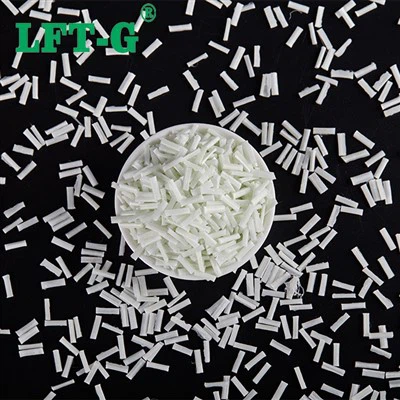
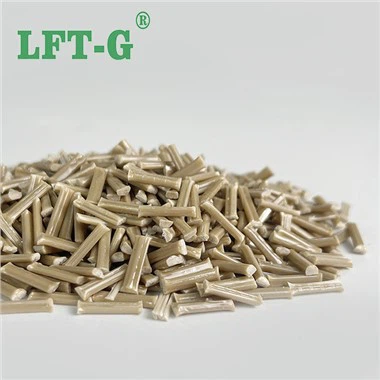
To understand why LFT-G® LCF is disrupting the market, one must look at Specific Strength-the ratio of a material's strength to its density. While aluminum has a density of approximately 2.7 g/cm³, our Long Carbon Fiber reinforced Polyamide (PA) or PPA matrices hover around 1.2 to 1.4 g/cm³. This allows for a dramatic increase in performance metrics without the mass penalty.
The Formula for Performance:
Specific Strength = Tensile Strength (σ) / Density (ρ)
In laboratory benchmarking, LFT-G® LCF composites demonstrate a specific modulus that can be up to 3 times higher than traditional aluminum alloys. For a UAV flying at high altitudes or a robotic arm performing high-frequency pick-and-place tasks, this translates to reduced inertia, higher precision, and significantly lower energy consumption.
Beyond the First Flight: Overcoming Metal Fatigue
Aluminum is notorious for its lack of a fatigue limit; eventually, every aluminum structural part subjected to cyclic loading will fail. In the world of Robotics Structural Integrity, where joints and limbs undergo millions of cycles, this is a critical liability. Metal replacement in robotics isn't just a trend-it's a safety necessity.
LFT-G® LCF composites utilize a 3D interwoven network of long carbon fibers that effectively blunts crack propagation. When a robotic component is subjected to vibration, the polymer-fiber interface dissipates energy, providing inherent vibration damping that metals simply cannot offer. This leads to a lifespan increase of 200-300% in high-vibration environments, making LCF the superior choice for the 2026 industrial landscape.

Figure 2: Precision robotic arm joints utilizing LFT-G® LCF to achieve ultra-low inertia and high stiffness.
From Prototype to Mass Production: The Injection Molding Revolution
One of the biggest hurdles for traditional carbon fiber (laminates/prepregs) has been the slow, labor-intensive production process. However, Injection Molding Carbon Fiber using LFT-G® pellets bridges the gap between high performance and mass-market scalability.
- Design Freedom: Complex internal ribs and integrated fasteners can be molded in a single shot, eliminating the need for multi-part aluminum assemblies and heavy bolts.
- Cycle Time: While a CNC-machined aluminum part might take hours to produce, an LFT-G® LCF part can be injection molded in 45-90 seconds.
- Waste Reduction: Scrap rates in CNC machining can reach 70%; injection molding LFT-G® is a near-net-shape process with minimal waste.
-

B2B Decision Matrix: LFT-G® LCF vs. Aluminum 6061
| Feature | Aluminum 6061-T6 | LFT-G® LCF Composite |
|---|---|---|
| Density (g/cm³) | 2.70 | 1.18 - 1.45 |
| Corrosion Resistance | Requires Coating | Inherent / Excellent |
| Fatigue Limit | Non-existent | High / Extended Life |
| Production Method | CNC / Casting | High-Speed Injection Molding |

Figure 3: The 2026 vision of fully integrated, LFT-G® reinforced structural components for humanoid robots.
Conclusion: The LCF-G® Era has Arrived
The "Death of Aluminum" might sound provocative, but in the context of high-speed robotics and long-endurance UAVs, it is a data-driven reality. As we analyze the feedback from Chinaplas 2026, it is clear that the industry's leaders are moving away from the weight and rigidity of metals toward the intelligent design of long fiber composites. By selecting LFT-G® LCF, you are choosing a material that offers superior specific modulus, better fatigue life, and the manufacturing speed required to dominate the global market.
Partner with the LFT-G® Engineering Team
Optimize your UAV or Robotics project with our advanced LCF solutions. Let's discuss your metal replacement strategy today.
© 2026 Xiamen LFT Composite Plastic Co., Ltd. All Rights Reserved.
Your Premium trial has ended