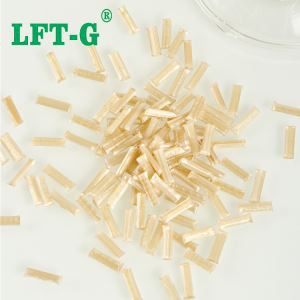
Is carbon fiber basically plastic? The Truth About Composites
This is a common and understandable question. The simple answer is no: carbon fiber itself is not a plastic. Carbon fiber is a high-strength reinforcement material, consisting of microscopic crystalline filaments of carbon. A plastic, or polymer, is a matrix material that acts as a binder. The high-performance material that people commonly refer to as "carbon fiber" is actually a composite-a sophisticated combination of these two distinct components.
Think of it like reinforced concrete: the steel rebar provides the tensile strength, while the concrete holds it all together. In carbon fiber nylon, the carbon fibers provide exceptional stiffness and strength, and the nylon (plastic) matrix binds the fibers, transfers the load between them, and provides toughness and chemical resistance. Our LFT-G® PA12 CF is an advanced version of this, using a premium Polyamide 12 matrix and long carbon fiber (LCF) reinforcement to create a material that is far more capable than any basic plastic.
In the industrial sector, this material system is professionally designated as Carbon Fiber Reinforced Plastic (CFRP). By engineering the ideal synergy between carbon fibers and high-performance engineering plastics, LFT-G® enables companies worldwide to achieve critical lightweighting targets and execute structural metal replacement with confidence.
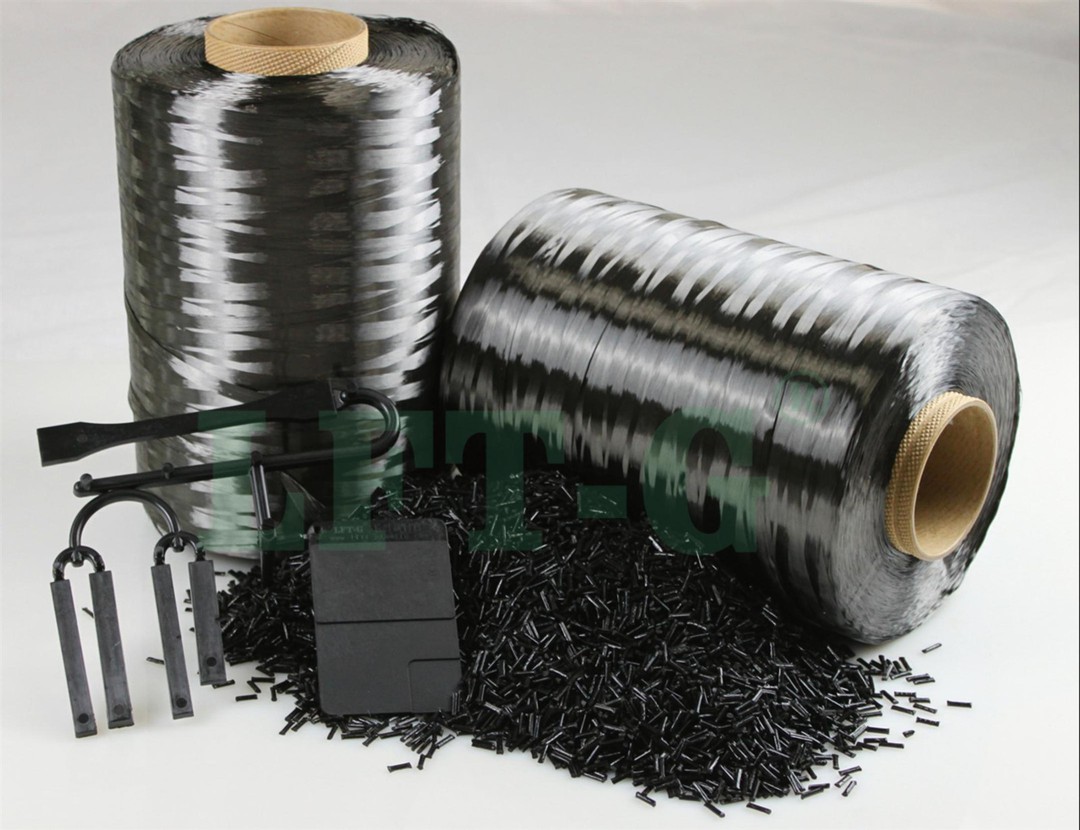
Understanding the Anatomy of Carbon Fiber Reinforced Plastic (CFRP)
To understand why carbon fiber is not simply plastic, it is essential to analyze the two distinct phases of a CFRP composite. Each component plays a vital role in the structural outcome of the molded parts:
1. The Reinforcement Phase (Carbon Fiber)
These are microscopic filaments composed of crystalline carbon atoms aligned longitudinally. Raw carbon fibers possess extreme tensile strength and stiffness but are flexible and cannot carry loads alone. They act as the structural "bones" of the compound.

2. The Matrix Phase (Thermoplastic Polymer)
The matrix is the plastic polymer (such as Polypropylene, Nylon PA6, Polyamide 12, PPA, or PEEK) that encapsules the fibers. The matrix acts as the "flesh," binding the fibers in place, protecting them from chemical degradation, and distributing external mechanical stresses.

By selecting different polymer matrices, LFT-G® engineers custom materials to withstand extreme environments, low temperature impacts, high heat exposures, and chemical solvents, providing unparalleled design freedom compared to monolithic plastics.

LFT-G® Carbon Fiber Nylon for UAV Propellers
The unmanned aerial vehicle (UAV) and drone industry demands the ultimate in lightweight strength and reliability. LFT-G® PA12 CF is the ideal material for these demanding structural applications. The PA12 matrix provides exceptionally low moisture absorption, ensuring that components maintain their dimensional stability and mechanical properties regardless of humidity or weather-a critical factor for consistent flight performance.
The long carbon fiber (LCF) reinforcement delivers the extreme stiffness needed for precise aerodynamic control and the fatigue resistance required for long-term durability. Specific UAV component applications include:
- UAV Propellers: High stiffness-to-weight ratios allow for thinner, aerodynamic airfoils that respond instantly to motor speed changes.
- Drone Airframes & Arms: Creating a rigid skeleton that resists flex under load, crucial for stable payload carrying.
- Landing Gear Struts: Shock-absorbent carbon fiber network structures that disperse impact energy during hard landings.
What is the difference between PC and carbon fiber nylon?
While Polycarbonate (PC) is an amorphous polymer highly valued for its optical clarity and impact toughness, it falls short in applications requiring high rigidity, chemical defense, and fatigue endurance. In contrast, LFT-G® PA12 CF30 (a semi-crystalline Polyamide 12 reinforced with 30% long carbon fiber) is engineered specifically for metal replacement under heavy load.
| Property (Typical Values) |
Polycarbonate (PC) |
LFT-G® PA12 CF30 (Long Fiber) |
LFT-G® Advantage |
| Density (g/cm³) |
~1.20 |
~1.08 |
Lighter (10% Reduction) |
| Tensile Strength (MPa) |
~60 |
~185 |
>3x Stronger |
| Flexural Modulus (GPa) |
~2.4 |
~18.0 |
~7.5x Stiffer |
| Notched Izod Impact (kJ/m²) |
~60 |
~25 |
PC has higher raw toughness |
| Water Absorption (24hr, %) |
~0.15 |
~0.20 |
Both are Excellent (Low) |
Note: Data represents typical values for general comparison. While unfilled PC offers excellent impact energy absorption, it cannot match the mechanical strength, dimensional stability, or petroleum-based chemical resistance of LFT-G® PA12 CF composites. For robust structural engineering, long carbon fiber nylon is the superior metal-replacement solution.
What are the benefits of carbon fiber nylon?
By combining carbon fibers with a nylon matrix, LFT-G® carbon fiber nylon composites deliver a unique set of properties that far exceed those of unreinforced plastics.
- Exceptional Strength & Stiffness-to-Weight Ratio
- Significant Lightweighting for Metal Replacement
- Superior Fatigue, Creep, and Wear Resistance
- High Impact Strength (Optimized by LCF Structure)
- Excellent Chemical and Hydrolysis Resistance (Especially PA12)
- Very Low Coefficient of Thermal Expansion (CTE)
- Outstanding Dimensional Stability (Low Moisture Absorption)
- Tunable Electrical Conductivity for ESD/EMI Shielding
- Design Freedom for Complex Injection Molded Parts
The Science of Long Carbon Fiber (LCF) vs. Short Carbon Fiber (SCF)
Why does fiber length matter so much in plastics? Standard short carbon fiber compounds (SCF) utilize fibers chopped into tiny fragments (typically less than 1mm). During high-shear injection molding, these short fibers undergo further breakage, preventing them from distributing loads effectively. They act merely as particulate fillers.

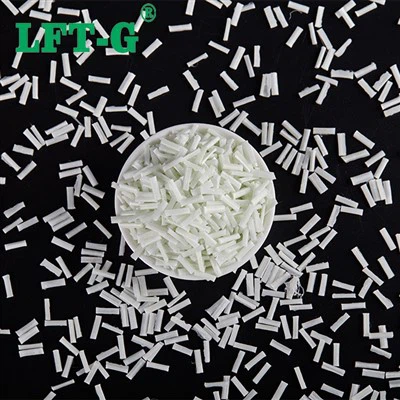
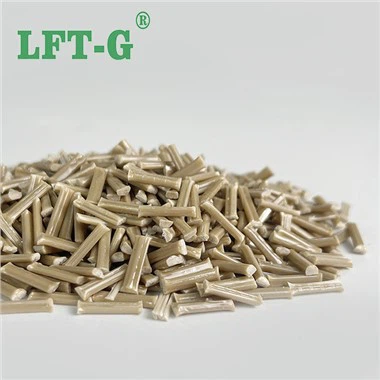
The LFT-G® Pultrusion Difference: In our pultrusion manufacturing process, continuous carbon fiber strands are pulled through a specialized crosshead die where they are completely impregnated with molten polymer matrix. When cut, the resulting pellets maintain a fiber length of 10-12mm. Once injection-molded, these fibers maintain an overlapping 3D skeleton network. This continuous framework distributes external mechanical stresses throughout the entire structure, resulting in excellent creep resistance and superior impact absorption.
This 3D interlocking skeleton also dramatically lowers isotropic mold shrinkage (between 0.1% and 0.2%), preventing the part warping and dimensional deformation common in highly filled short-fiber alternatives.
Frequently Asked Questions (FAQ)
Q: Is carbon fiber a type of plastic?
A: No. Pure carbon fiber consists of carbon filaments, not polymers. However, commercial carbon fiber components are Carbon Fiber Reinforced Plastic (CFRP) composites that bind these fibers in a thermoplastic or thermoset plastic matrix.
Q: Does carbon fiber melt under high heat?
A: Carbon fibers themselves can withstand temperatures up to 3000°C in non-oxygen environments. However, the composite structure will soften or melt depending on the plastic matrix's melting point (e.g., ~260°C for Nylon, >340°C for PEEK).
Q: How does LCF compare to short fiber?
A: LFT-G® long carbon fiber (LCF) composites retain 10-12mm fibers, forming a 3D structural skeleton. Standard short fibers (SCF) are under 1mm and cannot form an interlocking network, resulting in lower stiffness and poor fatigue performance.
Q: What plastic matrix is best for UAVs?
A: Polyamide 12 (PA12) is the optimal matrix for outdoor drone applications because of its extremely low moisture absorption. Combined with carbon fibers, it maintains mechanical properties and dimensional stability in humid conditions.