
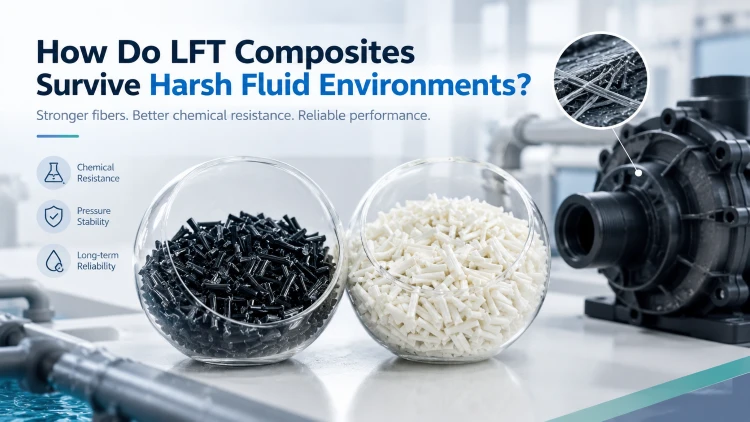
How Do LFT Composites Survive Harsh Fluid Environments?
A practical guide to hydrolysis resistance, chemical compatibility, and pressure fatigue for pump, valve, and fluid-handling components.
A pump housing that absorbs water will swell, lose dimensional precision, and eventually crack. A valve body exposed to coolant will degrade if the polymer is not hydrolysis-stable. A fluid connector under cyclic pressure will fail if the fiber network cannot distribute stress. These are not hypothetical concerns - they are the daily reality of fluid engineering.
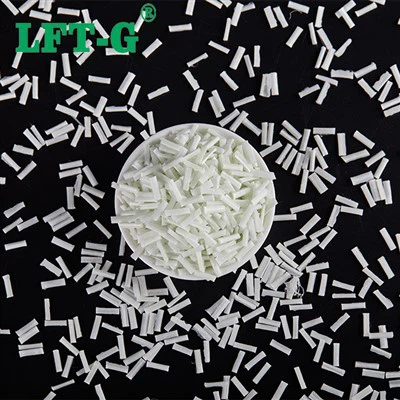
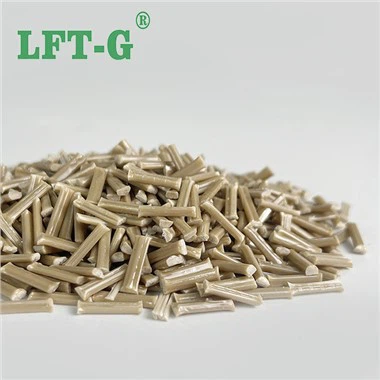
LFT-G® has developed a family of long fiber reinforced thermoplastics specifically for these conditions, including custom hydrolysis-resistant grades such as CPP-LGF40YD and CPP-LGF50YD, formulated for pump housings, impellers, and other fluid-contact components. This guide explains the mechanisms that matter, how LFT addresses them, and how to validate performance for your application.
Hydrolysis Stability: The First Requirement
Hydrolysis is the chemical breakdown of a polymer caused by water. In fluid components, it is the primary aging mechanism for hot-water and coolant-exposed parts. Water molecules attack the polymer chains, gradually reducing molecular weight. The result is embrittlement, loss of strength, and eventual cracking - often without any visible warning until failure.
Hydrolysis resistance is therefore not a nice-to-have property for fluid components. It is the baseline requirement. Without it, every other performance attribute - strength, stiffness, fatigue life - becomes temporary.
LFT-G® addresses this at the material formulation level. Our CPP-LGF40YD and CPP-LGF50YD grades are built on hydrolysis-stable polymer systems and paired with long glass fiber reinforcement. The fibers themselves are unaffected by water; the formulation ensures that the matrix and the fiber-matrix interface retain their integrity under continuous or intermittent hot-water exposure. This is what allows these grades to be specified for pump housings and impellers where conventional materials would degrade over time.
Practical guidance: For hot-water or coolant-contact parts, specify hydrolysis-resistant grades such as CPP-LGF40YD or CPP-LGF50YD. These are formulated for long-term fluid exposure, not just short-term splash contact.
Chemical Compatibility: Know What's in the Fluid
 Fluid-handling components rarely see only water. Coolants contain glycols and corrosion inhibitors. Hydraulic fluids contain additives. Industrial processes use detergents, solvents, and process chemicals. The material must be compatible with all of them - not just the primary fluid.
LFT-G® fluid-grade materials are formulated for broad chemical compatibility. They resist aqueous solutions, oils, fuels, hydraulic fluids, salt solutions, and a wide range of industrial chemicals. The polymer system's low moisture absorption maintains dimensional stability even under immersion-sealing surfaces, mating tolerances, and fit-up dimensions stay within specification over time.
This combination - chemical resistance plus dimensional stability - is what makes LFT-G® materials suitable for components where leak-free performance depends on maintaining precise clearances and sealing surfaces throughout service life.
Selection framework: Identify the full fluid stream - primary fluid, additives, and any secondary chemicals - along with the maximum continuous temperature and pressure class. Share this with our engineering team to confirm compatibility and select the appropriate grade.
Pressure Fatigue: The Fiber Network's Role
Fluid components do not see static loads. Pumps cycle. Valves open and close. Hydraulic systems pulse. Every pressure cycle sends stress through the housing, and the material must resist progressive damage over millions of cycles.
The long glass fiber network in LFT-G® materials distributes stress across the entire part rather than concentrating it at localized points. Cracks that initiate in the polymer matrix encounter the fiber network and are forced to navigate around and between fibers - a process that consumes far more energy than crack growth in an unreinforced polymer. The result is a component that resists progressive damage and lasts longer under cyclic pressure.
This fatigue resistance is particularly important in fluid components because failure is often progressive rather than sudden. A material that resists fatigue gives maintenance teams time to detect and address issues before a catastrophic leak or rupture occurs.
Design note: For pressure-retaining components, specify LFT-G® fluid-grade materials with fiber content and wall thickness validated for the intended pressure class. Our engineering team can provide fatigue data and design recommendations for your specific operating conditions.
How to Validate Performance
Material selection is the starting point. Validation is what confirms the part will perform in service. Three tests are particularly relevant for fluid components.
Hydrolysis testing. Immerse test specimens in the target fluid at the maximum operating temperature for a defined period , then measure retention of tensile strength, impact strength, and dimensional change. This confirms that the polymer matrix and fiber-matrix interface survive the exposure.
Chemical immersion testing. For each chemical in the fluid stream, verify compatibility at the expected concentration and temperature. Pay particular attention to sealing surfaces and thin-wall sections, where degradation may appear first.
Pressure cycling. Subject the finished component to the intended pressure profile for the expected number of cycles. Monitor for dimensional change, crack initiation, and leakage. This is the most direct validation of fatigue performance in the actual geometry.
LFT-G® support: We provide material-specific hydrolysis and chemical resistance data, and can assist with test protocol design for your application. Contact us for validation guidance before committing to production tooling.
Key Requirements for Fluid-Grade LFT
Fluid environments are demanding, but they are not unpredictable. Hydrolysis, chemical attack, and pressure fatigue follow known mechanisms - and LFT-G® materials are engineered to address them.
- Hydrolysis resistance - dedicated grades such as CPP-LGF40YD and CPP-LGF50YD are formulated for hot-water and coolant exposure.
- Chemical compatibility - resistance to oils, fuels, hydraulic fluids, salts, and industrial chemicals, with dimensional stability under immersion.
- Pressure fatigue - the long fiber network distributes stress and resists progressive damage under cyclic loading.
LFT-G® provides fluid-engineered grades, application-specific validation data, and design support for pump housings, valve bodies, impellers, and fluid-handling components. If you are evaluating LFT for a fluid application, reach out to our engineering team. We will help you select the right grade and validate it for your operating environment.
LFT team: ready to support your fluid engineering application
Xiamen LFT Composite Plastic Co., Ltd. is a global supplier of long-fiber-reinforced thermoplastics with 20+ years of innovation. We specialize in LFT‑PP, LFT‑PA, LFT‑PPS, and LFT‑Elastomers – offering high‑strength, lightweight alternatives to metal for automotive, aerospace, industrial, and fluid-handling applications. Our engineering team provides material selection, chemical compatibility assessment, design review, and on-site technical support for customers worldwide. Reach out for a free consultation.