
Beyond Rubber: Engineering the Perfect Shot With  LFT-G® TPU LGF40 For Recoil Pads
In the pursuit of marksmanship, control is everything. For designers of high-end sporting and tactical firearms, mitigating recoil is a critical frontier in enhancing that control. A harsh recoil not only causes shooter discomfort and fatigue but also compromises sight recovery and follow-up shot accuracy. For years, the solution was simple: a soft rubber pad. But rubber is a compromise-a trade-off between softness and stability. Today, advanced material science offers a superior path forward. This article is an engineering breakdown of how **LFT-G® TPU LGF40 (Long Fiber Thermoplastic Polyurethane)** composites are not just improving recoil pads, but re-engineering the entire shooter experience from the ground up.
Modern firearms demand advanced materials that deliver both comfort and control.
The Recoil Paradox: Why Softness Isn't Enough
Designing the ideal recoil pad presents a fundamental engineering conflict we call the "Recoil Paradox." A material must be soft and compliant enough to absorb and dissipate the violent, instantaneous shock of firing. However, it must also be stiff and stable enough to provide a firm, non-mushy anchor point for the shooter's shoulder, ensuring a consistent and repeatable shooting stance. Traditional materials struggle to satisfy both needs simultaneously:
- Soft Rubbers: Excellent at absorbing shock but can feel "mushy" or "spongy," leading to an unstable shoulder interface and inconsistent sight alignment shot after shot.
- Hard Plastics/Woods: Provide a very stable platform but transfer almost all the recoil energy directly to the shooter, leading to significant discomfort and flinching.
Solving this paradox requires a material that doesn't just compromise between toughness and stiffness, but possesses both properties at an elite level. This is where engineered composites enter the picture.

The ideal material must solve the conflict between energy absorption and structural stability.
The LFT-G® TPU LGF40 Advantage: An Engineering Breakdown
Our LFT-G® TPU LGF40 is not a single material, but a synergistic composite system designed specifically to solve the Recoil Paradox. Let's deconstruct its components to understand how it achieves this.
The TPU Matrix: The "Shock Absorber"
The foundation of the composite is a high-performance Thermoplastic Polyurethane (TPU) matrix. TPU is an elastomer known for its exceptional damping properties-the ability to absorb kinetic energy and convert it into negligible heat. When the firearm is fired, the TPU matrix absorbs the initial high-frequency shockwave, effectively "taking the sting out" of the recoil impulse. Furthermore, its elastomeric nature gives the material excellent abrasion and tear resistance, far superior to many thermoset rubbers.


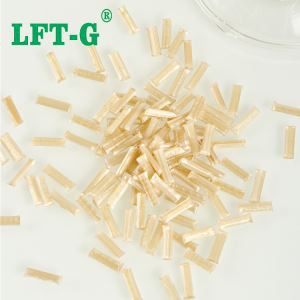
The LFT-G® composite combines a damping TPU matrix with a reinforcing LGF skeleton.
The 40% LGF Network: The "Structural Frame"
Embedded within this energy-absorbing matrix is a precisely engineered network of 40% long glass fibers (LGF). These fibers form a three-dimensional internal skeleton throughout the part. This LGF network is the source of the material's critical stiffness and structural integrity. It prevents the TPU from over-compressing under load, providing the shooter with a solid, responsive, and predictable shoulder interface. This reinforcement is what eliminates the "mushy" feeling of pure elastomers and ensures the firearm returns to the same position consistently.
The Synergistic Effect: Toughness Meets Stability
The true innovation of LFT-G® TPU LGF40 is how these two components work in concert. The TPU matrix absorbs the shock, and the LGF skeleton provides the stability. This synergy results in a material with "No Break" impact strength-it can withstand thousands of violent recoil cycles without cracking, chipping, or degrading. This combination of properties is simply unattainable with monolithic materials like rubber or basic plastics.
The Proof: A Case Study in High-End Firearm Design
The theoretical benefits of LFT-G® TPU LGF40 are proven in real-world applications. We partnered with a manufacturer of high-end sporting rifles to put this material to the test.
The Challenge
A manufacturer of high-end sporting rifles needed to develop a new recoil pad for their flagship product. The goal was to significantly reduce the "felt recoil" for the shooter, enhancing comfort and accuracy. The material needed to be exceptionally tough to absorb the violent, instantaneous shock of firing, yet stiff enough to provide a stable, non-mushy interface with the shoulder. It also needed to be resistant to gun oils and cleaning chemicals, and maintain its performance in both hot and cold weather.
 The Solution: LFT-TPU-LGF40-NG04M
Our LFT-G® TPU composite was the perfect material for this demanding application. The inherent damping properties of the TPU matrix absorbed and dissipated the recoil energy, while the 40% long glass fiber network provided the structural reinforcement needed for a solid, responsive feel. The material's "No Break" impact strength ensured it could withstand thousands of firing cycles without cracking or degrading. Its polyester base provided excellent resistance to common firearm chemicals.
The Measurable Difference: Quantifying the Results
The adoption of LFT-G® TPU LGF40 resulted in clear, quantifiable improvements that directly enhanced the product's value and the end-user's experience.
>30%
Reduction in Felt Recoil
Lighter
Component Weight
Superior
Durability & Chemical Resistance
From Concept to Component: The Manufacturing Advantage
Beyond end-user performance, LFT-G® TPU LGF40 offers significant advantages for firearm manufacturers. As a thermoplastic, it can be precision injection molded. This process provides:
- Design Freedom: Create complex, ergonomic shapes and integrate features like logos, textures, and mounting points directly into the part, eliminating secondary operations.
- Part-to-Part Consistency: Injection molding ensures every recoil pad produced has the exact same material properties and dimensions, guaranteeing consistent performance for every rifle that leaves the factory.
- Scalable Production: High-speed molding cycles allow for rapid, scalable production to meet market demand, a significant advantage over slow-curing thermoset rubber processes.
Engineer Your Next Component with LFT-G® Composites
Whether it's a recoil pad, a stock, a chassis, or another structural component, our LFT composites offer a pathway to lighter, stronger, and higher-performing products. Contact our engineering team to discuss your specific application needs and discover how we can help you gain a competitive edge.
Request a Material Consultation