
Why Are Your Plastic Parts Warping? The Definitive Guide to LFT Solutions
Why Are Your Plastic Parts Warping?
The Engineer's Definitive Guide to Achieving Perfect Dimensional Stability with LFT Composites

Conventional plastics (left) often fail under stress, while LFT composites (right) maintain their engineered shape.
The Pervasive Nightmare of Warping: A Critical Failure
In high-precision manufacturing, from automotive assemblies to intricate electronic housings, plastic warping isn't a minor imperfection-it's a critical failure that signals a loss of control over the final product. This dimensional distortion, where a part twists, bends, or bows from its intended shape after molding, is a persistent and costly headache. It triggers a cascade of devastating problems: assembly line shutdowns due to misaligned parts, compromised structural integrity leading to field failures, expensive tool modifications, and immense financial losses from scrapped production runs. But to solve it, we must first understand its origins. Warping is not random; it is the physical manifestation of uncontrolled and non-uniform material shrinkage and stress. Understanding these root causes is the first step toward engineering a permanent solution.
The Root Causes of Warpage: A Technical Deep Dive
Cause 1: Differential Shrinkage & Anisotropy
This is the primary culprit, especially in fiber-reinforced plastics. During injection molding, the molten plastic flows into the mold, causing the short reinforcing fibers (SGF) to align predominantly in the direction of flow. As the part cools, the plastic shrinks. However, the aligned fibers resist shrinkage in their direction (the "flow" direction) much more effectively than they do in the direction perpendicular to them (the "transverse" direction). This creates **anisotropic (non-uniform) shrinkage**. The part shrinks significantly more in one direction than the other. This imbalance creates immense internal stress that pulls the part out of shape, leading to bowing and twisting. The larger the part, the more pronounced this effect becomes, making dimensional control a near-impossible task.
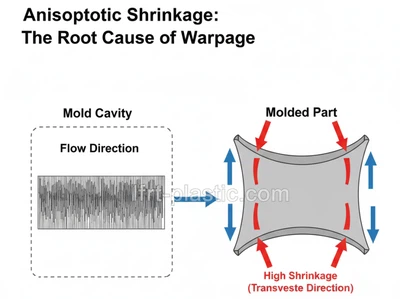
Fig. 2: Anisotropic shrinkage pulls the part out of its intended shape.
Cause 2: Non-Uniform Cooling
An injection-molded part rarely has a perfectly uniform thickness. It has thick walls, thin ribs, and sharp corners. During the cooling phase, the thinner sections of the part solidify and shrink much faster than the thicker, insulated sections. The slower-cooling thick sections continue to shrink as the thin sections are already rigid. This creates a "tug-of-war" within the component. The still-shrinking areas pull on the already-solid areas, generating powerful internal stresses. These stresses are then locked into the part upon full solidification. Once the part is ejected from the mold and is no longer constrained by the steel cavity, these internal stresses attempt to relieve themselves, physically bending and distorting the component into a warped shape.

Fig. 3: Different cooling rates create a "tug-of-war" inside the part.
Cause 3: Residual & Post-Molding Stress
Even a part that appears perfect upon ejection can warp over time. The high pressures used during injection molding pack polymer chains into a non-ideal, high-energy state. Over hours, days, or weeks, these polymer chains naturally try to relax into a lower-energy state. This process, known as **stress relaxation**, causes post-molding shrinkage and distortion. Furthermore, if the part is subjected to elevated temperatures during shipping, storage, or in its final application (e.g., under the hood of a car), this can accelerate the stress relaxation process, causing a seemingly stable part to suddenly warp. This makes predicting the long-term dimensional stability of conventional plastics a significant engineering challenge.
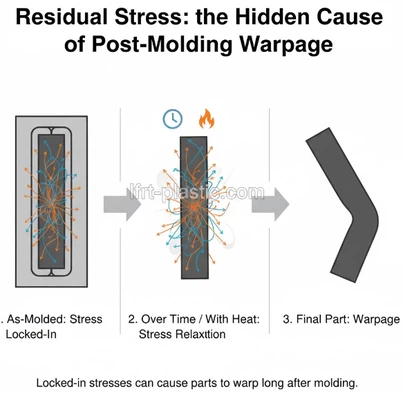
Fig. 4: Locked-in stresses can cause parts to warp long after molding.
The Engineering Solution: How LFT Creates an Internal Skeleton
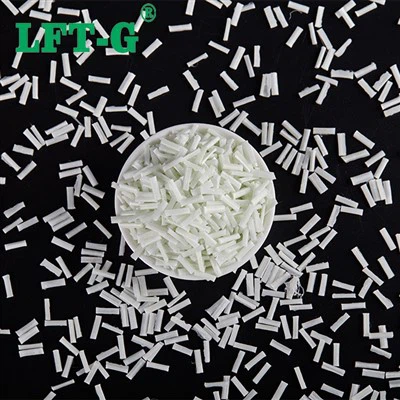
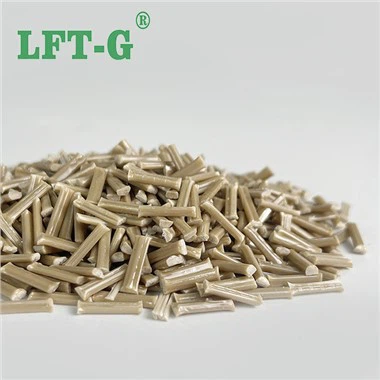
Enter Long Fiber Thermoplastic (LFT) composites, a material class engineered specifically to counteract these root causes. The magic of LFT lies in its unique internal architecture. Unlike traditional SGF plastics, LFT incorporates a robust, three-dimensional network of long glass or carbon fibers. This isn't just filler; it's a powerful internal 'skeleton' that is formed during the injection molding process. During the crucial cooling phase, this entangled fibrous skeleton acts as a powerful stabilizing force. It physically restrains the polymer matrix from shrinking non-uniformly, forcing it to behave in a more **isotropic (uniform)** manner. The result is a dramatic reduction in differential shrinkage, a key driver of warpage. This internal framework also provides immense creep resistance, preventing stress relaxation and post-molding distortion. LFT doesn't just treat the symptoms of warping; it solves the problem at its structural core.
LFT vs. SGF: The Data Behind the Stability
The superior dimensional stability of LFT composites is not just theoretical; it is quantifiable. The data below shows a typical comparison of mold shrinkage for a 30% glass-filled material.
| Property (Test Method: ISO 294-4) | Conventional SGF PP | LFT PP |
|---|---|---|
| Mold Shrinkage, Flow Direction | 0.2 - 0.4 % | 0.2 - 0.4 % |
| Mold Shrinkage, Transverse Direction | 0.6 - 0.9 % | 0.3 - 0.5 % |
| Differential Shrinkage (Transverse - Flow) | HIGH | LOW |
Notice the significant difference in transverse shrinkage. It is this high "Differential Shrinkage" in conventional materials that directly causes warping. LFT's ability to minimize this differential is its key advantage.
Technical Spotlight: Why a Low CLTE is a Game-Changer
Beyond initial warpage, long-term stability in fluctuating temperatures is governed by the **Coefficient of Linear Thermal Expansion (CLTE)**. This value measures how much a material expands or contracts with temperature changes. Unreinforced plastics have a very high CLTE, often 5-10 times that of metals. When you assemble a high-CLTE plastic part with a low-CLTE metal component, the differing expansion rates create immense internal stress that can lead to cracks, loosening of fasteners, or critical alignment failures. The long fiber skeleton in LFT composites dramatically lowers the material's CLTE, bringing it much closer to that of aluminum or steel. This allows for the design of robust hybrid plastic-metal assemblies that remain stable and stress-free across a wide range of operating temperatures, a feat unattainable with conventional plastics.
Ready to Engineer Out Warpage for Good?
Stop letting dimensional instability dictate your design limitations, scrap rates, and manufacturing costs. Our team of material experts is ready to help you leverage the power of LFT composites for your next project. Let's build products that perform flawlessly from the first part to the millionth.
Submit Your Warped Part for an LFT Feasibility Study