
The Technical University of Vienna has developed a special epoxy resin formulation for fiber reinforced composites in aerospace, shipbuilding and automotive manufacturing, even for underwater refurbishment. This is achieved by illuminating any part of the resin with light.
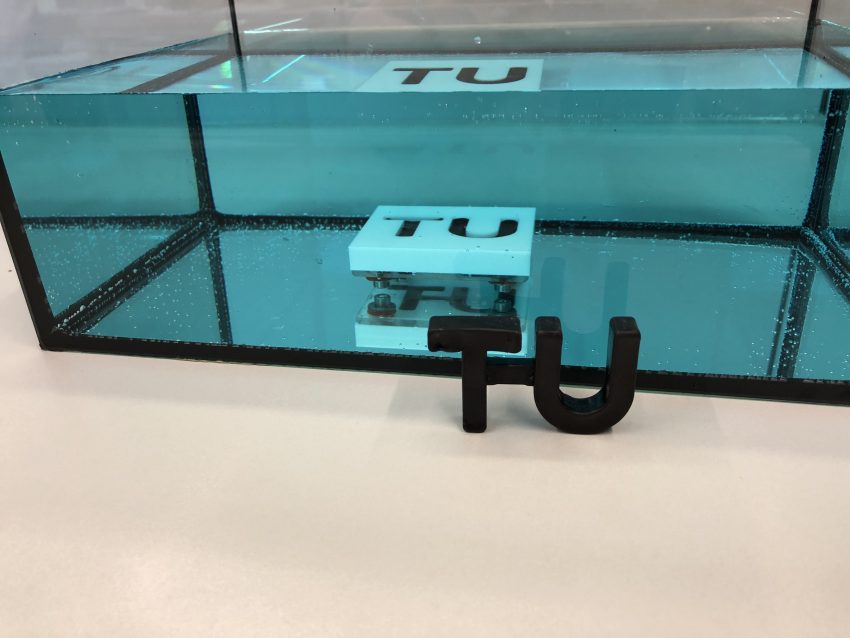
Within a few seconds, the new material can be completely transformed. Initially, the material is transparent and can be liquid or pasty; then, when any portion of it is illuminated with the appropriate light, the entire resin begins to solidify and appears dark. TU Wien (Vienna Technical University) has patented special epoxy resin formulations. Now, the researchers have successfully carried out this process underwater. This means that new epoxy resins can be used for tasks that have been very difficult to implement to date, such as filling underwater cracks in bridges or dams, or repairing pipes during ongoing operations.
As a further novelty, this special formulation can be used in combination with carbon fiber and carbon fiber mats. There are many possibilities for applications in aerospace engineering, wind turbines, shipbuilding or the automotive industry - in each area where high mechanical performance and lightweight design are required.
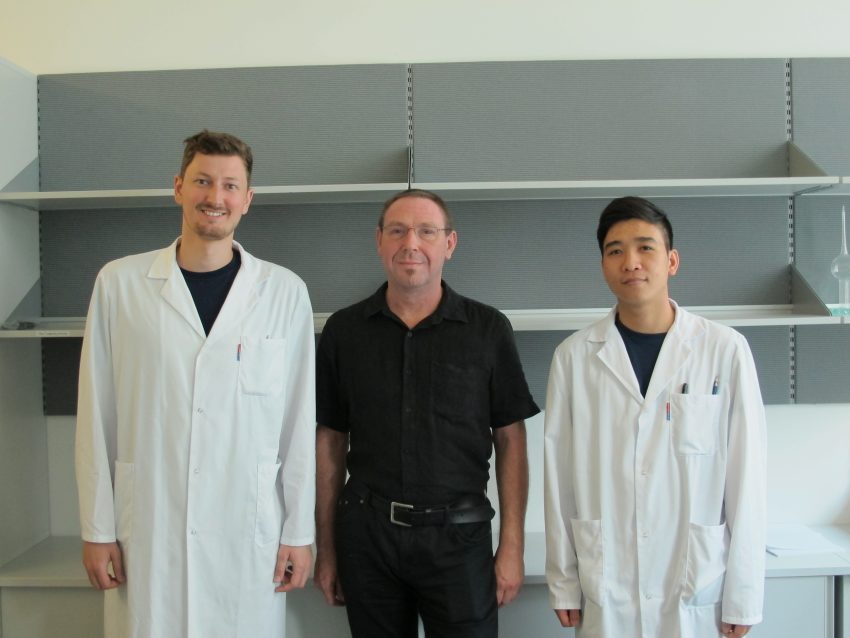
Epoxy resins are standard materials used in the industrial field for many different purposes, such as insulated electronic components or fixed mechanical components. A team led by Professor Robert Liska (TU Wien Institute of Applied Synthetic Chemistry) developed additives added to common epoxy resins to adjust their properties and achieve target cure through push buttons.
“We are developing a special compound in which light can trigger a chemical reaction,” explains Robert Liska. “This may be a bright flash of visible light, but we also have compounds that only emit light for ultraviolet light.”
At the point where the light illuminates the resin, the reaction is started to release heat. This heat spreads elsewhere and initiates a chemical cascade until all the resin has cured.
“The key advantage of this approach is that there is no need to illuminate the entire resin like other photocurable materials,” explains Liska. “It is enough to illuminate any part of the resin with light. The rest can be cured even in the depths of the dark cracks you want to fill.”
Industrial sector interest
Partner companies from industry have asked whether this process can also be carried out in the presence of "dark" fillers or fibers, since self-curing epoxy resins are very useful for some of these more difficult applications.
"On the surface, this idea contradicts all theories," Liska said. “The penetration depth of the light-transmitting material is very low because it is strongly absorbed by the carbon fiber.” TU Wien's experiment still shows the working process.
Effective underwater curing is also in contradiction with theory.
“Initially we thought it was impossible. People would first expect water to chemically react with the components of the resin and also eliminate the heat needed to maintain the reaction.”
Surprisingly, however, the light-triggered self-curing process can still be carried out underwater.
“One of the key reasons for doing this is that the chemical reaction will make the water boil,” explains Robert Liska. “Then a thin layer of water vapor barrier is formed between the hardened resin and the surrounding water.”
Researchers are looking for more users in the industry to explore the potential of this particular resin. In addition to the application of fiberglass and carbon fiber reinforced composites in aerospace, shipbuilding and automotive manufacturing, the repair of buildings is a particularly interesting area. For example, a user can fill a crack in a building built in water with a viscous resin and then cure them with a flash lamp. Maintenance of the pipeline is another job that is often difficult to implement - it is also appropriate to use new resins here.
“There are many possibilities, and we hope to have some interesting new ideas,” says Robert Liska.
------------------------------------------------------------------------------------------------------------------
XIAMEN LFT COMPOSITE PLASTIC CO.,LTD.
Focus on (LFT-G, LFRT) R&D and production: PA, PP, TPU, PPS, PBT, PPA,PEI,PEEK long glass fiber & carbon fiber continuous infiltration thermoplastic composite reinforcement series engineering plastics.It can be used in aerospace, automotive, medical equipment, sports equipment, home appliances and other lightweight and cost-effective semi-structural parts that require high performance markets.
If you need more information, please feel free to contact me.
Mike Lee
Email: sale02@lfrtplastic.com
Mobile phone : +86-180-5026-9764 (wechat / whatsapp/ skype)
Website :www.lfrt-plastic.com
Add:No.27 Hongxi Road, Tiangong Chuangxin Technology Park, Maxiang Town, Xiang'an Dist., Xiamen, Fujian, China.