

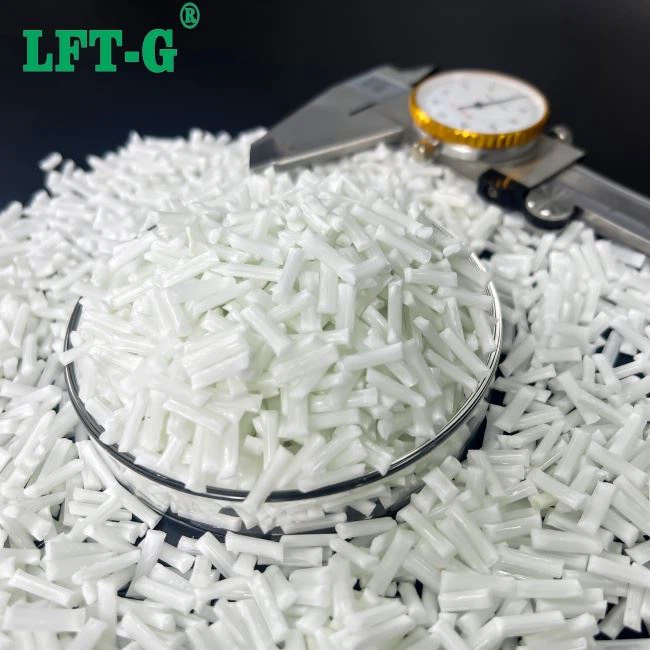
PP LGF60 Technical Data
LFT-G® PP LGF60 is a 60% long glass fiber reinforced polypropylene (homopolymer), delivering high stiffness for heavy-duty structural parts that upgrade short-fiber PP and replace die-cast metal.
| Property | Specification |
|---|---|
| Product Grade | LFT-G® PP LGF60 |
| Material Type | Long Glass Fiber Reinforced Thermoplastic (LFT) |
| Polymer Matrix | Polypropylene (Homopolymer, HPP) |
| Glass Fiber Content | 60% |
| Available Color | Black / Natural |
| Form | Pellets (Length 10–12mm, customizable 6–25mm) |
Typical Material Properties of PP LGF60
| Property | Value | Standard |
|---|---|---|
| Density | 1.49 g/cm³ | ASTM D-792 |
| Molding Shrinkage | 0.1–0.3% | ASTM D-955 |
| Tensile Strength | 155 MPa | ISO 527 |
| Tensile Modulus | 13,900 MPa | ISO 527 |
| Tensile Elongation | 1.8–2.5% | ISO 527 |
| Flexural Strength | 213 MPa | ASTM D-790 |
| Flexural Modulus | 11,632 MPa | ASTM D-790 |
| Notched Charpy Impact | 44 kJ/m² | ISO 180 |
| HDT (1.8 MPa) | 162 °C | ISO 75-2 |
| Flame Retardant | HB @ 1.5 mm | UL-94 |
Typical values are based on limited laboratory test specimens and are provided for reference only. They are not intended as specification limits. Actual molded-part performance can vary with test conditions, specimen preparation, processing conditions, part design and production batch. Source: official TDS LFT-G® PP-LGF60-NG06-2 (Revised 30/06/2026, version A3).
Mold Compatibility Check: PP LGF60 requires a gate diameter of 5–6 mm. Pin-point gates are not suitable. Please confirm your mold meets this requirement before requesting a trial sample. If your gate is smaller than 5 mm, PP LGF60 cannot be molded in your existing tool - contact us to review alternatives.
PP GF60 vs PP LGF60: Why Engineers Upgrade
PP LGF60 is not a stronger PP GF60. It is a different reinforcement system. In short-fiber PP GF60, the fibres break down to < 3 mm during molding and cannot form a load-bearing skeleton. In PP LGF60, the long fibres survive molding and form a skeleton that carries load, resists creep and absorbs impact. That skeleton is why PP LGF60 holds up under sustained load and sudden impact where short-fiber grades fatigue and crack. The result is a step change in stiffness and long-term performance, not a marginal gain.
It is not a drop-in replacement. PP LGF60 needs a gate diameter of 5–6 mm, and pin-point gates are not suitable (see the check above). When the mold meets this requirement, PP LGF60 can replace PP GF60 in structural parts, and in many cases heavier ABS, nylon or die-cast metal, at lower weight.

Schematic, not to scale: long fibres (10–12 mm) form a load-bearing skeleton, while short fibres (< 3 mm) stay fragmented.
| Property | PP GF60 (Short Fiber) | PP LGF60 (Long Fiber) |
|---|---|---|
| Fiber length in pellet | Short fibres (< 3 mm) | 10–12 mm |
| Fiber skeleton in molded part | Fragmented, no load-bearing skeleton | Load-bearing skeleton |
| Notched impact strength | Lower and inconsistent | 44 kJ/m² (ISO 180) |
| Creep resistance | Lower | Higher |
| Fatigue resistance | Lower | Higher |
| Warpage / shrinkage | Higher, less stable | Lower, more stable |
| Mold requirement | Standard gates | Gate diameter 5–6 mm; no pin-point gates |
PP LGF60 values are from the official TDS (NG06-2). Short-fiber performance varies by grade and supplier. This table compares reinforcement mechanisms, not one competing grade. For a number-to-number comparison, specify the competing grade's TDS.
PP LGF60 Applications
Electrical Equipment Parts
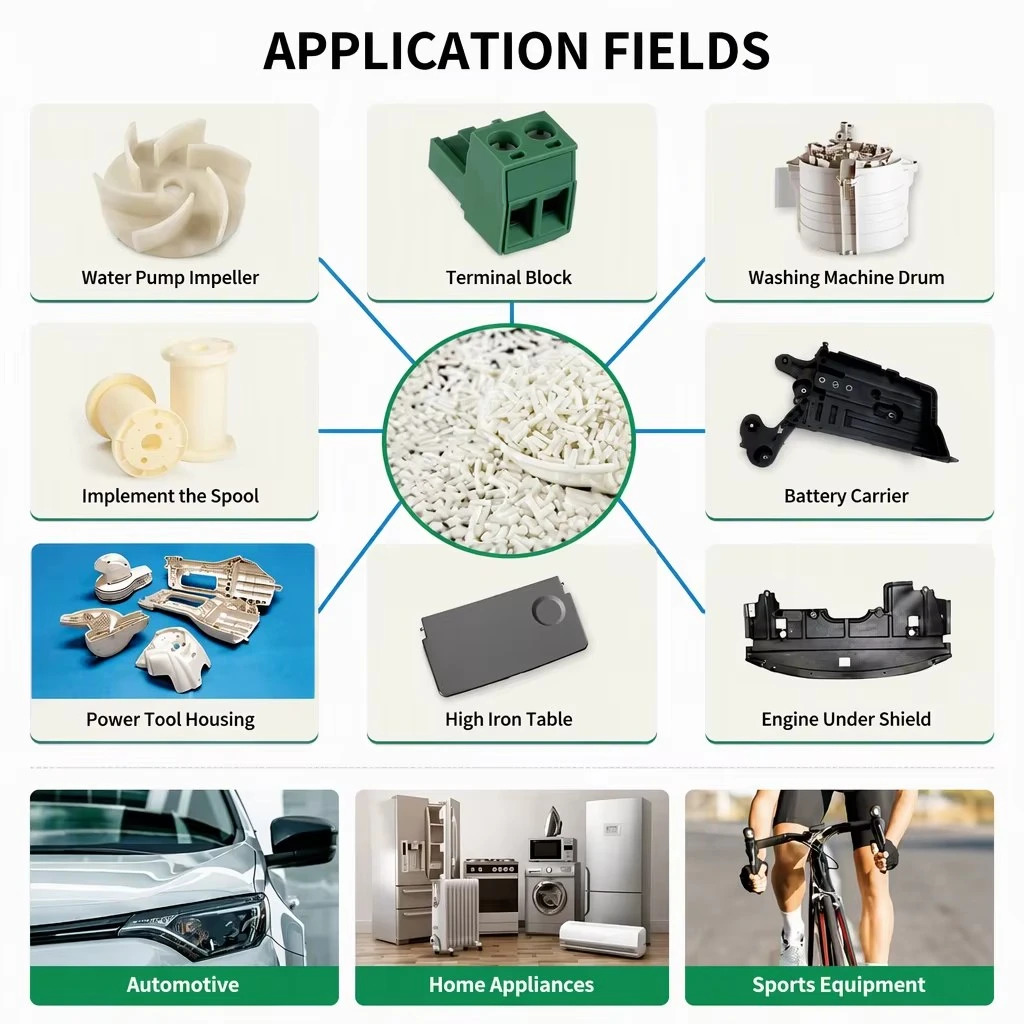
High-precision electrical equipment needs housings and frames that stay rigid and dimensionally stable over years of service. PP LGF60's 13,900 MPa tensile modulus (ISO 527) and 11,632 MPa flexural modulus (ASTM D-790) hold housings, chassis and brackets rigid under load, while its 44 kJ/m² Charpy impact (ISO 180) resists cracking during assembly and handling. Typical uses include housings for industrial power inverters, structural chassis for servers and telecom equipment, mounting brackets for electrical switchgear, protective casings for high-voltage connectors, frames for large-format display screens, support structures for solar panel arrays, and bodies for portable test and measurement devices.

Washing Machine Components
Washing machine drums and frames carry heavy, unbalanced, vibrating loads. PP LGF60 replaces metal in the most demanding of these parts: structural support spiders for washing machine drums, load-bearing base frames for commercial laundry units, motor mounting brackets subjected to high vibration, high-stress gearbox components, balancer ring assemblies, and structural frames for large appliances like dryers and dishwashers. Its 155 MPa tensile strength (ISO 527) and 162 °C HDT (ISO 75-2) hold these parts rigid under load and near heat, while 44 kJ/m² impact strength absorbs vibration and shock.

Consumer Goods, Sports Equipment & Construction
Beyond electrical and appliance parts, PP LGF60 suits durable, impact-resistant consumer and sports products where stiffness and light weight matter: luggage, cases and containers; golf club shafts, tennis rackets and bicycle frames; and structural construction components. At 1.49 g/cm³, it replaces heavier materials at lower weight while keeping the rigidity these products need. If your part falls in this range, send us the drawing and we will confirm whether the 60% grade fits, or whether a lower-filled grade molds more easily.
How to Mold PP LGF60?
PP LGF60 runs on standard injection molding machines, with two non-negotiable items: a gate diameter of 5–6 mm and pre-drying.

Schematic, not to scale. Numbers refer to the steps below.
① Drying: Dry the pellets for 2–4 hours at 80–90°C, and keep moisture below 0.1%. Long-fiber pellets pick up surface moisture, and wet pellets degrade during molding.
② Melting: Melt at 210–250°C. Use a low-shear screw and avoid overheating, which breaks fibres and degrades the material.
③ Injection: Inject at 69–103 MPa. Keep flow paths open and shear low so the long fibres survive to the part.
④ Gate: Use a gate diameter of 5–6 mm. Pin-point gates are not suitable: they shear the fibres at the gate and destroy the reinforcement. If your gate is smaller than 5 mm, do not run PP LGF60 in that tool.
⑤ Mold: Hold the mold at 38–69°C. Confirm the mold temperature by measurement, not by the machine setting, since mold temperature affects appearance and dimensional stability.
Processing parameters are from the official TDS (NG06-2). Actual settings depend on part design, mold and machine. Validate with a trial sample before production.
Which PP LGF60 Grade Should You Choose?
Start from the job, not the datasheet. The general grade (PP LGF60) is the default answer for heavy-duty structural parts that need high stiffness. Move to a special grade only when a specific requirement forces it - sustained heat and aging, or outdoor exposure. Each special grade is a trade-off, not an upgrade on every property. Request the TDS of the grade you choose, and confirm it with a trial sample.
| If you need | Choose | Next step |
|---|---|---|
| General heavy-duty structural parts with no special requirement | HPP LGF60 (General) | Download TDS |
| Parts exposed to heat and aging | HPP LGF60 AR (Aging & Heat Retardant) | Inquiry to obtain the TDS |
| Outdoor parts exposed to UV | HPP LGF60 V (UV Retardant) | Inquiry to obtain the TDS |
Each variant has its own TDS. Do not apply the general grade's values to a special grade - request the TDS of the grade you choose.
FAQ
How does PP LGF60 compare with PP LGF50 or LGF40?
PP LGF60 contains a 60% fiber loading, making it significantly stiffer than lower-filled grades, with a 13,900 MPa tensile modulus (ISO 527). The trade-off is flowability: at 60% loading, thin-wall filling is harder than at 30–50%, so confirm wall thickness and gate design before switching.
Can PP LGF60 replace die-cast metal?
It is a candidate for metal replacement in structural parts, subject to part redesign. Successful substitution requires wall-thickness optimization and reinforcing ribs, rather than a direct drop-in into existing metal tooling. Share your part drawings and we will assess suitability.
What gate size does PP LGF60 require?
A minimum gate diameter of 5–6 mm. Pin-point gates shear the long fibres at the gate and destroy the reinforcement, so they are not suitable. If your gate is smaller than 5 mm, do not run PP LGF60 in that tool - contact us to review alternatives.
Can I order a small trial batch before committing to bulk?
Yes. We offer a 25 KG trial MOQ - one bag - so you can validate shrinkage, stiffness and molding behavior on your own machines before scaling up.
Do UV-retardant and aging-resistant grades exist for PP LGF60?
Yes. UV-retardant (V) and aging- and heat-retardant (AR) variants exist alongside the general grade. Their TDS documents are not published on this page - contact us and we will provide the data and a trial sample.
What pellet length and colors are available?
Standard pellet length is 10–12 mm, customizable to 6–25 mm. Colors are natural and black. Confirm color and pellet length when requesting a trial sample, since colorants can affect final part performance.
Request PP LGF60 TDS & Trial Sample
Send us your part drawing and current grade. We will confirm whether PP LGF60 fits, recommend the right variant if needed, and arrange a trial sample.
Ordering grade: LFT-G® PP-LGF60-NG06-2 - 60% LGF, homopolymer (HPP), natural.
Email: candyhu@lfrtplastic.com
WhatsApp: +86 139 5009 5707

Related Grades
PP LGF40
40% long glass fiber reinforcement balancing stiffness with thin-wall flowability.
PP LGF50
50% long glass fiber reinforcement for heavy-duty parts that need slightly easier flow than LGF60.
PP LGF60
60% long glass fiber reinforcement for the stiffest structural parts in this series.
Current Grade
Hot Tags: PP LGF60, Long Glass Fiber Polypropylene, Long Fiber Reinforced PP, PP LGF Compound


