

Technical Data
| Property | Specification |
|---|---|
| Product Grade | PA6 LGF30 |
| Base Resin | Polyamide 6 (PA6 / Nylon 6) |
| Fiber Type | Long Glass Fiber |
| Fiber Content | 30% |
| Color | Black and Natural |
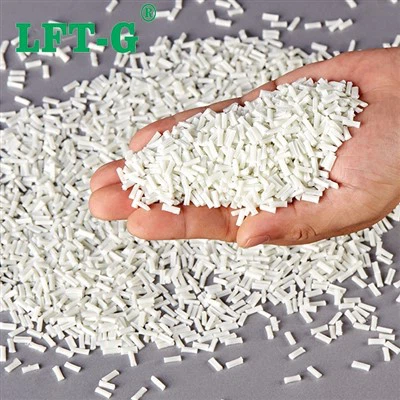
| Form | Injection-Molding Pellets, 10–12 mm |
| Property | Value | Standard |
|---|---|---|
| Density | 1.34 g/cm³ | ASTM D-792 |
| Molding Shrinkage | 0.2–0.4% | ASTM D-955 |
| Tensile Strength | 168 MPa | ISO 527 |
| Tensile Modulus | 10,893 MPa | ISO 527 |
| Tensile Elongation | 1.7–2.5% | ISO 527 |
| Flexural Strength | 253 MPa | ASTM D-790 |
| Flexural Modulus | 7,899 MPa | ASTM D-790 |
| Charpy Notched Impact Strength | 28 kJ/m² | ISO 179 |
| Heat Deflection Temperature | 208°C | ISO 75-2 (1.8 MPa) |
| Flammability | HB @ 1.5 mm | UL-94 |
Typical values from our factory TDS LFT-PA6-LGF30-NG03-Datasheet-TDS.pdf, A3, Revised 30/06/2026. Values are typical values from limited laboratory test specimens and are not specification limits.
The table above lists our A3 factory TDS typical values. Tensile strength and tensile modulus also have ASTM D-638 values - 166 MPa and 10,502 MPa - for same-standard comparison. Notched Izod impact is 29 kJ/m² (ISO 180), or 266 J/m (ASTM D-256); the two Izod figures use different test methods. Charpy notched impact is 28 kJ/m² (ISO 179). PA6 LGF30 has a density of 1.34 g/cm³ and a flexural modulus of 7,899 MPa, per our factory TDS.
PA6 LGF30 vs. Other Reinforced Nylon Materials
PA6 LGF30 is the balanced grade of the PA6 LGF range: the 30% fiber content most commonly specified for structural parts, balancing stiffness, impact resistance, and flow. The three comparisons below explain when 30% long glass fiber is the right choice, when a different base resin fits better, and how the grade compares with a published competitor grade on matched test methods.
PA6 GF30 vs. PA6 LGF30: When Is a Long-Fiber Upgrade Worth It?

Long fibres vs. short fibres. Schematic, not to scale.
| Property | PA6 LGF30 | PA6 GF30 short fiber |
|---|---|---|
| Glass fiber content | 30% | 30% |
| Tensile strength | 168 MPa (ISO 527) | 165 MPa (dry) / 130 MPa (conditioned) |
| Notched Izod impact | 29 kJ/m² (ISO 180) | 12 kJ/m² |
| Density | 1.34 g/cm³ | 1.38 g/cm³ |
Both materials contain 30% glass fiber, but the reinforcement architecture is different: PA6 LGF30 uses long glass fibers that form a skeletal network inside the molded part, while conventional PA6 GF30 uses short fibers that disperse independently. The long-fiber network gives higher stiffness and impact resistance at the same fiber content; compare matched data and confirm performance through molding trials. Pellet length is 10–12 mm; retained fiber length after molding depends on the part and process - we confirm it with a molding trial. Switching from short fiber? Compare the matched data above and validate on your part; a 25 kg trial is the fastest way to confirm fit.
PA6 LGF30 Molding Shrinkage: 0.2–0.4% (ASTM D-955)
Our A3 TDS reports molding shrinkage of 0.2–0.4% (ASTM D-955) for PA6 LGF30-NG03. This value applies to this grade only; it varies with flow direction, fiber orientation, part geometry, mold design, and processing conditions, and it must not be quoted as a general PA6 GF30 short-fiber value.
Long fibers resist contraction during cooling, so LGF30 generally shows lower and less direction-dependent shrinkage than short-fiber PA6 GF30, but the comparison is qualitative: the short-fiber side has no single verified number.
PA6 vs. PA66: Choosing the Base Resin
PA6 and PA66 differ first in the base resin, not in the fiber. PA66 generally offers a higher heat deflection temperature and lower moisture absorption than PA6, which is why it is often specified for high-temperature service. PA6 LGF30's HDT is 208°C (ISO 75-2, 1.8 MPa) - a grade measurement, not a continuous-use temperature rating. PA6 crystallizes more slowly than PA66, which generally gives a brighter molded surface with less floating fiber; PA66 crystallizes faster and is more prone to sink marks and floating fiber. These are tendencies, not absolutes. Need PA66 instead? We supply PA66 LGF in the same long-fiber architecture - ask us for the grade that fits your part.
LFT-G PA6 LGF30 vs. PlastiComp Complet® LGF30-PA6
| Property | LFT-G PA6 LGF30 | Complet® LGF30-PA6 |
|---|---|---|
| Glass fiber content | 30% | 30% |
| Tensile strength (ASTM D-638) | 166 MPa | 174 MPa |
| Flexural strength (ASTM D-790) | 253 MPa | 268 MPa |
| Flexural modulus (ASTM D-790) | 7,899 MPa | 9,650 MPa |
| Density (ASTM D-792) | 1.34 g/cm³ | 1.36 g/cm³ |
Same resin, same fiber content, matched ASTM methods - compare the numbers directly and judge on what your part needs. PA6 LGF30 is the lighter option at 1.34 g/cm³. Request our TDS or a 25 kg trial to validate it on your part.
Applications of PA6 LGF30
Electrical Sensor Housings
PA6 LGF30 is used in injection-molded electrical sensor housings for an Israel-based customer. The housings were sampled in red and yellow, and after sampling the customer purchased about 3 tons. Impact resistance and UV performance were the project requirements; the grade was selected on its A3 TDS values - tensile 168 MPa, flexural modulus 7,899 MPa, notched Izod 29 kJ/m².

Power Tool Housings
PA6 LGF30 can be evaluated for power tool housings that need long-fiber stiffness and impact resistance with a clean molded surface, subject to drop, fatigue, and dimensional validation.

Office Chair Bases
PA6 LGF30 can be evaluated for structural furniture components such as office chair bases, subject to load, fatigue, and dimensional validation.

Best where the long-fiber network stays intact. Vibration-welded joints such as air intake manifolds are the exception - welding breaks the fiber network at the seam, so short-fiber grades fit those parts better. For sustained high-temperature service near the engine compartment, validate on your part first: HDT is 208°C (ISO 75-2, 1.8 MPa), a grade measurement rather than a continuous-use rating. Ask us to confirm fit for your part.
Injection Molding Processing Guide
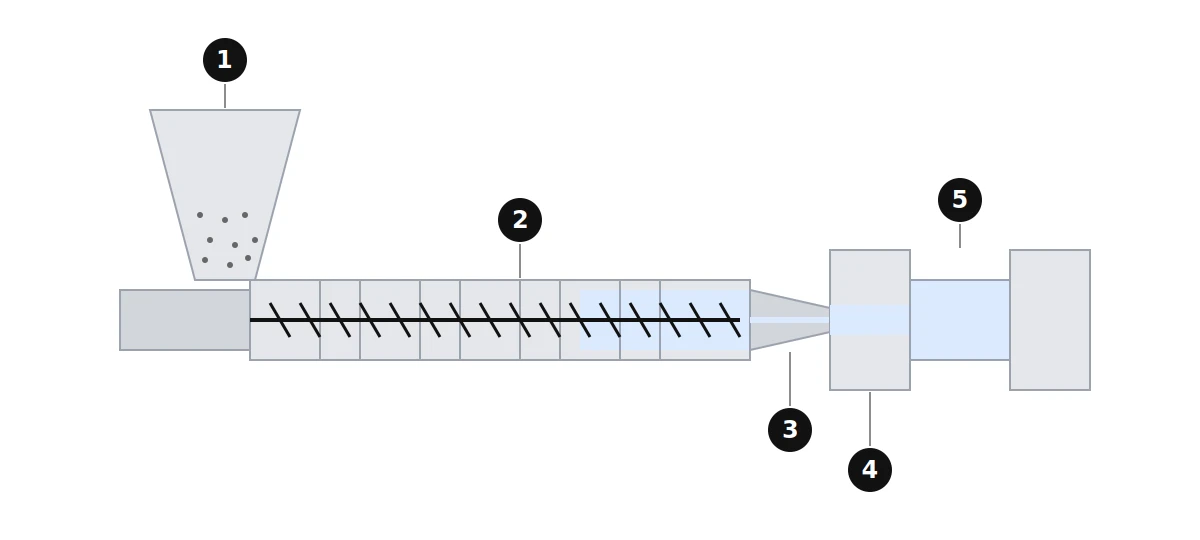
- Drying - Dry at 80–90°C for 2–4 hours and keep moisture below 0.05% before molding. Drying is the most critical step: PA6 amide bonds break down at high temperature when wet, and under-dried material loses performance directly.
- Melt - Melt temperature 243–270°C. The figure is the actual melt temperature inside the barrel, not the machine set temperature; check the deviation between set and actual temperature to avoid degradation from overheating.
- Injection - Injection pressure 69–124 MPa. Use a metering screw with an L/D ratio of 18:1–24:1 and a large open nozzle to reduce shear; keep feeding at about 40%.
- Gate and runner - Use a full-round runner with a minimum diameter of 5–6 mm; make the gate as large as practical and avoid pin-point gates. Use a large sprue and a straight (direct) gate, and keep the sprue as short as practical.
- Mold - Mold temperature 54–93°C (actual mold temperature, not the set value). Use a clamping force above 100 tons. Regrind up to 5%. Purge the machine with PE or PP before shutdown, and do not leave long glass fiber material in the barrel for extended periods.
Grade Selection
| Grade | Base Resin | Fiber Content | Color | TDS |
|---|---|---|---|---|
| PA6 HLGF30 (high-performance grade) | PA6 | 30% long glass fiber | Black and Natural | Download TDS Inquiry Us |
High-Performance Grade - HLGF30-NG03
For higher stiffness and strength at the same 30% fiber content, the high-performance grade HLGF30-NG03 is available. The table below compares the two grades on our factory A3 TDS; both have the same HDT of 208°C, so the high-performance grade is a stiffness and strength upgrade, not a heat-resistance upgrade.
| Property | PA6 LGF30-NG03 | PA6 HLGF30-NG03 |
|---|---|---|
| Tensile strength (ISO 527) | 168 MPa | 179 MPa |
| Tensile modulus (ISO 527) | 10,893 MPa | 11,063 MPa |
| Flexural strength (ASTM D-790) | 253 MPa | 271 MPa |
| Flexural modulus (ASTM D-790) | 7,899 MPa | 8,122 MPa |
| Notched Izod (ISO 180) | 29 kJ/m² | 31 kJ/m² |
| Charpy (ISO 179) | 28 kJ/m² | 34 kJ/m² |
| Density (ASTM D-792) | 1.34 g/cm³ | 1.35 g/cm³ |
| HDT (ISO 75-2, 1.8 MPa) | 208°C | 208°C |
Our factory TDS covers two PA6 LGF30 grades: the standard grade PA6-LGF30-NG03 and the high-performance grade PA6-HLGF30-NG03. For higher stiffness, see PA6 LGF40; for a flame-retardant PA6 LGF grade, see HLGF50-NG05FR on the PA6 LGF50 page. The standard trial quantity is 25 kg for LFT-LGF materials. Trial pellet length is 10–12 mm as standard, with custom lengths from 6–25 mm.
FAQ
Q: 1. What is the difference between PA6 LGF30 and PA6 GF30 short-fiber compounds?
A: Both contain 30% glass fiber, but PA6 LGF30 uses long-fiber reinforcement, while conventional PA6 GF30 uses short fibers. The different reinforcement architectures affect molded-part behavior; compare grade data under matched test methods and conditioning. Pellet length is 10–12 mm; retained fiber length after molding depends on the part and process.
Q: 2. What colors and pellet lengths are available for PA6 LGF30?
A: PA6 LGF30-NG03 is available in black and natural. Standard pellet length is 10–12 mm, with custom lengths from 6–25 mm. Across the PA6 LGF range, HLGF50-NG05FR is available in natural only.
Q: 3. How should PA6 LGF30 be dried, and how does moisture affect it?
A: Dry PA6 LGF30-NG03 at 80–90°C for 2–4 hours and keep moisture below 0.05% before molding. PA6 generally absorbs more moisture than PA66 under comparable conditions; moisture can affect dimensions and mechanical properties. Unreinforced-PA6 saturation figures should not be assigned to this grade.
Q: 4. What runner and gate design is recommended for PA6 LGF30?
A: Use a full-round runner with a minimum diameter of 5–6 mm. Make the gate as large as practical and avoid pin-point gates; 5–6 mm is the runner recommendation, not a universal gate-opening dimension.
Q: 5. What is the trial order quantity for PA6 LGF30?
A: The standard trial quantity is 25 kg for LFT-LGF materials. Share the application, target properties, color, and molding conditions so the appropriate PA6 LGF grade and trial arrangement can be confirmed.
Q: 6. What should I check before choosing PA6 LGF30?
A: Check service temperature and moisture conditions against the TDS first. HDT is 208°C at 1.8 MPa (ISO 75-2), a grade measurement rather than a continuous-use rating. Measured molding shrinkage is 0.2–0.4% (ASTM D-955), varying with flow direction, fiber orientation, part geometry, mold design, and processing.
Q: 7. Should I upgrade from PA6 GF30 short fiber to PA6 LGF30?
A: Consider switching when a molded part needs long-fiber reinforcement or the short-fiber grade does not meet validated stiffness, impact, or structural requirements. Confirm fit with a molding trial - a 25 kg trial order is available.
Request TDS & Trial Sample - PA6 LGF30
Discuss your part with the LFT-G engineering team and request our factory TDS or a 25 kg trial order of PA6 LGF30.
Order as: LFT-G® PA6-LGF30-NG03 - 25 kg trial order available.
Email: candyhu@lfrtplastic.com
WhatsApp: +86 139 5009 5707

Related Grades
Hot Tags: PA6 LGF30, 30% long glass fiber polyamide 6, LFT-G PA6 LGF30