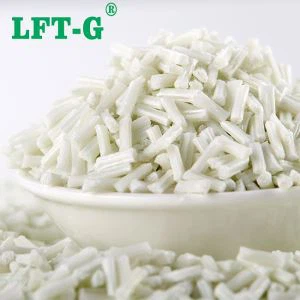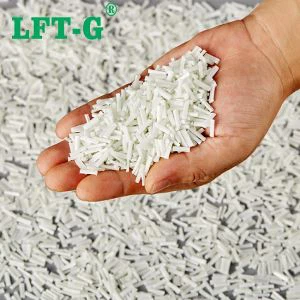


50% Long Glass Fiber Reinforced Nylon 6 Material
Engineered for ultimate rigidity and strength, this 50% long glass fiber composite is the champion of metal replacement. It is specifically formulated for structural applications where minimal deflection and unwavering performance under extreme loads are critical. This is our highest-performing grade, designed to directly substitute die-cast aluminum and zinc.

Performance Profile: The Metal Replacement Champion
Specific Stiffness (Stiffness-to-Weight)
Creep Resistance (Dimensional Stability Under Load)
Technical Specifications
Note: As a hygroscopic material, the properties of PA6 are influenced by moisture content. Data is provided for Dry-As-Molded (DAM) and conditioned (50% RH) states.
| Property | Test Method | Metric (DAM) | Metric (COND) |
|---|---|---|---|
| Density | ISO 1183 | 1.53 g/cm³ | 1.53 g/cm³ |
| Tensile Modulus | ISO 527 | 15,000 MPa | 11,000 MPa |
| Tensile Strength | ISO 527 | 211 MPa | 160 MPa |
| Notched Izod Impact (23°C) | ISO 180 | 42 kJ/m² | 27 kJ/m² |
| Heat Deflection Temp (1.8 MPa) | ISO 75 | 208 °C | - |
Download Complete LFT PA6 GF50 Data Sheet PDF
Applications Demanding Maximum Rigidity

Automotive Chassis & BIW
Structural cross-members, chassis reinforcements, and Body-in-White (BIW) components replacing steel.

Industrial Robotic Equipment Base
Metrology equipment frames, machine tool bases, and components where dimensional stability is paramount.

Gas Nail Gun Box
Military & Defense
Weapon systems chassis, tactical equipment mounts, and lightweight armor components.
Design & Processing Excellence
Q: Critical Moisture Management
A: Pre-Drying is Mandatory. Dry pellets for 3–4 hours at 80-90°C (176-194°F) to reduce moisture content below 0.1%. Proper drying is essential to prevent hydrolysis during molding and ensure optimal mechanical properties.
Q: Recommended Injection Molding Parameters
A: Use a general-purpose screw with low shear. Melt temperatures should be in the 260-280°C (500-536°F) range. A high mold temperature of 80-120°C (176-248°F) is crucial for achieving a high-quality surface finish and optimal crystallinity.
Q: Design for Long Fiber Composites
A: Utilize generous radii and uniform wall thicknesses. Gate locations should be chosen to promote fiber alignment in the direction of principal stress. Be aware of anisotropic shrinkage; consult our full design guide or technical team for support.
Frequently Asked Questions
Q: When should I choose 50% LGF over the 40% grade?
A: Choose the 50% LGF grade for applications where minimizing deflection, vibration, or creep under high, constant load is the absolute number one priority. If your design is stiffness-critical and you are replacing a thick metal section, the LFT-G® PA6 GF50 provides the ultimate performance in a lightweight thermoplastic form.
Q: Does the 50% fiber loading affect part design and moldability?
A: Yes. The material has lower flow than lower-content grades. This makes it best suited for parts with wall thicknesses of 2.5mm or greater. Thin, complex geometries can be challenging. We highly recommend a mold flow analysis during the design phase, a service our technical team is happy to provide, to ensure optimal filling and fiber alignment.
Bring Us Your Toughest Metal Replacement Challenge
When standard materials won't cut it, LFT-G® PA6 GF50 delivers. Contact our engineering team to discuss your most challenging structural applications and discover the ultimate lightweighting solution.
Hot Tags: pa6 gf50 composite, China, manufacturers, suppliers, factory, buy, customized