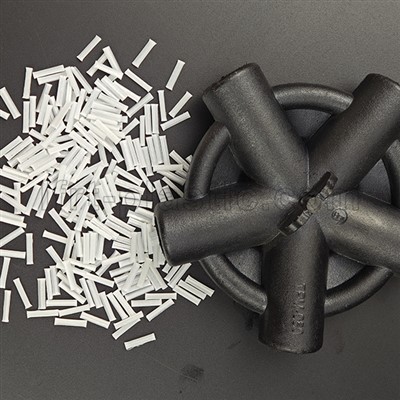


60% Long Glass Fiber Reinforced Nylon 6 Material
Presenting the absolute ceiling of thermoplastic performance. This 60% long glass fiber composite offers uncompromising stiffness and near-zero creep, making it the definitive substitute for die-cast metal in applications where precision and dimensional stability are paramount. It is engineered for the most extreme structural challenges.

rigidity from LFT-G® PA6 GF60 is critical.
Performance Profile: Uncompromising Rigidity
Specific Stiffness (Stiffness-to-Weight)
Creep Resistance (Dimensional Stability Under Load)
Technical Specifications
Note: As a hygroscopic material, the properties of PA6 are influenced by moisture content. Data is provided for Dry-As-Molded (DAM) and conditioned (50% RH) states.
| Property | Test Method | Metric (DAM) | Metric (COND) |
|---|---|---|---|
| Density | ISO 1183 | 1.63 g/cm³ | 1.61 g/cm³ |
| Tensile Modulus | ISO 527 | 18,000 MPa | 13,000 MPa |
| Tensile Strength | ISO 527 | 270 MPa | 185 MPa |
| Notched Izod Impact (23°C) | ISO 180 | 46 kJ/m² | 42 kJ/m² |
| Heat Deflection Temp (1.8 MPa) | ISO 75 | 208 °C | - |
Download Complete LFT PA6 GF60 Data Sheet PDF
Value Proposition & Total Cost of Ownership
Radical Part Consolidation
Integrate multiple metal pieces, brackets, and fasteners into a single, complex injection-molded part, drastically reducing assembly labor, time, and supply chain complexity.
Elimination of Secondary Operations
Achieve net-shape parts directly from the mold, eliminating costly and time-consuming secondary operations like machining, deburring, and corrosion-resistant coating required for metals.
Enhanced Lifetime Performance
Benefit from superior fatigue resistance and inherent corrosion immunity. This leads to longer component life, reduced warranty claims, and improved brand reputation compared to metal alternatives.
Co-Engineering & Support

Design Considerations
- Wall Thickness: Best suited for sections 3.0mm or greater to ensure proper melt flow and fiber dispersion.
- Gating: Utilize large, unobtrusive gates (e.g., tab or fan gates) to minimize fiber breakage during injection.
- FEA Simulation: We strongly recommend collaborative Finite Element Analysis (FEA) to predict fiber orientation and part performance.
Processing Best Practices
- Melt Viscosity: Expect high viscosity. Requires machines with sufficient injection pressure and clamping force.
- Tool Steel: Due to the high glass content (60%), use hardened tool steels (e.g., H-13) for molds to prevent abrasion and ensure long tool life.
- Drying: Absolutely critical. 4 hours at 90°C is mandatory to prevent material degradation.
Frequently Asked Questions
Q: What are the main challenges when injection molding 60% long glass fiber?
A: The main challenges are managing the high melt viscosity and potential for tool abrasion. Success requires a robust molding machine, a hardened steel mold with optimized flow paths, and precise process control. Our technical team specializes in helping customers overcome these challenges to achieve successful production.
Q: LFT PA6 LGF60 vs. Carbon Fiber Reinforced PA6: How do they compare?
A: LFT PA6 LGF60 offers the best stiffness-per-dollar, providing performance close to carbon fiber at a significantly lower cost. Carbon fiber composites offer slightly higher stiffness and lower density (the ultimate in lightweighting), but LGF60 is the ideal choice for cost-sensitive applications that still demand extreme rigidity and strength.
Q: How does LFT PA6 LGF60 help with NVH (Noise, Vibration, Harshness) reduction?
A: The interlocking long fiber network within the polymer matrix is exceptionally effective at damping vibrations, much more so than metals. By replacing a resonant metal component with a highly stiff and damping LFT-G® part, you can significantly reduce NVH, leading to a quieter and more pleasant end-user experience.
Q: Is this material electrically conductive or insulating?
A: Standard LFT-G® PA6 GF60 is electrically insulating, making it suitable for applications where electrical isolation is needed, such as in electric vehicle battery housings or electronic equipment chassis. Electrically conductive grades can be specially formulated upon request.
Partner With Us On Your Most Ambitious Project
When off-the-shelf solutions fail, true innovation begins. Partner with our engineering team to leverage the uncompromising performance of LFT-G® PA6 GF60 and turn your most ambitious design concepts into reality.
Hot Tags: pa6 gf60 compounds, China, manufacturers, suppliers, factory, buy, customized