


High Toughness Glass Fiber GF ABS Polymer
In the field of engineering plastics, ABS (acrylonitrile butadiene styrene) pellet has long been renowned for its excellent surface gloss and toughness. However, when standard ABS is confronted with applications involving high loads, high temperatures, or requiring extremely high dimensional stability, it often falls short.
This is precisely the moment for LGF ABS (Long Glass Fiber Reinforced ABS) plastic pellet to make its appearance. As a high-performance thermoplastic composite material, LGF ABS, by incorporating long glass fibers, not only inherits the easy processability and aesthetic appeal of the ABS base material but also achieves a qualitative leap in strength, impact resistance, and dimensional accuracy.
Why are "long" fibers so crucial?
To understand the advantages of LGF ABS material, one must first understand its microstructure. Unlike traditional short glass fiber (SGF) materials, LGF ABS is manufactured through the pultrusion process.
Skeleton Effect: In the molded products, glass fibers with lengths maintained at a certain level (typically with lengths greater than 1 mm) will interweave with each other, forming a three-dimensional "skeleton network".
Stress Transfer: This network can more effectively transfer and disperse external stress, thereby preventing the expansion of cracks.
Long glass fibers do not merely have a filling effect. Short glass fibers usually only increase rigidity as fillers, while long glass fibers act as reinforcing ribs, giving the material structural strength. This microstructure enables LGF ABS composite to absorb a large amount of energy when subjected to impact, which is the core reason for its superior performance compared to ordinary reinforced plastics.
Performance Multi-Dimensional Analysis
Break through traditional boundaries
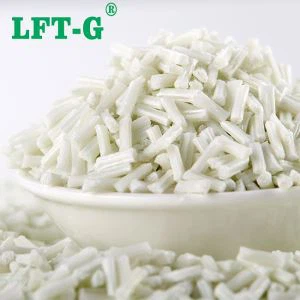
We will analyze the performance advantages of LGF ABS compound resin from three dimensions that are of concern to manufacturers:
The peak of dimensional stability (against warpage)
For large flat components or thin-walled parts, "warpage" is the greatest nightmare.
ABS itself is a non-crystalline polymer with a low shrinkage rate and good isotropy. Combined with the mechanical restraint of long glass fibers, LGF ABS polymer exhibits extremely low molding shrinkage rate and thermal expansion coefficient. It can be an ideal choice for manufacturing high-precision electronic housings and dashboard frameworks.
The perfect balance of rigidity and toughness
Generally, the harder the material (higher rigidity), the more brittle it becomes (lower toughness). LGF ABS breaks this curse. Even at high temperatures, the long glass fibers can maintain extremely high bending modulus.
Low-temperature impact resistance: Even at an extreme low temperature of -30 °C, LGF ABS plastic granules still maintains excellent notch impact strength, which is an advantage that LGF PP material (polypropylene) cannot match.
Anti-creep and fatigue resistance
Under long-term continuous loading conditions, materials will undergo permanent deformation (creep). The fiber network within LGF ABS effectively prevents the sliding of polymer chains, enabling it to withstand long-term static loads and making it suitable as a metal substitute material.
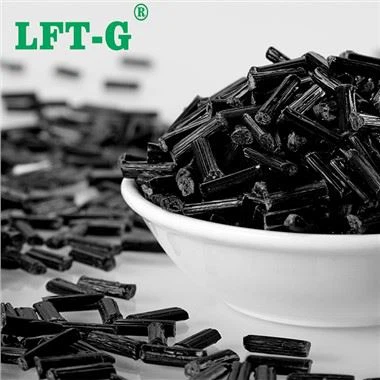
GF ABS: Future Scenarios for Applications
New Energy Vehicle Components
As the demand for light weighting and quietness in electric vehicles increases, LGF ABS has become a key material.
Application Examples: Dashboard frame, sunroof frame, central console bracket.
Value: Compared to metals, it reduces weight, and the ABS base material has splendid sound absorption and vibration damping properties, which helps improve NVH (Noise, Vibration, and Sound Insulation Roughness) performance.
Consumer electronics and precision instruments
Application examples: Laptop computer bottom shell, drone body, projector stand.
Value: Capable of being molded into complex thin-walled structures without deformation, while providing sufficient drop protection (impact resistance).
Appliances and industrial parts
Application examples: Balance ring of washing machine, outer shell of vacuum cleaner, pump housing. Value: It has superior chemical corrosion resistance compared to metals, and its surface finish is better than LGF PP. It is also more suitable for secondary processing such as painting and electroplating.
LGF ABS plastic pellet is not merely an enhanced plastic; it is a strategic solution that lies between common engineering plastics and specialized metal materials. It addresses the dilemma faced by manufacturers in choosing between "achieving strength" and "controlling weight". For projects that require extreme dimensional accuracy, low-temperature toughness and lightweight design, LGF ABS compound resin is undoubtedly one of the most competitive options available on the market at present.
FAQ
Q: Is LGF ABS prone to warping and deformation?
A: It is not prone to deformation. The ABS base material has low shrinkage and long glass fiber mechanical restraint, making it the preferred material for achieving low warpage and high dimensional stability.
Q: What are the reasons for choosing LGF ABS instead of LGF-PP?
A: Better appearance and paintability. If the product requires painting, electroplating or has extremely high requirements for dimensional accuracy, LGF ABS is superior to LGF PP composite.
Q: Will there be "floating fibers" on the surface of LGF ABS after it is molded?
A: The surface float fibers will improve. Compared to LGF-PP material, the surface gloss of the ABS base material is better. By increasing the mold temperature and optimizing the process, a good appearance can be achieved, which is easy for painting and electroplating.
Hot Tags: high toughness abs polymer, China, manufacturers, suppliers, factory, buy, customized


