
BLUF: PA66-LGF50 Delivers Higher Specific Strength and 35% Lower Part TCO Than A380 Aluminum
In industrial fluid handling, centrifugal pump volutes, and pneumatic impact tool bodies, replacing standard A380/ADC12 die-cast aluminum with 50 wt% long glass fiber reinforced polyamide 66 (PA66-LGF50) delivers a 41.7% direct weight reduction while exceeding aluminum's structural strength-to-weight ratio. While die-cast A380 aluminum exhibits an ultimate tensile strength of 310 MPa at a density of 2.71 g/cm³, dry-as-molded (DAM) PA66-LGF50 achieves 235–250 MPa at a density of only 1.58 g/cm³. This yields a specific strength of 148.7 kN·m/kg for PA66-LGF50 versus 114.4 kN·m/kg for cast aluminum-a 30% mechanical efficiency advantage.
Beyond raw mechanical metrics, PA66-LGF50 achieves net-shape injection molding in a single cycle. It eliminates secondary CNC boring, thread tapping, chemical de-flashing, and protective e-coating, reducing Total Cost of Ownership (TCO) by 25% to 38% per finished assembly while providing 100% immunity to galvanic corrosion and acidic fluid erosion.
| Engineering Property | Test Standard |
Die-Cast Aluminum (A380 / ADC12) |
Short GF PA66 (PA66-GF50, DAM) |
LFT-G® PA66-LGF50 (DAM / Cond.) |
|---|---|---|---|---|
| Density (g/cm³) | ISO 1183 / ASTM D792 | 2.71 | 1.58 | 1.58 (-41.7% Mass) |
| Tensile Strength (MPa) | ISO 527 / ASTM E8 | 310 | 215 / 155 | 235 – 250 / 180 – 195 |
| Specific Strength (kN·m/kg) | Calculated (Tensile/Density) | 114.4 | 136.1 | 148.7 – 158.2 (+30%) |
| Tensile Modulus (GPa) | ISO 527 / ASTM E111 | 71.0 | 15.5 / 10.2 | 16.5 – 17.8 / 11.8 – 13.0 |
| Charpy Unnotched Impact (kJ/m²) | ISO 179/1eU | ~15.0 (Brittle Fracture) | 55.0 / 65.0 | 90.0 – 105.0 / 110.0+ |
| HDT @ 1.80 MPa (°C) | ISO 75 | > 350 | 245 | 255 – 260 |
| Corrosion in Salt Water (5% NaCl) | ASTM B117 (1000h) |
Severe Pitting & Galvanic Attack |
Zero Chemical Corrosion | Zero Corrosion / Inert |
Structural Physics: Withstanding Internal Hoop Stresses and High-Temperature Creep
Industrial pump bodies and pressurized fluid chambers operate under sustained internal hydrostatic pressure (P), generating multi-axial tensile stresses along the circumferential wall. This tangential stress-known as Hoop Stress (σθ)-is governed by the classical thin-walled pressure vessel relationship:
Where P is working fluid pressure (MPa), Di is the internal chamber diameter (mm), and t is wall thickness (mm).
In a 1.6 MPa (16 bar) continuous water pump system with a 120 mm internal diameter, standard unfilled polymers or short glass fiber plastics (SGF) undergo progressive viscoelastic deformation. Over time, sustained hoop stress pulls short fibers out of the polymer matrix, causing creep rupture at the weld lines.
The 3D Entangled Skeletal Mechanism Against Sustained Load
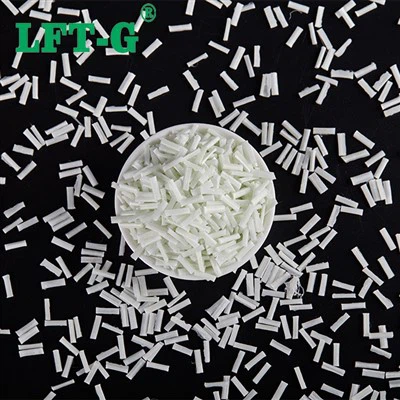
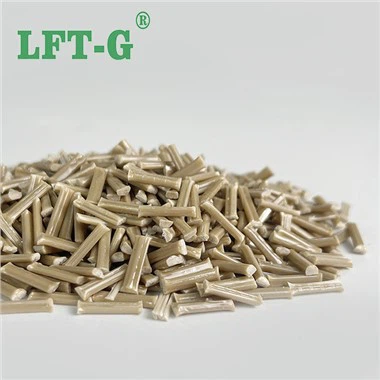
In LFT-G® PA66-LGF50, continuous 12mm pultruded glass fibers form an isotropic, three-dimensional interlocking skeleton during proper low-shear injection molding. When pressurized fluid exerts tensile expansion forces on the chamber walls:
- Continuous Load Transfer: Tensile hoop stresses are transferred immediately from the polyamide matrix to the high-modulus E-glass fibers via chemically coupled silane sizing agents.
- Suppression of Creep Strain: Over 10,000 hours of continuous static loading at 80°C, the long fiber skeleton limits total apparent creep strain to less than 0.42%, matching the dimensional stability required for precision mechanical seal faces.
- Hydrodynamic Fatigue Endurance: Under cyclical water-hammer pressure pulsations (0 to 2.5 MPa at 2 Hz), the intertwined fiber network disperses localized energy pulses, preventing fatigue micro-cracking.
The Moisture Reality: Dry-as-Molded (DAM) vs. Conditioned Equilibrium
A rigorous engineering evaluation must address the hygroscopic nature of polyamide 66. In humid or submerged pump environments, PA66 absorbs moisture until reaching an equilibrium state (~2.0% to 2.5% moisture content). While moisture plasticization reduces tensile modulus from 17.0 GPa (DAM) to approximately 12.5 GPa (Conditioned), it simultaneously increases unnotched impact toughness from 95 kJ/m² to over 110 kJ/m². Structural engineers compensate for this modulus shift by introducing thin-walled structural rib patterns (t_{rib} = 0.6 \times t_{wall}) to maintain rigid cross-sectional moments of inertia (I = bh^3 / 12) without adding excess mass.
Chemical Resistance, Cavitation Resilience & Acoustic Damping vs. Metals
While die-cast aluminum offers high absolute stiffness, its performance degrades rapidly when exposed to challenging chemical environments or dynamic fluid excitation.
1. Zero Galvanic Corrosion and Chemical Immunity
When aluminum pump volutes connect to stainless steel shafts, copper fittings, or carbon face seals in the presence of conductive fluids (de-icing salts, marine cooling loops, glycol mixtures), galvanic corrosion cells form immediately. Anodized coatings frequently suffer pinhole micro-cracking, leading to rapid subsurface pitting and catastrophic casing breaches. In contrast, PA66-LGF50 is an electrically non-conductive polymer matrix that is completely immune to galvanic coupling, rust, and salt-spray degradation.
2. Acoustic Noise Reduction and Cavitation Energy Dissipation
Rigid metallic castings have extremely low internal loss factors (Tan approx 0.001), causing pump impeller harmonics and fluid turbulence to radiate as audible airborne noise. PA66-LGF50 provides a viscoelastic loss factor that is an order of magnitude higher (Tan delta = 0.025–0.045). This internal damping attenuates operational vibration, cutting pump running noise by 6 to 10 dB(A). Furthermore, the viscoelastic damping layer cushions microscopic cavitation bubble collapse implosions, preventing the localized surface erosion that strips metal castings.
Total Cost of Ownership (TCO): Eliminating Secondary CNC Machining
Procurement teams often compare raw material costs per kilogram and conclude that aluminum ingot is cheaper than high-performance engineered composite pellets. However, evaluating the Finished Part Manufacturing Cost reveals a massive financial advantage for injection molded PA66-LGF50.
| Manufacturing Phase | Die-Cast Aluminum Component (A380) | Injection Molded PA66-LGF50 |
|---|---|---|
| Primary Forming Cycle | High-pressure die casting (45–60 sec) | Single-step injection molding (30–45 sec) |
| Secondary Machining (CNC) | Mandatory (Milling faces, drilling, tapping) | 100% Eliminated (Molded-in threads & O-ring grooves) |
| Deburring & Finishing | Trimming dies, manual de-gating, shot blasting | Zero deburring; automatic runner separation |
| Surface Protection | Mandatory Anodizing / Powder Coating / E-coat | None required (Inherent chemical resistance) |
| Tooling Lifespan | 80,000 – 120,000 shots (Thermal fatigue cracking) | 500,000 – 1,000,000+ shots (Hardened tool steel) |
By integrating internal thread brass inserts, precision O-ring seal tracks, and mounting flanges directly into the mold tool, PA66-LGF50 eliminates 4 to 6 discrete secondary manufacturing operations. When amortized over production volumes of 50,000+ units, total part cost drops by 32% to 40% compared to finished machined aluminum castings.
Application Engineering: Fluid Pumps & Pneumatic Tool Casings

Industrial Centrifugal Pump Volute: Burst Pressure & Weight Optimization
An industrial pump manufacturer replaced die-cast ADC12 aluminum volute housings with LFT-G® PA66-LGF50. The component operates at 1.8 MPa continuous discharge pressure handling chlorinated cooling water at 85°C.
The molded PA66-LGF50 volute achieved a hydraulic burst pressure of 6.8 MPa (over 3.7× safety factor), eliminated all post-cast CNC machining of the outlet flange, dropped total pump assembly weight by 1.85 kg, and demonstrated zero corrosion failure after 8,000 hours of continuous endurance testing.
Heavy-Duty Pneumatic Impact Wrench Housing: High-Cycle Shock Absorption
Pneumatic assembly tools generate intense repetitive recoil shock pulses (>1,200 impacts per minute) that lead to operator fatigue and hairline fatigue fracture in die-cast magnesium/aluminum shells.
By converting the main motor housing to PA66-LGF50, the tool manufacturer reduced tool weight by 450 grams, improved drop-test survival from 1.5 meters onto solid concrete to 100% survival at 3.0 meters, and lowered hand-arm vibration levels transmitted to the operator by 22%.

LFT-G® High-Performance PA66-LGF Product Grades & Datasheets
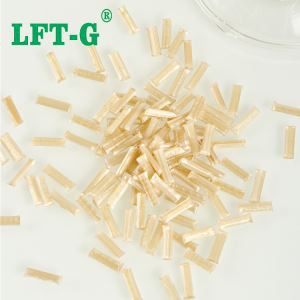
Achieving successful metal replacement requires precision-pultruded pellets where every single glass filament is fully wetted with high-molecular-weight polyamide matrix. Xiamen LFT Composite Plastic Co., Ltd, abbreviated as LFT-G® engineers advanced long fiber compounds designed to replace die-cast aluminum and zinc in demanding structural environments.
Explore our structural polyamide long fiber portfolio and download technical datasheets:
- LFT-G® PA66-NA-LGF50: Standard natural / black 50% long glass fiber grade offering maximum specific stiffness, dimensional stability, and burst pressure resistance. [View Product Specifications & TDS]
- LFT-G® PA66-HR-LGF50: Hydrolysis-resistant formulation engineered specifically for continuous exposure to hot water, engine coolants, and glycol mixtures at 120°C+.
- LFT-G® PA66-LCF50: 50% Long Carbon Fiber reinforced PA66 for extreme specific modulus, electrostatic discharge (ESD) protection, and high-frequency dynamic stiffness.