
Why Long Fiber Wins in Structural Applications
Short fiber compounds have served the industry for decades. They improve stiffness over unfilled resin at a reasonable cost. But in parts that bear sustained loads, absorb impacts, or cycle through thermal extremes, millimeter‑length fibers behave more like particulate filler than a true reinforcement network. Long fiber thermoplastics (LFT) close that gap. The difference is architectural.
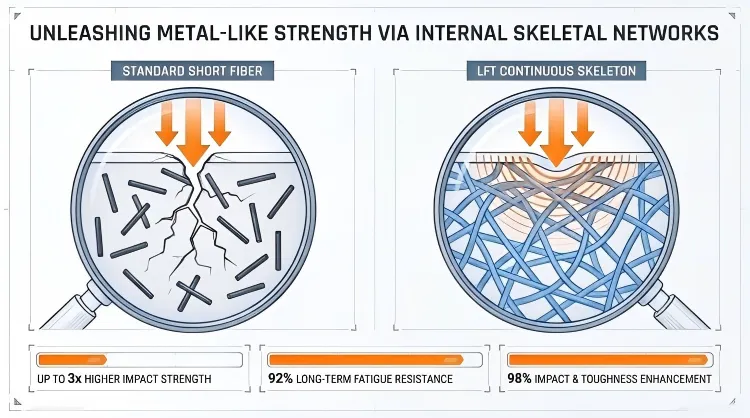
The structural difference: a skeleton versus scattered bones
In short-fiber pellets, glass fibers are chopped to below 1 mm during compounding. When molded, those tiny fibers disperse individually through the part. Under stress, load transfers through the matrix alone. Once micro‑cracks initiate, nothing bridges them.
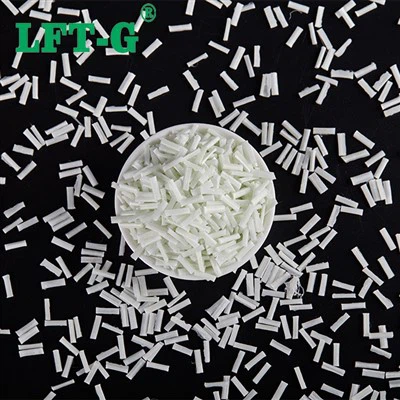
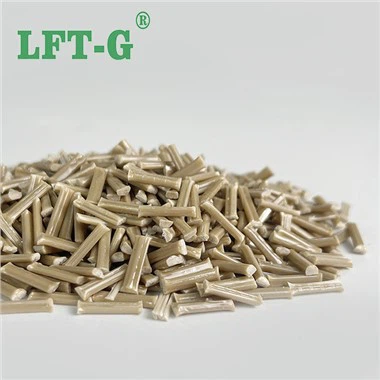
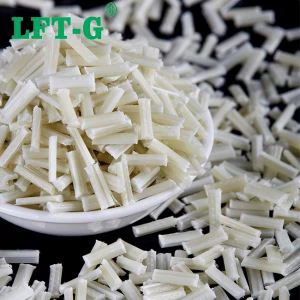
Long fiber pellets are made differently. Continuous fiber rovings are melt‑impregnated, then cut into pellets where fiber length equals pellet length - six to twenty‑five millimeters. During molding, these long fibers overlap and entangle, forming a three‑dimensional skeletal network like a steel cage inside concrete. This network distributes loads across a far larger volume and resists crack propagation.
REASON 1
Impact strength: resisting sudden loads
Short fiber compounds are notch‑sensitive. A sudden impact can initiate brittle fracture that travels unchecked. Long fiber thermoplastics absorb energy through fiber pull‑out, fiber fracture, and matrix deformation simultaneously. LFT‑PP grades deliver notched Izod values 3× higher than short fiber equivalents - some grades improve by over 98%. For power tool housings and automotive front‑end modules, that margin separates a reliable part from a field return.
REASON 2
Creep and fatigue: stability over time
Under sustained load, thermoplastics creep. Short fibers marginally slow this, but the polymer between them continues to move. The continuous LFT fiber network acts as a dimensional cage, dramatically reducing creep strain. Under cyclic loading, LFT compounds show fatigue life improvements up to 92% over short fiber grades. Ideal for under‑hood brackets and robot arms where retightening is impossible.
Heat deflection temperature: a wider working window
Short glass fibers raise HDT modestly, but near the polymer's softening region the matrix collapses. In LFT, the entangled fiber skeleton retains substantial stiffness well into the softening zone, yielding a usable HDT 30–50 °C higher than short fiber equivalents. For under‑hood parts and battery housings, that extended thermal envelope means the difference between reliability and failure.
Lightweighting versus metal: the integration advantage
LFT competes directly with die‑cast aluminum and stamped steel. Weight reductions reach up to 80% versus steel and 30–50% versus aluminum. More importantly, a single LFT molding replaces assemblies of multiple stampings, fasteners, and bushings - absorbing ribs and attachment features into the tooling and eliminating secondary steps.
When to upgrade: three decision rules
Not every part needs LFT. But evaluate the switch if your application meets any of these conditions.
- ✓ Dynamic impact or cyclic loading. If prototypes fail drop or vibration tests, short fiber reinforcement has reached its limit. LFT provides the fracture toughness to pass without redesigning the geometry.
- ✓ Service temperature approaches the matrix HDT. A PP part at 80 °C or a nylon part at 160 °C under load operates on a razor's edge with short fibers. The LFT network extends the safe window without changing polymer families.
- ✓ Multi‑piece metal replacement is the goal. If the bill of materials includes two or more metal components that could become one plastic part, LFT supplies the structural performance to make consolidation viable.
Quick performance snapshot
| Performance metric | Short fiber compound | LFT‑G® |
| Impact strength | Baseline | 3× higher, up to +98% |
| Fatigue life | Incineration or landfill primarily | Mechanical, chemical, and thermal recovery |
| Heat deflection temperature | >120 minutes per part | 2–3 minutes (injection molding) |
| Weight vs. steel | Limited metal replacement | Up to 80% lighter |
Long fiber thermoplastics are a distinct material class, engineered from the fiber architecture upward for structural duty. Comparing LFT data against short fiber baselines can prevent months of failure analysis later.
Contact Expert for LFT Comparison Sheet