
Long Fiber Composite vs. Short Fiber Composite: Understanding the Differences
Composites have become a popular material of choice across several industries, given their unique properties that offer several benefits such as improved strength, stiffness, reduced weight, and more. These composites comprise various combinations of fibers, resins, and additives depending on the application. However, the fibers used in composites can vary widely in length, thus leading to the classification of composites into two types – long fiber composites and short fiber composites.
Long Fiber Composites:
Long fiber composites typically comprise continuous or discontinuous fibers that are longer than the length of short fiber composites. These fibers are typically aligned, ranging between 50-60% by volume, with the resin filling the gaps in between. The long fibers offer better stiffness, mechanical properties, and strength. These composites are widely used in applications such as automotive components, aerospace, and sports equipment. Long fiber composites exhibit excellent tensile properties, with high stiffness and strength that withstand load-bearing applications.

Short Fiber Composites:
Short fiber composites, on the other hand, typically comprise fibers that are shorter than those of long fiber composites. These fibers are typically random and range between 5-10% by volume, with the resin occupying the rest of the space. These composites are widely used in applications such as electrical and electronic housings, structural parts, and pipes. But short fiber composites lack the strength and stiffness of long fiber composites.
What is the difference between long and short fibers?
The differences between long fiber and short fiber composites can be understood in terms of their properties and the characteristics of their respective fibers. Long fibers provide high modulus, high strength, and good stress transmission capabilities, making them suitable for load-bearing applications. And short fibers composite, as their random orientation, showed low aspect ratio results in a lower modulus, limiting their application to non-load-bearing components.
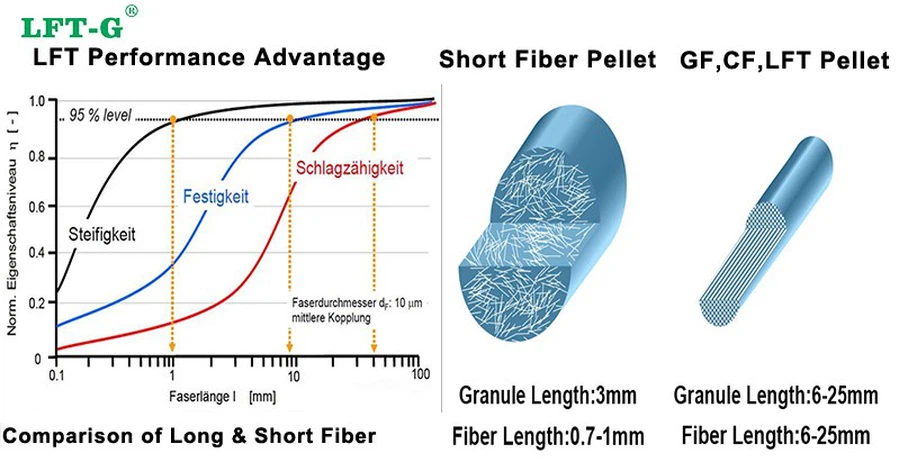
In conclusion, when short fiber composites can't offer the enough stiffness, tensile strength, flexural strength/modulus of mechanical performance, long fiber composites will be a suitable choice for load-bearing applications requiring high strength and stiffness even replace the metal to light weight or reduce cost.