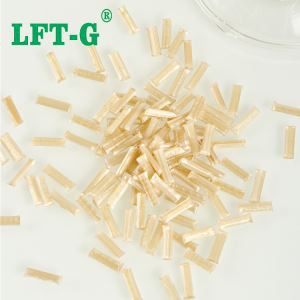

The advantages of glass fiber-reinforced PA
1. After adding glass fiber to nylon, the mechanical properties, heat resistance, dimensional stability, and aging resistance of modified nylon are significantly improved, and the fatigue strength is 2.5 times that of unenhanced nylon.
2. Due to the addition of glass fiber, the mutual movement between the polymer chains of plastic is limited. Therefore, the shrinkage rate of reinforced plastic decreases a lot, that is, the shrinkage phenomenon of products is much better than before without glass fiber, and the rigidity is greatly improved.
3. Glassfiber-reinforced nylon softening point is high, low friction coefficient, wear resistance, self-lubrication, shock absorption, silencing, good electrical insulation, oil resistance, weak acid resistance, alkali resistance and general solvent, self-extinguishing, non-toxic, odorless, good weather resistance.
4. Nylon after fiber reinforced, can reduce the water absorption of nylon slice so that it can work in high temperature, high humidity environments.
Disadvantages of glass fiber reinforced nylon
1. Decreased toughness and increased brittleness. This can be improved by adding a toughening agent.
2. Because the glass fiber will be oriented along the direction of flow during the injection molding process, the mechanical properties and shrinkage will be enhanced in the direction of orientation, resulting in product deformation and warping.
3. In the process of injection molding, the glass fiber enters the surface of the plastic products, making the surface of the products become very rough and spot-spotted, such as floating fiber, material flowers, and other defects.
4. The greater the proportion of glass fiber added, the greater the wear of plasticizing components of the injection molding machine, mainly screw wear.
5. There will be less liquidity.
Problems and solutions in injection molding
The process of injection molding may be due to poor raw material treatment, product or mold design being unreasonable, the operator did not grasp the appropriate injection molding nylon process operating conditions or because of mechanical reasons, often making the product produce a lot of defects. In the production of glass fiber reinforced nylon is the most prone to surface appearance is bad, mainly for glass fiber exposed, burnt, material flowers, dents, silver lines, ripples, and overflow edges.
1. Exposed glass fiber
Compared with nylon, the fluidity of glass fiber is much worse, and the material flows in the mold on the way of flowing forward from the middle of the sandwich and turning outward on both sides. Therefore, the good liquidity must run to the front, while the bad liquidity will stay on the surface of the mold.
The solution of glass fiber exposure is as follows:
(1) Increase the shooting speed. After increasing the speed, although the flow speed of glass fiber and nylon is different, compared with the high-speed shooting glue, the proportion of the relative speed difference is very small.
(2) Increase the mold temperature. To increase the mold temperature is to reduce the contact resistance between the glass fiber and the mold, make the speed difference between the glass fiber and nylon as small as possible, make the middle layer of the material flow as thick as possible, and the shell layer on both sides as thin as possible.
(3) reduce the measuring chamber temperature, and reduce the amount of sol. This minimizes the possibility of separation between nylon and fiberglass.
(4) Wipe the nylon raw material to be treated and remove the residual grease or release agent on the surface.
(5) Spray or wipe the nylon and glass fiber treatment agent on the material to be treated to 5-10 microns dry film, standing for 5-10 minutes.
(6) It is better to force-dry the coated workpiece at 80℃ for 30 minutes.
2. Burn
In the filling process, there is not only the original air in the mold cavity but also the volatile gas formed in the molding process. During high-speed injection, the gas is compressed and produces a high temperature, which is easy to cause local carbonization or scorching of the parts.
Generally, the following measures are taken:
Adjust the feeding speed, reduce the mold temperature, and dry the modified nylon raw materials before use or apply the modified nylon materials without drying.
3. Plant flowers
If you need to get high-quality glass fiber reinforced nylon, it is recommended to use twin-screw extruder granulation, for the choice of glass fiber, you can choose nylon special reinforced glass fiber, at the same time add coupling agent or compatibilizer, graft type of compatibilizer addition amount is about 3%. Can also add about 0.6% of the silicone series of auxiliaries, and the surface effect will be greatly improved.
4. Dents
Possible causes of dents and their solutions are as follows:
(1) If the filling material is insufficient or the feeding amount is not enough, the feeding should be increased or the feeding gate should be opened;
(2) Improper gate position or gate asymmetry, should be adjusted according to the specific situation;
(3) If the diverter and gate are insufficient or too small, more diverter and gate size should be increased;
(4) If the wall thickness of the product is not uniform, the mold should be modified or the injection pressure should be increased.
5. Glass fiber silver grain
Silver pattern defects such as metal bright spots appear on the surface of the parts with glass fiber added, especially near the material flow area of the raised part and the joint line where the fluid meets again.
The causes and solutions of silver stripes are as follows:
(1) If the injection speed is too low, the injection speed should be increased and multi-stage injection (slow first and fast later) should be considered;
(2) the mold temperature is too low, should increase the mold temperature;
(3) If the melting temperature is too low, the temperature of the barrel should be increased and the back pressure of the screw should be increased;
(4) The melting temperature change is large, should increase the screw back pressure, reduce the screw speed, the use of longer barrel to shorten the travel.
6. Ripples
Possible causes of ripples and their solutions are as follows:
(1) The sprue is small, leading to the spraying phenomenon in the mold cavity, the sprue size should be modified or the spraying pressure should be reduced;
(2) the flow channel is tortuous, narrow, roughness is poor, the supply of rubber is insufficient, should modify the flow channel and reduce its roughness, so that the rubber supply is sufficient;
(3) The workpiece section thickness is not uniform, the area is large, the shape is complex, the workpiece should be set to make the section thickness is the same, or remove the protruding plate and raised line on the workpiece;
(4) If the mold cooling system is improper or the mold temperature is low, the cooling system should be adjusted or the mold temperature should be increased;
(5) If the melt temperature, mold, or nozzle temperature is low, the melt tube temperature and nozzle temperature should be increased;
(6) If the injection pressure and speed are too small, the corresponding parameter setting values should be increased.
7. Overflow edge
A thin flying edge will appear along the parting line or the sealing surface of the mold. In most cases, overflow occurs because the machine's clamping force is insufficient during injection and pressure holding to lock and seal the mold along the parting line.
The following measures can be taken:
(1) Increase the clamping force;
(2) Reduce the injection speed and adopt multi-stage injection (fast-slow);
(3) A little earlier voltage holding switch;
(4) reduce the temperature of the barrel;
(5) Reduce the die wall temperature;
(6) Reduce the retaining pressure.