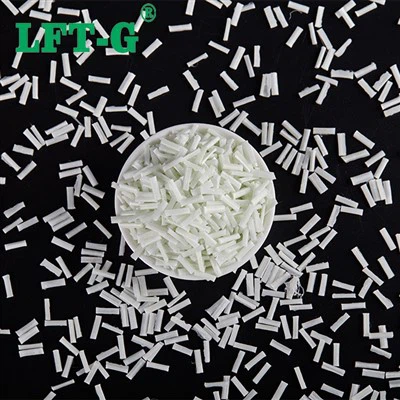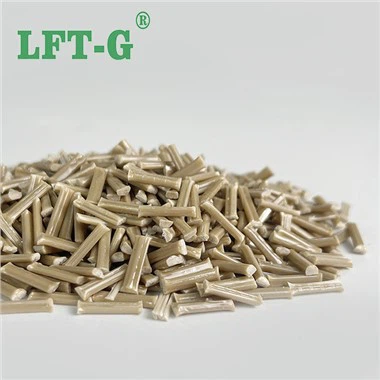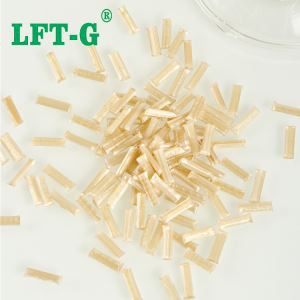

The dispersion of glass fiber, the bonding of glass fiber and base nylon, the size and distribution of glass fiber, the correct application of various additives, the adjustment of process conditions, the screw combination and the control of the speed will all affect the performance of the product.
1) The diameter of glass fiber is generally controlled at 10-20 microns
2) The length of the glass fiber is generally best controlled at 2 ~ 3 millimeters. In theory, the longer the length of the glass fiber, the better the reinforcement effect, but it will cause problems such as rough surface and warpage of the product. The length of the glass fiber has nothing to do with its original length, but is related to the screw combination structure and rotation speed.
3) The water on the surface of the glass fiber will cause the PA to undergo a hydrolysis reaction during the melt extrusion process, leading to PA degradation, thereby reducing the mechanical properties of the enhanced PA.
4) The effect of the amount of coupling agent on the notched impact. The notched impact strength increases with the increase of the amount of coupling agent.
5) The thermal deformation temperature of PA6 increases with the increase of glass fiber content within 30% of glass fiber content, and the thermal deformation temperature does not change much with the increase of glass fiber after more than 35%.
6) When the glass fiber content increases, the molding shrinkage of the reinforced PA decreases. Almost all reinforced PAs have the same rule. When the glass fiber content reaches 35%, the mold shrinkage is about 0.2%.
7) The effect of blending temperature on reinforced PA Extrusion temperature is too low, the coating effect of glass fiber is poor, and the phenomenon of glass fiber exposure often occurs. The surface of the strip is rough, matte, loose particles, large brittleness, and the impact strength of the product If the extrusion temperature is too high, the mechanical properties of the thermo-oxidative decomposition products of PA will be easily reduced, the appearance will turn yellow, or even gray. The principle of blending extrusion temperature selection is to control the temperature range slightly higher than the melting point of the base material. In the actual operation process, the temperature of the melting zone can be determined according to the melt flow condition of the glass fiber inlet, and the temperature of the metering section and the temperature of each zone of the compression section can be determined according to the gloss of the extruded strip.
8) The effect of screw speed on the performance of reinforced PA. When the screw speed is too low, the shear effect of the screw is small and the glass fiber is not uniformly dispersed. At the same time, its shear mixing effect is enhanced, but due to the high-speed rotation of the screw, a large frictional heat will be generated, which will cause the temperature of the screw to be too high and cause the base material and some additives to thermally decompose, affecting the product quality. The speed can be increased moderately. For flame retardant enhancement, because the flame retardant is prone to thermal decomposition, a low speed should be used.

Please feel free to contact us if you have any problems.
Xiamen LFT Composite Plastic Co.,Ltd
Candy Hu
Email: candyhu@lfrtplastic.com
Tel : 0086-186-5906-9962 (wechat/whatsapp)
Skype:candy328520
Address : No. 27,Hongxi Road, Ma xiang town, Xiang 'an district, Xiamen(361000),China